
Portfolio Monitoring Agent with Market Data APIsPortfolio Monitoring Agent with Market Data APIs使用市场数据 API 构建投资组合监控 Agent使用市场数据 API 构建投资组合监控 Agent
Build a portfolio monitoring agent that connects holdings, market data, alerts, validation, and auditable actions.
构建连接持仓、市场数据、预警、校验与可审计操作的投资组合监控智能体。
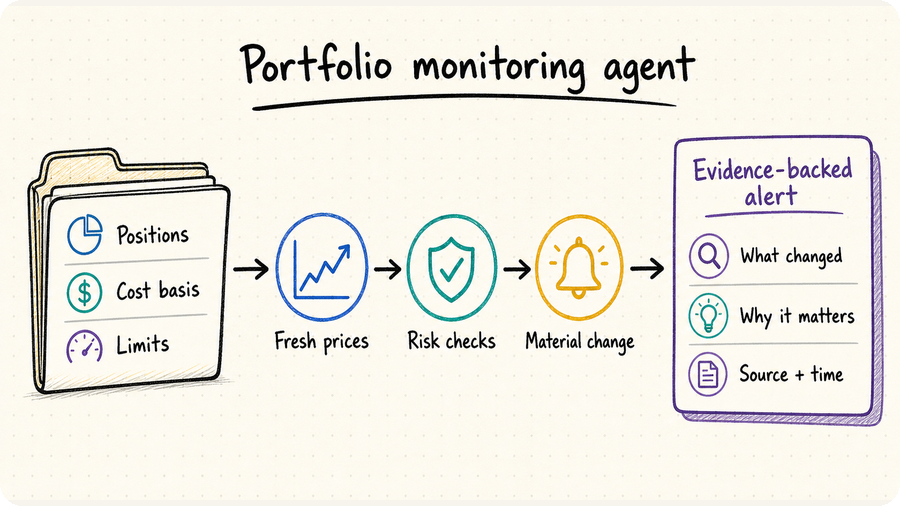
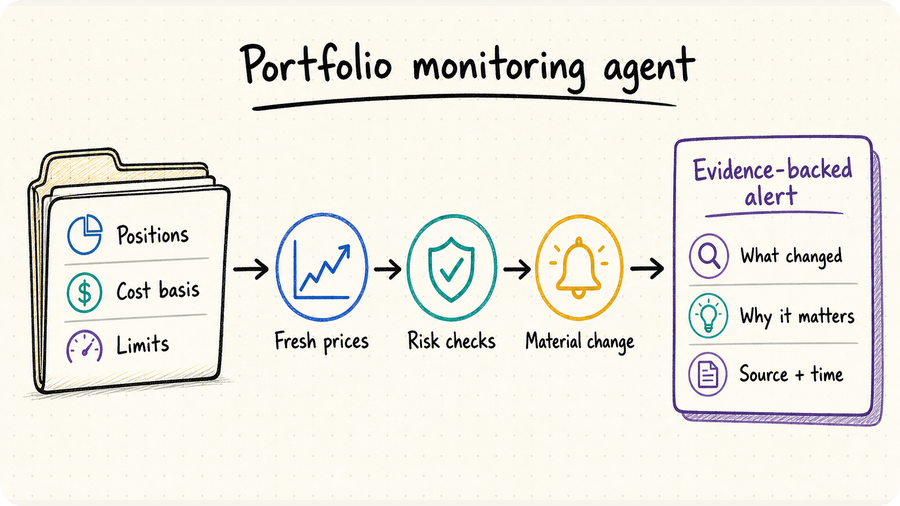
Build an AI agent that monitors holdings, prices, market news, risk signals, FX exposure, filings, and portfolio-level alerts through QVeris-supported capability routing.
Holdings · Market data · Risk signals · Alerts
What Is a Portfolio Monitoring Agent?
A Portfolio Monitoring Agent is an AI agent that tracks a user-provided portfolio or watchlist and monitors relevant market signals over time. It summarizes what changed, which holdings moved, what news appeared, where concentration exists, and what risks may need review. It organizes signals and generates research outputs — it does not provide investment recommendations or decide what to buy or sell.
A portfolio is more than a list of tickers. It has weights, asset classes, currencies, sectors, and risk characteristics. A single stock moving 3% means something different in a diversified portfolio than in a concentrated one. A portfolio monitoring agent provides that context — tracking holdings against market data, news, filings, FX exposure, and risk metrics to generate structured briefs and alerts.
The agent's scope includes: holdings and watchlists (user-provided or authorized inputs), market prices (latest quotes, daily changes, volume), financial news (company-specific headlines, sector context), risk signals (concentration, volatility, drawdown, exposure), FX rates (for multi-currency portfolios), company filings (official disclosures that may affect holdings), and alert delivery (daily briefs, threshold alerts, risk checklists).
Portfolio Monitoring vs Portfolio Advice
| Workflow | Main Purpose | What It Can Output | What It Should Avoid |
|---|---|---|---|
| Portfolio Monitoring Agent | Track changes, signals, risk context, and alerts | Daily brief, alert, risk checklist, JSON summary | Buy/sell recommendations |
| Portfolio Advice / Management | Recommend allocation or trades | Investment decisions | Should require licensing, compliance, and authorization |
Why AI Agents Need Portfolio Monitoring Workflows
1. Portfolio Context Requires Multiple Data Sources
A stock quote API tells an agent the price of one symbol. A portfolio monitoring agent determines whether that price move matters to the overall holdings, whether related news appeared, and whether the move changed concentration risk.
2. Prices Alone Don't Explain Portfolio Movement
A holding dropping 5% could be company-specific news, sector rotation, or macro pressure. A portfolio agent cross-references price moves with financial news and filings to provide context — not just numbers.
3. Concentration and Exposure Require Aggregation
Five holdings in the same sector may look diversified individually but represent concentrated risk at the portfolio level. A monitoring agent aggregates across holdings to surface hidden concentration.
4. FX and Crypto Exposure Change Risk Context
Multi-currency portfolios need FX rate monitoring. A 5% gain in a foreign holding may be offset by a 4% currency move. The agent must track both the asset price and the currency effect.
5. Filings Can Affect Multiple Holdings
An 8-K filing or earnings release for one company may have sector-wide implications. A portfolio agent monitoring SEC filings can surface cross-holding impacts.
6. Alerts Need Source Timestamps and Validation
A portfolio alert that says "Tech holdings down 2%" without source timestamps, currency context, or news cross-references is not actionable. Portfolio monitoring outputs should preserve full source traceability.
Data Capabilities a Portfolio Monitoring Agent Needs
1. Portfolio Input
Holdings, weights, symbols, cost basis (user-provided), asset
grouping.
QVeris Support: discover
portfolio data capabilities → inspect schema → validate symbol
mapping.
2. Market Data
Latest prices, daily changes, volume, market status. Real-time
via
WebSocket
or snapshot via REST. Validate the provider contract against
Massive's official Stocks WebSocket documentation and
Alpaca's official real-time stock data documentation.
QVeris Support: discover market
data → inspect latency and coverage → call.
3. Historical Prices
Performance, drawdown, volatility, and trend context. See the
historical price guide.
QVeris Support: discover
historical capabilities → inspect adjusted close policy →
call.
4. Financial News
Company-specific headlines, sector news, sentiment, event
context.
QVeris Support: discover
news capabilities → inspect source and sentiment fields →
call.
5. FX & Currency Rates
Multi-currency conversion, FX exposure monitoring, currency
effect on returns.
QVeris Support:
discover FX rate capabilities → inspect pair coverage → call.
6. Risk Metrics
Concentration, volatility, drawdown, exposure, and correlation
summaries.
QVeris Support:
discover risk capabilities → inspect methodology → call →
validate.
7. Company Filings
8-K updates, 10-Q/10-K filings, risk factors. See the
SEC filing guide.
QVeris Support: discover filing
capabilities → inspect form type coverage → call.
8. Alert Delivery
Email, Slack, webhook, dashboard, or structured JSON
notifications.
QVeris Support:
discover alerting → inspect output formats → call → validate
delivery.
QVeris Support means this workflow can be structured around capabilities discoverable through QVeris. Portfolio data must come from user-provided or authorized sources. Confirm exact capability availability during Inspect before production use.
Portfolio Monitoring Workflow
Import or Define Portfolio
User provides holdings manually or through an authorized data source. QVeris does not automatically connect to brokerage accounts. Symbols, weights, and asset classes are normalized for downstream processing.
Normalize Symbols & Asset Classes
Map tickers, ETFs, crypto assets, FX pairs, and currencies to consistent identifiers. A portfolio mixing US stocks, European ETFs, and crypto needs unified symbol handling.
Discover Required Capabilities
Use QVeris Discover to find market price, historical price, news, FX, filing, risk metric, and alert delivery capabilities matching the portfolio's asset classes and monitoring requirements.
Inspect Schemas Before Calling
Check input format, cost, latency, provider notes, and output fields. Verify that each capability supports the required symbols, currencies, and timeframes before execution.
Call Selected Capabilities
Pull prices, news, risk signals, FX rates, and filing updates. Execute calls in parallel where possible — price checks, news lookups, and FX rates can run concurrently.
Validate Outputs
Check timestamps, symbol mapping, currencies, missing data, and source links. A price without a timestamp or a news headline without a source URL should not appear in the monitoring output.
Generate Monitoring Output
Produce a daily brief, portfolio alert, JSON payload, risk memo, or executive summary — with source timestamps, currency context, and clear separation of data from interpretation.
Trigger Follow-Up Workflows
For unusual price moves, route to deeper stock research. For filings, link to SEC filing workflows. For earnings events, hand off to the Earnings Monitoring Agent.
Example Portfolio Monitoring Agent Output
Portfolio Monitoring Brief — Daily Summary
Growth Watchlist
Today
12 positions across US equities, ETFs, crypto
3 holdings moved >3%
Signals Tracked: Latest prices · Daily price change · Financial news · Sector movement · FX exposure · Recent filings · Concentration risk
Agent Brief: Three holdings moved more than 3% today. One appears related to sector-wide market pressure, while another coincides with company-specific news. Portfolio concentration remains high in large-cap technology names. No investment recommendation is provided; review source links and risk notes before taking action.
Recommended Follow-up: Review company-specific news for top movers · Check whether earnings or filings were released · Generate stock-level research brief for the largest contributor · Monitor concentration exposure over the next week
Illustrative example. Not real portfolio data or investment advice. All portfolio monitoring outputs should be reviewed by qualified professionals.
QVeris Support for Portfolio Monitoring Agents
Portfolio monitoring requires multiple external capabilities — market prices, historical data, financial news, FX rates, company filings, risk metrics, and alert delivery — each potentially from different providers. QVeris structures this through a unified Discover → Inspect → Call → Validate → Report pattern:
Discover
Find market data, news, FX, filing, risk, and alerting capabilities across providers — without manually searching each provider's documentation for portfolio-relevant endpoints.
Inspect
Review schema, cost, latency, coverage, provider notes, and output examples before calling. Ensure multi-symbol and multi-currency support before execution.
Call
Execute capabilities through a unified interface. Consistent field names regardless of which provider answers — critical when aggregating signals across asset classes.
Validate & Report
Check timestamps, symbol mapping, currencies, and source URLs. Generate a portfolio brief, risk memo, alert, or JSON output — with source traceability throughout.
QVeris Support does not mean QVeris is the original source of every portfolio or market dataset. Portfolio data must come from user-provided inputs or authorized connected sources. QVeris is a capability routing layer — it helps agents discover, inspect, and call relevant external capabilities through a unified workflow. Read the docs → or view pricing →.
Getting Started Checklist
QVeris is a capability routing layer. Portfolio data from user-provided sources. Monitoring workflow — not investment advice.
Portfolio Monitoring Agent FAQ
What is a Portfolio Monitoring Agent?
Is this the same as portfolio management?
What APIs does a portfolio monitoring agent need?
Can QVeris access my brokerage account?
Can the agent recommend trades?
How does QVeris help with portfolio monitoring?
Is this investment advice?
References & Sources
- QVeris Docs — qveris.ai/docs
- QVeris Pricing — qveris.ai/pricing
- QVeris For Agents — qveris.ai/for-agents
- Real-Time Stock Price API for AI Agents
- Stock API Free Comparison
- Historical Stock Price API for AI Agents
- WebSocket Stock API for AI Agents
- SEC Filing API for AI Agents
- Technical Indicator API for AI Agents
- Earnings Monitoring Agent
构建一个 AI Agent,通过 QVeris 支持的能力路由监控持仓、价格、市场新闻、风险信号、外汇敞口、文件和投资组合级别的警报。
持仓 · 市场数据 · 风险信号 · 预警
什么是投资组合监控 Agent?
投资组合监控 Agent 是一个 AI Agent,跟踪用户提供的投资组合或观察列表,并随时间监控相关市场信号。它总结发生了什么变化、哪些持仓发生了变动、出现了什么新闻、集中度在哪里、以及哪些风险可能需要审查。它组织信号并生成研究输出 — 不提供投资建议或决定买卖什么。
投资组合不仅仅是股票代码列表。它有权重、资产类别、货币、行业和风险特征。单只股票波动 3% 在分散化投资组合中与在集中投资组合中含义不同。投资组合监控 Agent 提供这种背景 — 根据市场数据、新闻、文件、外汇敞口和风险指标跟踪持仓,生成结构化简报和警报。
Agent 的范围包括:持仓和观察列表(用户提供或授权的输入)、市场价格(最新报价、每日变动、成交量)、金融新闻(公司特定头条、行业背景)、风险信号(集中度、波动率、回撤、敞口)、外汇汇率(多币种投资组合)、公司文件(可能影响持仓的官方披露)和警报交付(每日简报、阈值警报、风险清单)。
投资组合监控 vs 投资组合建议
| 工作流 | 主要用途 | What It 能否 输出 | 避免的问题 |
|---|---|---|---|
| 投资组合监控 Agent | 跟踪变化、信号、风险背景与预警 | 每日简报、预警、风险清单与 JSON 摘要 | 买卖建议 |
| 投资组合建议或管理 | 推荐资产配置或交易 | 投资决策 | 此类行为应具备相应资质、合规流程与明确授权 |
为什么 AI Agent 需要投资组合监控工作流
1. 投资组合背景需要多种数据源
股票报价 API只能告诉 Agent 单个标的的价格;投资组合监控 Agent 还会判断该价格变化对整体持仓是否重要、是否出现相关新闻,以及集中度风险是否发生变化。
2. 仅凭价格无法解释投资组合变动
单项持仓下跌 5% 可能源于公司新闻、行业轮动或宏观压力。投资组合 Agent 会把价格变化与金融新闻和公司文件交叉核验,提供背景,而不只是数字。
3. 集中度与敞口需要汇总分析
同一行业的五项持仓单独看似分散,但在组合层面可能形成集中风险。监控 Agent 会汇总全部持仓,识别隐藏的集中度。
4. 外汇与加密货币敞口会改变风险背景
多币种投资组合需要监控汇率。海外持仓上涨 5%,可能被 4% 的汇率变动抵消,因此 Agent 必须同时跟踪资产价格与货币效应。
5. 公司文件可能同时影响多项持仓
一家公司的 8-K 文件或财报可能影响整个行业。监控SEC 文件的投资组合 Agent 可以识别这种跨持仓影响。
6. 预警必须包含来源时间戳并经过验证
如果“科技持仓下跌 2%”的预警没有来源时间戳、货币背景和新闻交叉验证,就缺乏行动参考价值。投资组合监控输出应保留完整来源追踪。
投资组合监控 Agent 需要的数据能力
1. 投资组合输入
持仓、权重、代码、用户提供的成本基础与资产分组。
QVeris 支持:发现投资组合数据能力 → 检查 Schema → 验证标的代码映射。
2. 市场数据
最新价格、日内涨跌、成交量和市场状态。实时更新可使用
WebSocket,快照查询可使用 REST;上线前请根据
Massive 官方股票 WebSocket 文档和
Alpaca 官方实时股票数据文档核对供应商契约。
QVeris 支持:
发现市场数据能力 → 检查延迟与覆盖范围 → 调用并验证。
3. 历史价格
收益表现、回撤、波动率与趋势背景。参阅历史价格指南。
QVeris 支持:发现历史数据能力 → 检查复权收盘价规则 → 调用并验证。
4. 金融新闻
公司新闻标题、行业新闻、情绪与事件背景。
QVeris 支持:发现新闻能力 → 检查来源与情绪字段 → 调用并验证。
5. 外汇与货币汇率
多币种换算、外汇敞口监控,以及汇率对收益的影响。
QVeris 支持:发现外汇汇率能力 → 检查货币对覆盖范围 → 调用并验证。
6. 风险指标
集中度、波动率、回撤、敞口与相关性摘要。
QVeris 支持:发现风险能力 → 检查计算方法 → 调用 → 验证。
7. 公司文件
8-K 更新、10-Q/10-K 文件与风险因素。参阅SEC 文件指南。
QVeris 支持:发现文件能力 → 检查表单类型覆盖 → 调用并验证。
8. 预警送达
邮件、Slack、Webhook、仪表盘或结构化 JSON 通知。
QVeris 支持:发现预警能力 → 检查输出格式 → 调用 → 验证送达。
QVeris Support 意味着此工作流可以围绕通过 QVeris 可发现的能力构建。投资组合数据必须来自用户提供或授权的来源。生产使用前请在 Inspect 期间确认确切的能力可用性。
投资组合监控工作流
导入或定义投资组合
用户手动提供持仓,或从已授权数据源导入。QVeris 不会自动连接券商账户;系统会统一代码、权重和资产类别,供后续处理。
统一代码与资产类别
将股票代码、ETF、加密资产、外汇交易对和货币映射为一致标识符。混合美股、欧洲 ETF 与加密货币的组合尤其需要统一代码处理。
发现所需能力
使用 QVeris Discover 查找符合投资组合资产类别和监控要求的市场价格、历史价格、新闻、外汇、公司文件、风险指标与预警投递能力。
调用前检查 Schema
检查输入格式、成本、延迟、提供商说明和输出字段;执行前确认每项能力支持所需代码、货币和时间周期。
调用选定能力
获取价格、新闻、风险信号、汇率和文件更新;条件允许时并行执行价格检查、新闻查询和汇率调用。
验证输出
检查时间戳、代码映射、货币、缺失数据和来源链接。没有时间戳的价格或没有来源链接的新闻标题不应出现在监控结果中。
生成监控结果
生成每日简报、投资组合预警、JSON、风险备忘录或高管摘要,并包含来源时间戳、货币背景,清楚区分数据与解读。
触发后续工作流
对异常价格波动,转入更深入的个股研究;对公司文件,关联到SEC 文件工作流;对财报事件,交给财报监控 Agent继续处理。
示例 Agent 输出
投资组合监控简报 — 每日摘要
Growth 观察列表
今日
12 项美国股票、ETF 与加密资产
3 项持仓涨跌幅超过 3%
已跟踪信号:最新价格 · 日内涨跌 · 金融新闻 · 行业变化 · 外汇敞口 · 最新公司文件 · 集中度风险
Agent 简报:今日有三项持仓涨跌幅超过 3%。其中一项似乎与行业整体压力有关,另一项则与公司特定新闻同时出现。投资组合仍高度集中于大型科技股。本简报不提供投资建议;采取行动前请检查来源链接与风险说明。
建议后续检查:核查主要异动标的的公司新闻 · 检查是否发布财报或公司文件 · 为最大贡献标的生成个股研究简报 · 在未来一周持续监控集中度敞口
示意性示例。非真实投资组合数据或投资建议。所有投资组合监控输出应由合格专业人士审查。
QVeris 对投资组合监控 Agent 的支持
投资组合监控需要多种外部能力 — 市场价格、历史数据、金融新闻、外汇汇率、公司文件、风险指标和警报交付 — 每个可能来自不同的提供商。QVeris 通过统一的 发现 → 检查 → 调用 → 验证 → 报告 模式来构建此工作流:
发现
跨提供商查找市场数据、新闻、外汇、文件、风险和预警能力,无需逐一翻阅每家提供商文档寻找相关端点。
检查
调用前检查 Schema、成本、延迟、覆盖范围、提供商说明和输出示例,并确认支持多标的与多币种。
调用
通过统一接口执行能力,无论哪家提供商响应都使用一致字段名;这对跨资产类别汇总信号至关重要。
验证并生成报告
核对时间戳、代码映射、货币和来源链接,生成投资组合简报、风险备忘录、预警或 JSON,并全程保留来源追踪。
QVeris Support 并不意味着 QVeris 是每个投资组合或市场数据集的原始来源。投资组合数据必须来自用户提供的输入或授权的连接来源。QVeris 是能力路由层 — 它帮助 Agent 通过统一工作流发现、检查和调用相关外部能力。阅读文档 → 或 查看定价 →。
快速上手指南
QVeris 是能力路由层。投资组合数据来自用户提供的来源。监控工作流 — 并非投资建议。
投资组合监控 Agent 常见问题
什么是投资组合监控 Agent?
这与投资组合管理相同吗?
投资组合监控 Agent 需要哪些 API?
QVeris 能访问我的券商账户吗?
Agent 可以推荐交易吗?
QVeris 如何帮助完成投资组合监控?
这是投资建议吗?
参考资料与来源
- QVeris 文档 — qveris.ai/docs
- QVeris 定价 — qveris.ai/pricing
- QVeris Agent 方案 — qveris.ai/for-agents
- 面向 AI Agent 的实时股票价格 API
- 免费股票 API 对比
- 面向 AI Agent 的历史股票价格 API
- 面向 AI Agent 的 WebSocket 股票 API
- 面向 AI Agent 的 SEC 文件 API
- 面向 AI Agent 的技术指标 API
- 财报监控 Agent