
Crypto Market Data APIs for AI Agents
A practical guide to crypto market data APIs for AI agents — covering real-time prices, token metadata, exchange data, WebSocket streams, historical prices, order books, volatility, alerts, and unified capability routing with QVeris.
Prices · Metadata · Exchanges · WebSocket · Alerts · Agent workflows
What Is a Crypto Market Data API?
A crypto market data API provides programmatic access to cryptocurrency market information — real-time prices, token metadata, trading volume, market capitalization, exchange-specific data, historical prices, order book snapshots, and WebSocket streams. For AI agents, these APIs form the complete data layer needed for monitoring, research, alerting, token screening, and multi-step crypto workflows.
Human users browse dashboards. AI agents need structured, machine-readable data that can trigger reasoning, generate alerts, populate research briefs, normalize token identities across naming conventions, and feed downstream workflows. A single price endpoint is a starting point — not a complete crypto data architecture. For narrower deep-dives, see the Cryptocurrency Price API for AI Agents (provider comparison), Crypto WebSocket API (streaming architecture), and CoinGecko API (single-provider guide).
Why AI Agents Need Crypto Market Data
1. Crypto Markets Operate 24/7
A monitoring agent must maintain continuous awareness with no closing bell. WebSocket streams and real-time price APIs enable persistent observation.
2. Prices Differ Across Exchanges
BTC on Binance ≠ BTC on Coinbase. Agents need exchange-source attribution and quote-currency awareness (USDT ≠ USD).
3. Token Metadata Enables Normalization
Users say "BTC." APIs use "bitcoin." Agents need metadata to map symbols to token IDs across providers.
4. WebSocket Streams Power Alerts
REST polling misses fast moves. WebSocket streams enable event-driven detection.
5. Historical Data Provides Context
A 5% BTC move means more when compared against recent volatility, historical ranges, and volume patterns.
6. Multi-Provider Fallback Matters
One provider's rate limit or downtime should not break the agent. Multi-provider routing adds resilience.
Crypto Market Data Types AI Agents Should Know
| Data Type | What It Contains | Why It Matters |
|---|---|---|
| Price Data | Latest token price and quote currency | Core signal for monitoring, summaries, and alerts |
| Token Metadata | Token ID, symbol, name, category, chain | Symbol normalization and provider-agnostic token mapping |
| Market Cap | Total market value estimate | Market ranking, screening, and size context |
| Volume | Trading activity over 24h or other windows | Confirms or questions price moves — move without volume is weaker |
| Historical Prices | Past OHLCV data | Trend, volatility, drawdown, and context analysis |
| WebSocket Streams | Real-time ticker, trade, book, candle updates | Event-driven alerts and 24/7 crypto monitoring |
| Exchange Data | Exchange-specific prices, pairs, liquidity | Source-aware monitoring and cross-exchange comparison |
| Order Book | Bid/ask levels and depth | Spread and liquidity context — early signal of market shifts |
| Global Market Data | Total market cap, BTC dominance, trends | Daily briefs and market overview agents |
| News / Events | Headlines or event signals if available | Explains market moves beyond price data alone |
Crypto Market Data API Provider Comparison
Provider coverage, limits, pricing, and terms change frequently. Verify official documentation before production deployment.
| Provider | Best For | Data Coverage | WebSocket | Free Access | Agent Fit |
|---|---|---|---|---|---|
| CoinGecko | Prototype prices and metadata | Broad token coverage | Verify current | Strong prototype fit | High for prototypes |
| CoinMarketCap | Rankings and market data | Broad market coverage | Plan-dependent | Limited/plan | Medium-high |
| Binance | Exchange-native data | Spot, futures, options | Strong | Public streams | High for exchange |
| Coinbase | US exchange data | Listed markets | Supported | Public/auth | High for USD pairs |
| Kraken | Exchange monitoring | Listed pairs | Supported | Public/auth | High |
| CryptoCompare | Multi-source data | Broad market data | Streaming | Plan-dependent | Medium-high |
| CoinAPI | Production multi-exchange | Multi-exchange | Options | Paid-focused | High for prod |
| QVeris | Capability discovery & routing | Depends on capability | Depends on capability | Discover/Inspect free | High for multi-provider |
REST vs WebSocket vs Exchange Data
| Access Type | Best For | Strength | Limitation |
|---|---|---|---|
| REST Crypto Price API | Snapshots, metadata, history | Simple integration | Can miss fast moves |
| WebSocket Stream | Real-time monitoring and alerts | Event-driven updates | Reconnect and heartbeat logic needed |
| Exchange-Native API | Exchange-specific depth and pairs | Source-level detail | Limited to that exchange |
| Aggregated Market Data | Multi-asset overview | Easier summaries | May abstract exchange detail |
| QVeris Routing | Multi-provider agent workflows | Discover, inspect, call, validate | Depends on selected capabilities |
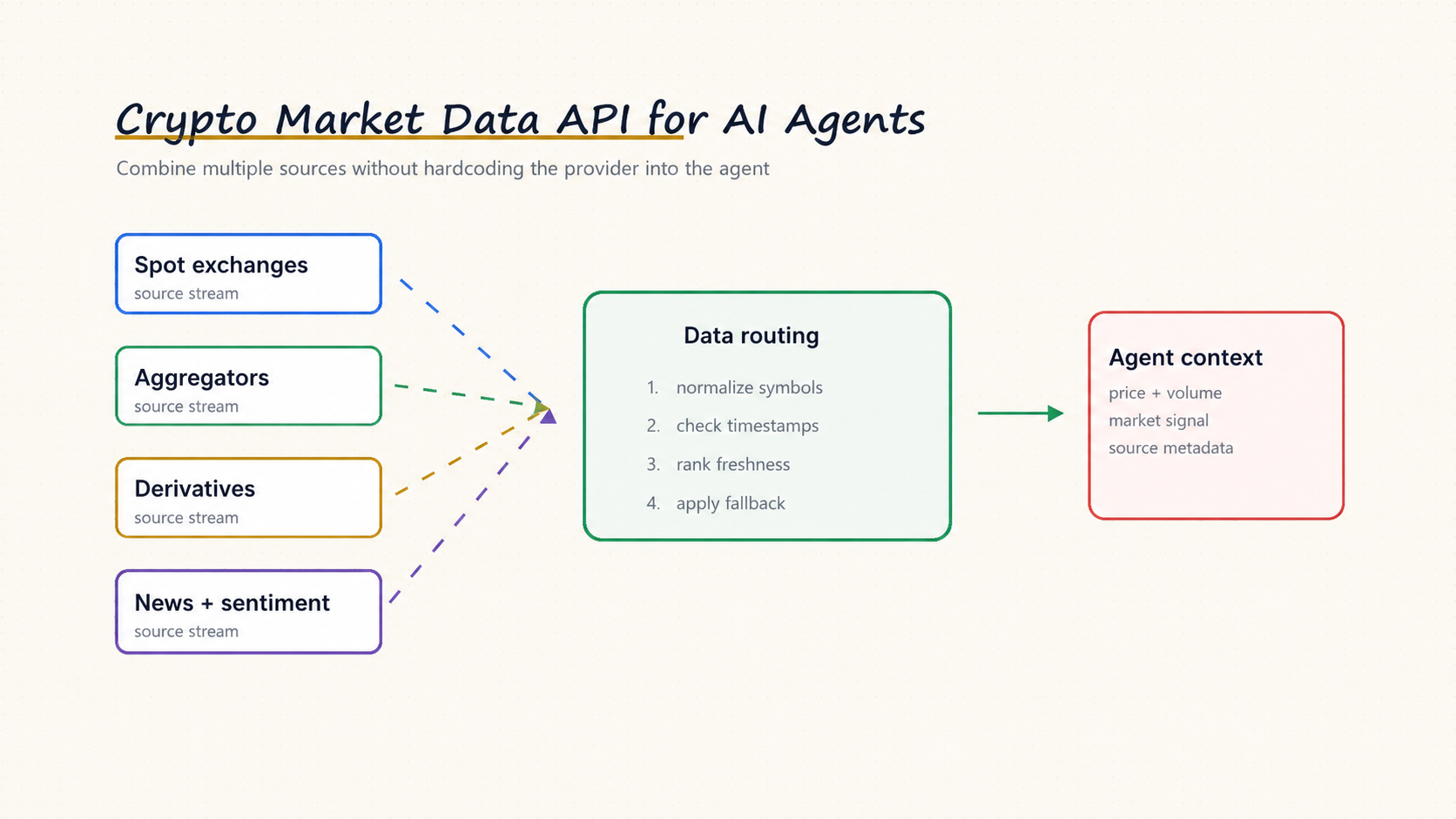
Production agents often combine multiple access types — WebSocket for streaming alerts, REST for metadata and fallback, and exchange-native APIs for source-specific depth.
Crypto Market Data Use Cases for AI Agents
1. Crypto Market Brief Agent
Required: crypto_price, global_market_data, token_metadata
Output: daily market brief
QVeris Support: discover overview capabilities → inspect → call → structure brief.
2. Crypto Price Alert Agent
Required: crypto_price, WebSocket stream, alert_delivery
Output: price alert with exchange context
QVeris Support: discover price + stream → inspect → subscribe → validate → alert. See Crypto Price Alert Agent.
3. Token Research Agent
Required: token_metadata, market_cap, volume, historical_prices
Output: token research summary
QVeris Support: discover token data → inspect → call → cross-reference.
4. Crypto Portfolio Context Agent
Required: crypto prices, token metadata, portfolio symbols, stablecoin mapping
Output: portfolio context brief
QVeris Support: discover multi-asset data → inspect → call → map to portfolio.
5. Exchange Spread Monitor
Required: exchange data, bid/ask, order book
Output: spread monitoring summary
QVeris Support: discover exchange data → inspect pairs → call → compare.
6. Multi-Provider Crypto Agent
Required: provider discovery, schema inspection, fallback, validation
Output: source-backed crypto response
QVeris Support: discover across providers → inspect schemas → route → validate and normalize.
QVeris Support means this workflow can be structured around capabilities discoverable through QVeris. Confirm exact availability during Inspect before production use.
Crypto Market Data Architecture for AI Agents
1. Identify Asset
Receive token, pair, or watchlist. Normalize symbol to provider-specific ID (BTC → "bitcoin" for CoinGecko, "BTCUSDT" for Binance).
2. Define Data Requirement
Price, metadata, history, stream, order book, or alert? The data type determines which capabilities and providers are relevant.
3. Discover Capabilities
Use QVeris Discover to find crypto market data capabilities matching the asset, data type, and provider preferences.
4. Inspect Schemas
Check token ID format, quote currency, exchange coverage, cost, rate limits, and provider notes before executing.
5. Call or Subscribe
Execute REST call or connect to WebSocket stream. For multi-asset workflows, batch where supported.
6. Validate & Output
Verify timestamp, exchange, pair, quote currency. Generate alert, brief, or JSON — with source traceability.
Common Crypto Data Challenges for AI Agents
Token Symbol Collisions
"ADA" could be Cardano or a different token. Always validate by token ID or contract address, not just ticker symbol.
Quote Currency Differences
BTC-USDT ≠ BTC-USD. Stablecoin de-pegs happen. Agents must preserve quote currency metadata in every output.
Exchange-Specific Prices
The same asset can trade at different prices across exchanges. Source attribution is required for auditability.
Rate Limits & Free Tiers
Production agents monitoring dozens of tokens can exceed free limits quickly. Plan fallback and paid tier upgrades.
Schema Changes
Providers change field names and response formats. Schema inspection before every call catches breaking changes early.
Provider Downtime
Single-provider dependency creates a single point of failure. Multi-provider routing with fallback adds resilience.
Unified Crypto Market Data Workflows with QVeris
Every provider has different token identifiers, schemas, rate limits, and pricing. An agent that hardcodes provider-specific logic accumulates technical debt with each new data source. QVeris addresses this with a unified Discover → Inspect → Call → Validate → Report workflow.
QVeris Support does not mean QVeris is a crypto exchange or the original source of every crypto market dataset. It means agents use QVeris to discover, inspect, and call relevant capabilities through a unified routing layer. Read the docs → or view pricing →.
Getting Started Checklist
QVeris is a capability routing layer. Crypto data from third-party providers. Verify terms before production.
Unify Your Agent's Crypto Market Data Access
QVeris helps your agent discover, inspect, and call crypto prices, metadata, WebSocket streams, exchange data, and alerts through one routing layer. Discover and Inspect are free forever.
Build Crypto Data Agent →Explore QVeris DocsCrypto Price API →
Broad provider comparison.
Crypto WebSocket API →
Streaming architecture.
CoinGecko API →
CoinGecko-specific workflows.
Crypto Price Alert Agent →
Event-driven alert workflows.
Portfolio Monitoring →
Portfolio-level crypto context.
Market Data API →
Broader financial data workflows.
Crypto Market Data API FAQ
What is a crypto market data API?
What crypto data do AI agents usually need?
Is WebSocket better than REST for crypto data?
How does QVeris help with crypto market data?
Is this crypto investment advice?
References & Sources
- CoinGecko API Documentation
- CoinMarketCap API Documentation
- Binance API Documentation
- Coinbase Exchange API Documentation
- Kraken API Documentation
- CryptoCompare API Documentation
- CoinAPI Documentation
- CCXT Documentation
- QVeris Docs
- QVeris Pricing
- Cryptocurrency Price API for AI Agents
- Crypto WebSocket API for AI Agents
- CoinGecko API for AI Agents
AI Agent 加密市场数据 API
面向 AI Agent 的加密货币市场数据 API 实用指南 — 涵盖实时价格、代币元数据、交易所数据、WebSocket 流、历史价格、订单簿、波动率、警报以及通过 QVeris 的统一能力路由。
价格 · 元数据 · 交易所 · WebSocket · 预警 · Agent 工作流
什么是加密货币市场数据 API?
加密货币市场数据 API 提供对加密货币市场信息的程序化访问 — 实时价格、代币元数据、交易量、市值、交易所特定数据、历史价格、订单簿快照和 WebSocket 流。对于 AI Agent,这些 API 构成了监控、研究、警报、代币筛选和多步骤加密货币工作流所需的完整数据层。
人类用户浏览仪表盘。AI Agent 需要结构化、机器可读的数据,以触发推理、生成警报、填充研究简报、跨命名约定标准化代币身份并驱动下游工作流。单个价格端点是起点 — 而非完整的加密货币数据架构。对于更深入的专题,请参阅面向 AI Agent 的加密货币价格 API(提供商对比)、加密货币 WebSocket API(流式架构)和CoinGecko API(单一提供商指南)。
为什么 AI Agent 需要加密货币市场数据
1. 加密货币市场 24/7 运行
加密货币市场没有收盘钟,监控 Agent 必须持续感知市场。WebSocket 数据流和实时价格 API 让全天候观察成为可能。
2. 不同交易所价格存在差异
Binance 上的 BTC 价格不一定等于 Coinbase。Agent 必须保留交易所来源和计价货币信息,因为 USDT 也不等于 USD。
3. 代币元数据支持标准化
用户说“BTC”,API 却可能使用“bitcoin”。Agent 需要借助元数据在不同提供商之间映射代码与代币 ID。
4. WebSocket 流支持实时预警
REST 轮询可能错过快速行情变化。 WebSocket 数据流 实现事件驱动的检测。
5. 历史数据提供上下文
将 BTC 的 5% 波动与近期波动率、历史区间和成交量形态结合比较,才能得到更有意义的解释。
6. 多提供商备用源很重要
单一提供商的速率限制或宕机不应让 Agent 整体失效;多提供商路由可提升韧性。
AI Agent 应了解的加密货币市场数据类型
| 数据类型 | 包含内容 | 为什么重要 |
|---|---|---|
| 价格数据 | 最新代币价格与计价货币 | 监控、摘要和预警的核心信号 |
| 代币元数据 | 代币 ID、代码、名称、类别与所属链 | 统一代码,并实现不依赖特定提供商的代币映射 |
| 市值 | 整体市场价值估算 | 用于市场排名、筛选和规模判断 |
| 成交量 | 24 小时或其他时间窗口内的交易活跃度 | 用于确认或质疑价格变动;没有成交量配合的波动可信度更低 |
| 历史价格 | 历史 OHLCV 数据 | 用于趋势、波动率、回撤与背景分析 |
| WebSocket 数据流 | 实时行情、成交、订单簿和 K 线更新 | 事件驱动预警与全天候加密货币监控 |
| 交易所数据 | 特定交易所的价格、交易对与流动性 | 保留来源的监控与跨交易所比较 |
| 订单簿 | 买卖盘档位与深度 | 价差与流动性背景,可作为市场变化的早期信号 |
| 全局市场数据 | 总市值、BTC 市占率与市场趋势 | 每日简报与市场概览 Agent |
| 新闻与事件 | 可用时提供新闻标题或事件信号 | 为仅凭价格无法解释的市场波动补充原因 |
加密货币市场数据 API 提供商对比
提供商覆盖范围、限制、定价和条款经常变化。生产部署前请验证官方文档。
| 提供商 | 最适合 | 数据覆盖 | WebSocket | 免费接入 | Agent Fit |
|---|---|---|---|---|---|
| CoinGecko | 价格与元数据原型 | 代币覆盖广 | 需核实当前支持 | 非常适合原型 | 适合原型验证 |
| CoinMarketCap | 排名与市场数据 | 市场覆盖广 | 取决于套餐 | 额度有限,取决于套餐 | 中到高 |
| Binance | 交易所原生数据 | 现货、期货与期权 | 强 | 公开数据流 | 适合交易所场景 |
| Coinbase | 美国交易所数据 | 已上线市场 | 支持 | 公开或需认证 | 适合美元交易对 |
| Kraken | 交易所监控 | 已上线交易对 | 支持 | 公开或需认证 | 高 |
| CryptoCompare | 多来源数据 | 广泛市场数据 | 流式 | 取决于套餐 | 中到高 |
| CoinAPI | 生产级多交易所 | 多交易所 | 期权 | 以付费方案为主 | 高:适合生产环境 |
| QVeris | 能力发现与路由 | 取决于具体能力 | 取决于具体能力 | Discover / Inspect 免费 | 高:适合多提供商 |
REST vs WebSocket vs 交易所数据
| 接入方式 | 最适合 | 优势 | 限制 |
|---|---|---|---|
| REST 加密货币价格 API | 快照、元数据与历史数据 | 集成简单 | 可能错过快速波动 |
| WebSocket 数据流 | 实时监控与预警 | 事件驱动更新 | 需要重连和心跳逻辑 |
| 交易所原生 API | 特定交易所的深度与交易对 | 来源级细节 | 仅覆盖该交易所 |
| 聚合市场数据 | 多资产概览 | 更容易生成摘要 | 可能抽象掉交易所层面的细节 |
| QVeris 路由 | 多提供商 Agent 工作流 | 发现、检查、调用与验证 | 取决于所选能力 |
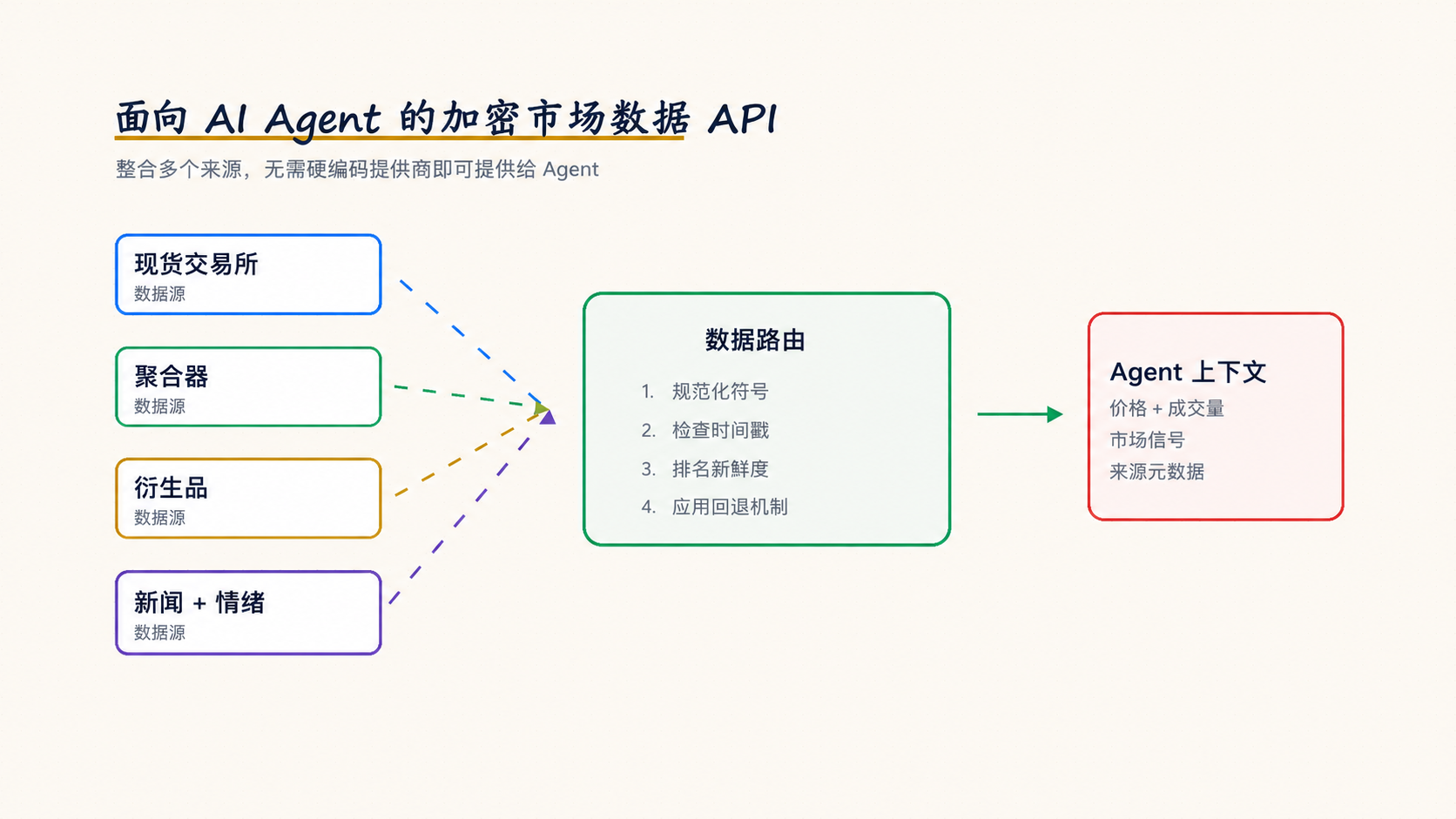
生产 Agent 通常组合多种访问类型 — WebSocket 用于流式警报,REST 用于元数据和回退,交易所原生 API 用于特定来源的深度数据。
面向 AI Agent 的加密货币市场数据应用场景
1. 加密市场简报 Agent
所需能力: crypto_price, global_market_data, token_metadata
输出: daily market brief
QVeris 支持: 发现概览能力 → 检查 → 调用 → 生成结构化简报。
2. 加密货币价格警报 Agent
所需能力: crypto_price, WebSocket stream, alert_delivery
输出: 包含交易所上下文的价格预警
QVeris 支持: 发现价格与数据流 → 检查 → 订阅 → 验证 → 触发预警。参见 Crypto Price Alert Agent.
3. 代币研究 Agent
所需能力: token_metadata, market_cap, volume, historical_prices
输出: 代币研究摘要
QVeris 支持: 发现代币数据 → 检查 → 调用 → 交叉验证。
4. 加密投资组合上下文 Agent
所需能力: crypto prices, token metadata, portfolio symbols, stablecoin mapping
输出: 投资组合上下文简报
QVeris 支持: 发现多资产数据 → 检查 → 调用 → 映射到投资组合。
5. 交易所价差监控 Agent
所需能力: exchange data, bid/ask, order book
输出: 价差监控摘要
QVeris 支持: 发现交易所数据 → 检查交易对 → 调用 → 比较。
6. 多提供商加密数据 Agent
所需能力: provider discovery, schema inspection, fallback, validation
输出: 具有来源依据的加密货币响应
QVeris 支持: 跨服务商发现 → 检查 Schema → 路由 → 验证并标准化。
QVeris Support 意味着此工作流可以围绕通过 QVeris 可发现的能力构建。生产使用前请在 Inspect 期间确认确切的能力可用性。
面向 AI Agent 的加密货币市场数据架构
1. 识别资产
接收代币、交易对或观察列表,并将代码规范化为提供商对应的 ID,例如 CoinGecko 使用“bitcoin”,Binance 使用“BTCUSDT”。
2. 定义数据需求
先判断需要价格、元数据、历史数据、数据流、订单簿还是预警;数据类型决定相关能力与提供商。
3. 发现能力
使用 QVeris Discover 查找符合资产、数据类型和提供商偏好的加密货币市场数据能力。
4. 检查 Schema
执行前检查代币 ID 格式、计价货币、交易所覆盖、成本、速率限制与提供商说明。
5. 调用或订阅
执行 REST 调用或连接 WebSocket 数据流;多资产工作流在提供商支持时应使用批量请求。
6. 验证并输出
核对时间戳、交易所、交易对和计价货币,再生成带来源追踪的预警、简报或 JSON。
AI Agent 常见的加密货币数据挑战
代币符号冲突
“ADA”可能指 Cardano,也可能与其他资产代码冲突。应使用代币 ID 或合约地址验证,不能只依赖代码。
报价货币差异
BTC-USDT 不等于 BTC-USD,稳定币也可能脱锚。Agent 必须在每次输出中保留计价货币元数据。
交易所特定价格
同一资产在不同交易所可能以不同价格成交,因此必须保留来源归属,确保结果可审计。
速率限制与免费额度
监控数十种代币的生产 Agent 很快会超过免费额度,应提前规划回退方案和付费套餐升级。
Schema 变化
提供商会调整字段名与响应格式;每次调用前检查 Schema,可尽早发现破坏性变更。
提供商停机
依赖单一提供商会形成单点故障;带回退的多提供商路由可增强韧性。
使用 QVeris 统一加密货币市场数据工作流
每个提供商都有不同的代币标识符、Schema、速率限制和定价。为每个提供商硬编码特定逻辑的 Agent 会随着每个新数据源累积技术债务。QVeris 通过统一的 发现 → 检查 → 调用 → 验证 → 报告 工作流解决这一问题。
QVeris Support 并不意味着 QVeris 是加密货币交易所或每个加密货币市场数据集的原始来源。它意味着 Agent 使用 QVeris 通过统一路由层发现、检查和调用相关能力。阅读文档 → 或 查看定价 →。
快速上手指南
QVeris 是能力路由层。加密货币数据来自第三方提供商。生产前验证条款。
统一您 Agent 的加密货币市场数据访问
QVeris 帮助您的 Agent 通过一个路由层发现、检查和调用加密货币价格、元数据、WebSocket 流、交易所数据和警报。Discover 和 Inspect 永久免费。
构建加密数据 Agent →查看 QVeris 文档加密货币价格 API →
提供商广泛对比。
Crypto WebSocket API →
流式数据架构。
CoinGecko API →
CoinGecko 专用工作流。
加密货币价格预警 Agent →
事件驱动预警工作流。
投资组合监控 →
投资组合层面的加密货币背景。
市场数据 API →
更广泛的金融数据工作流。