
Crypto Price Alert Agent with Real-Time APIs
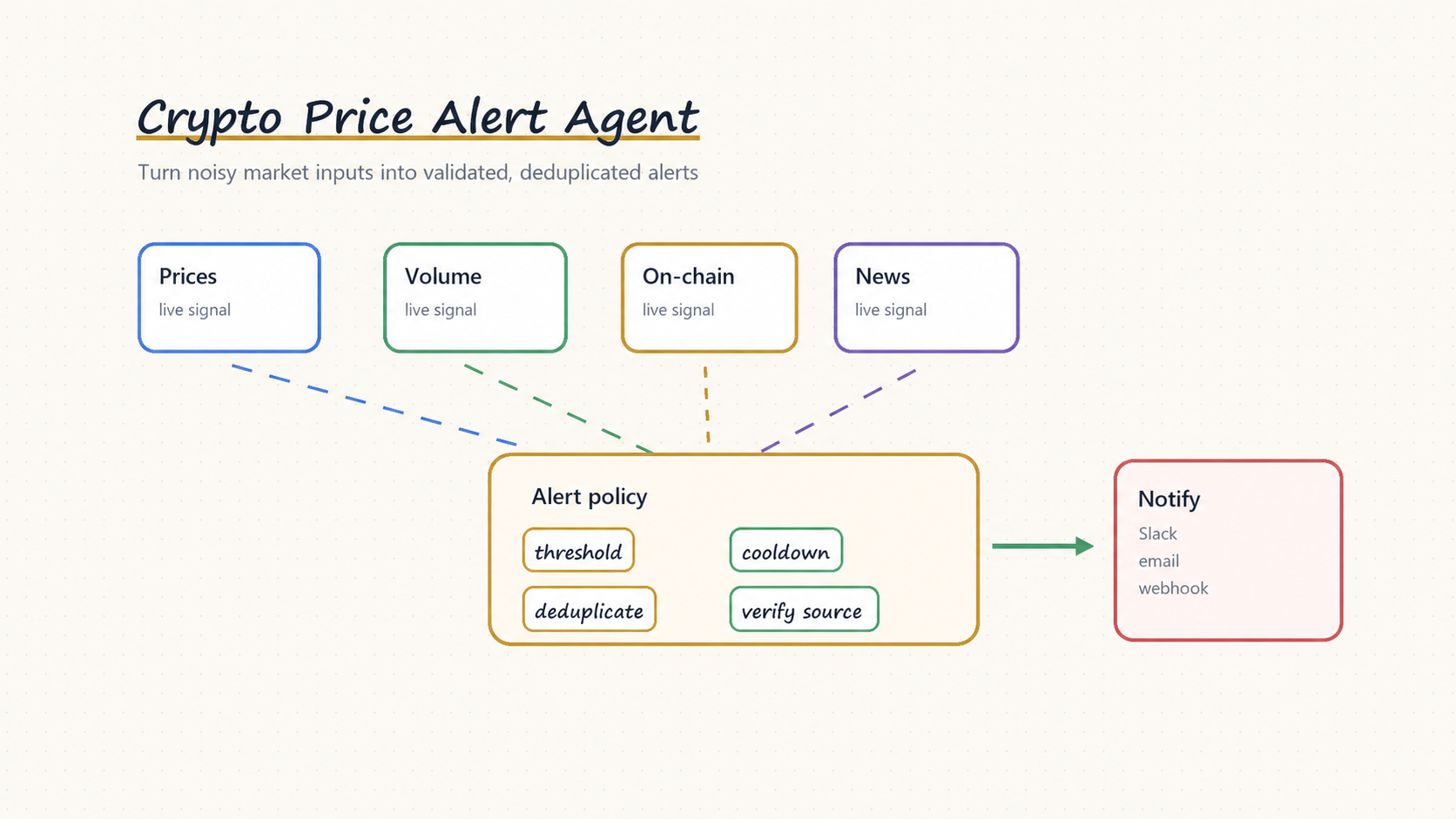
Build an AI agent that monitors BTC, ETH, altcoins, exchange prices, WebSocket streams, volatility spikes, volume changes, and crypto watchlists through QVeris-supported capability routing.
BTC · ETH · Altcoins · Price thresholds · Streaming events · Agent alerts
What Is a Crypto Price Alert Agent?
A Crypto Price Alert Agent is an AI agent that monitors crypto assets, pairs, exchanges, or watchlists and triggers alerts when user-defined market conditions are met — price thresholds, percent moves, volume spikes, spread changes, or volatility events. It detects conditions, validates source data (timestamps, exchange, pair, quote currency), adds context, and delivers structured alerts. It is an event monitoring workflow, not a trading bot or investment advisor.
The agent monitors across multiple dimensions: BTC, ETH, and altcoin prices (has the asset moved meaningfully?), exchange-specific data (is the price consistent across venues?), WebSocket streams (continuous monitoring for 24/7 crypto markets), bid/ask spreads (is liquidity changing?), volume (is the move confirmed?), volatility (is this move unusual?), and token watchlists (which assets in the user's list are moving?). Each alert preserves source exchange, pair, quote currency, and timestamp.
The core insight: a raw crypto price change is just a number. A useful alert adds context — which exchange did this happen on? What is the quote currency? Is volume confirming the move? Is the move unusual relative to recent volatility? Is there related news? For broader crypto API comparisons, see the Cryptocurrency Price API for AI Agents guide. For streaming architecture, see Crypto WebSocket API for AI Agents. For CoinGecko-specific workflows, see CoinGecko API for AI Agents.
Crypto Price Alerts vs Trading Signals
| Workflow | Main Purpose | Example Output | What It Should Avoid |
|---|---|---|---|
| Crypto Price Alert Agent | Detect crypto price/market conditions and notify users | Alert, event brief, JSON payload | Buy/sell recommendations |
| Crypto Trading Signal System | Generate trade ideas or execution signals | Signal, strategy output, order instruction | Requires risk controls, authorization, compliance |
| Crypto Portfolio Monitoring | Monitor broader crypto portfolio context | Daily brief, risk alert, exposure summary | Portfolio advice without authorization |
Why Crypto Agents Need Real-Time Alerts
1. Crypto Markets Operate 24/7
Unlike equities, crypto never closes. An alert agent must maintain continuous awareness — weekends, holidays, overnight. WebSocket streaming enables persistent monitoring without gaps.
2. Price Moves Can Happen Any Time
A 10% BTC move can happen at 3 AM Sunday. A REST-polling agent checking every hour misses it. A WebSocket-connected agent detects it as it unfolds.
3. Exchange-Specific Prices Differ
BTC can trade at different prices on Binance, Coinbase, and Kraken simultaneously. An alert agent monitoring multiple exchanges detects cross-venue divergences that single-exchange monitoring misses.
4. WebSocket Streams Beat Polling
Polling 50 crypto pairs every 30 seconds via REST burns API quota fast. WebSocket subscriptions handle multi-pair monitoring efficiently — only sending events when something changes.
5. Volatility Spikes Need Continuous Observation
Crypto volatility can surge from 2% to 20% daily range within hours. Streaming data lets the agent detect the transition from low-vol to high-vol regime in real time.
6. Source Timestamps and Exchange Context
An alert that says "BTC crossed $100K" should include the exchange, pair (BTC-USDT vs BTC-USD), timestamp, and quote currency. Source traceability makes alerts auditable.
Data Capabilities a Crypto Price Alert Agent Needs
1. Real-Time Crypto Price
Latest prices, percent changes, quote currency, market status. The core signal.
QVeris Support: discover crypto price → inspect latency → call → validate.
2. Crypto WebSocket Stream
Continuous monitoring, lower-latency alerts, 24/7 event detection. See Crypto WS guide.
QVeris Support: discover streaming → inspect schema → subscribe.
3. Exchange Market Data
Exchange-specific prices, order book, spread, pair-level validation.
QVeris Support: discover exchange data → inspect pair coverage → call.
4. Token Metadata
Symbol normalization, token IDs, quote currencies, asset mapping. BTC ≠ bitcoin ID.
QVeris Support: discover metadata → inspect ID mapping → call.
5. Historical Crypto Prices
Compare current move against recent volatility and typical ranges.
QVeris Support: discover historical → inspect timeframe → call.
6. Volume & Liquidity
Identify whether price moves are supported by market activity.
QVeris Support: discover volume data → inspect fields → call.
7. Crypto News
Explain whether moves relate to headlines, protocol events, or listings.
QVeris Support: discover news → inspect sentiment fields → call.
8. Alert Delivery
Email, Slack, webhook, dashboard, or JSON notifications.
QVeris Support: discover alerting → inspect formats → call → validate delivery.
QVeris Support means this workflow can be structured around capabilities discoverable through QVeris. Confirm exact availability during Inspect before production use.
Crypto Price Alert Workflow
Define Crypto Watchlist & Alert Conditions
User defines BTC, ETH, altcoins, pairs, exchanges. Alert rules: price threshold, percent change, volume spike, spread widening, exchange divergence, or volatility spike.
Discover Required Capabilities
Use QVeris Discover to find crypto price, WebSocket stream, exchange data, token metadata, historical prices, news, and alert delivery capabilities.
Inspect Schemas Before Calling
Check input format, token IDs, quote currencies, exchange coverage, cost, latency, provider notes, and output fields. Verify real-time vs delayed data before connecting.
Connect & Monitor
Subscribe to WebSocket streams for continuous monitoring, or poll REST endpoints on a defined interval. Pull exchange data for price comparison and spread context.
Evaluate Conditions
Compare incoming data against defined thresholds. Validate timestamps, exchange source, pair, and quote currency before triggering evaluation logic.
Add Context
If triggered, pull historical range, check volume, compare across exchanges, check for related news. Context turns a raw alert into an explained crypto market event.
Validate & Deliver Alert
Verify timestamps, exchange, pair, quote currency, source URLs. Send via Slack, email, webhook, dashboard, or JSON — with source traceability and disclaimer.
Example Crypto Price Alert Agent Output
BTC
BTC-USDT
Price moved >3% in 15m window
Verified from stream source
Signals Checked: Real-time crypto price · WebSocket stream · Exchange source · Volume change · Historical volatility · Recent crypto news
Agent Alert: BTC crossed the configured price movement threshold. The move appears larger than the recent monitoring range and was detected from the selected exchange stream. Volume is elevated, confirming the move. This is a monitoring alert only — not a trade recommendation.
Follow-up: Review exchange-specific source · Check for related news or macro events · Continue monitoring · Generate deeper crypto market brief if needed
Illustrative example. Not real market data or investment advice. All alerts should include source timestamps, exchange, pair, and disclaimers.
QVeris Support for Crypto Price Alert Agents
Crypto alert workflows need prices, WebSocket streams, exchange data, token metadata, historical prices, volume, news, and alert delivery — each from different providers. QVeris structures this through Discover → Inspect → Call → Validate → Report:
Discover
Find crypto price, WebSocket, exchange, market data, news, and alerting capabilities across providers.
Inspect
Review schema, cost, latency, stream type, exchange coverage, and provider notes before calling.
Call
Execute capabilities through a unified interface — consistent handling across providers.
Validate & Report
Check timestamps, exchange, pair, quote currency. Generate alert, webhook, or JSON with source traceability.
QVeris is a capability routing layer — not a crypto exchange or the original source of every price stream. Read the docs → or view pricing →.
Getting Started Checklist
QVeris is a capability routing layer. Crypto data from third-party providers and exchanges. Monitoring alerts — not investment advice.
Build a 24/7 Crypto Alert Agent
QVeris helps your agent discover, inspect, and call crypto price, WebSocket, exchange, and alerting capabilities through one unified routing layer. Discover and Inspect are free forever.
Build Crypto Alert Agent →Explore QVeris DocsCrypto Price Alert Agent FAQ
What is a Crypto Price Alert Agent?
Does a crypto alert agent need WebSocket data?
What APIs does a crypto price alert agent need?
Can this agent recommend crypto trades?
How does QVeris help with crypto price alerts?
Is this crypto investment advice?
使用实时 API 构建加密货币价格警报 Agent
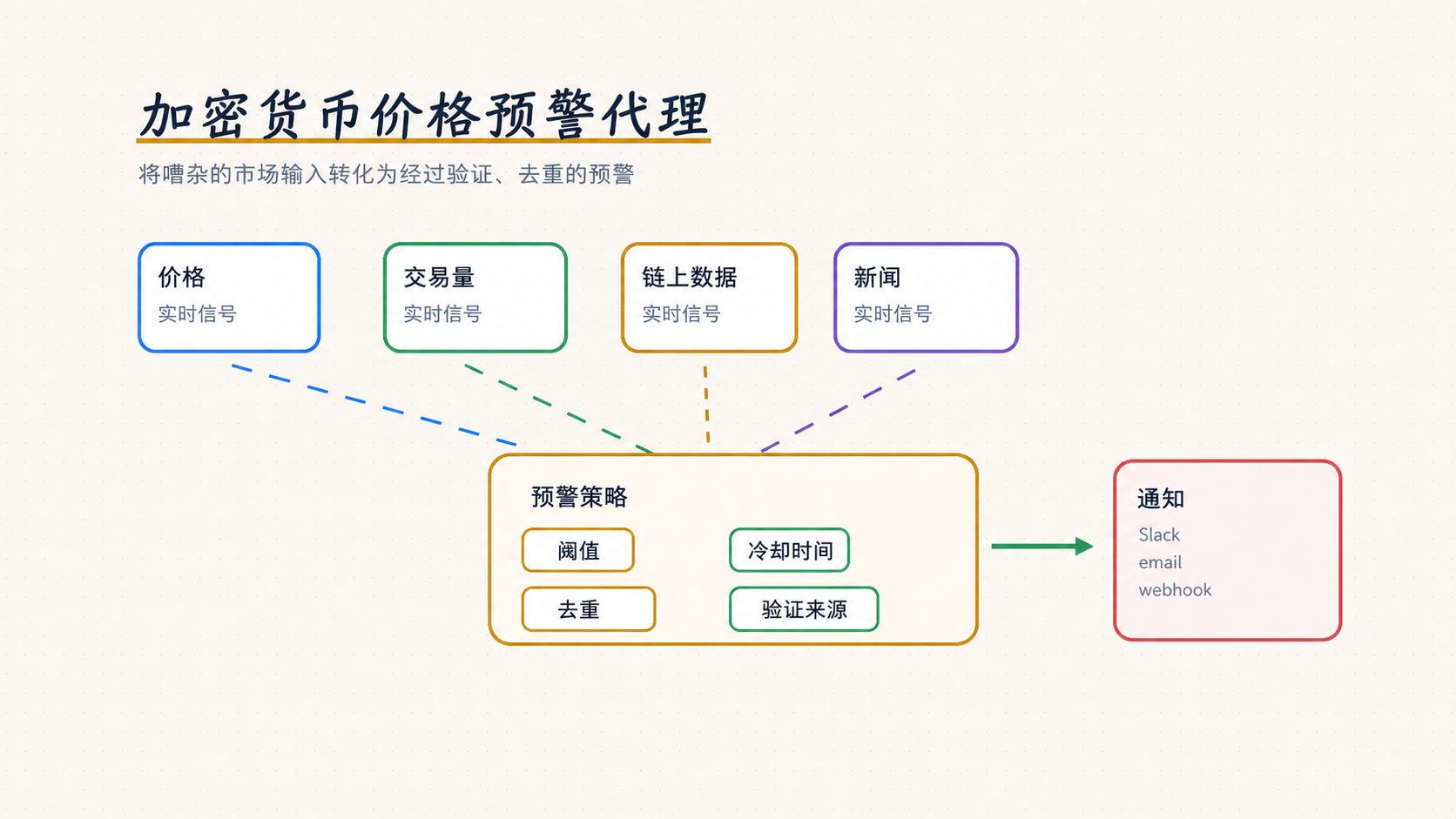
构建一个 AI Agent,通过 QVeris 支持的能力路由监控 BTC、ETH、山寨币、交易所价格、WebSocket 流、波动率飙升、成交量变化和加密货币观察列表。
BTC · ETH · 山寨币 · 价格阈值 · 流式事件 · Agent 警报
什么是加密货币价格警报 Agent?
加密货币价格警报 Agent 是一个 AI Agent,监控加密货币资产、交易对、交易所或观察列表,并在用户定义的市场条件满足时触发警报 — 价格阈值、百分比变动、成交量飙升、价差变化或波动率事件。它检测条件、验证来源数据(时间戳、交易所、交易对、计价货币)、添加上下文并交付结构化警报。它是一个事件监控工作流,而非交易机器人或投资顾问。
Agent 监控多个维度:BTC、ETH 和山寨币价格(资产是否有意义地变动了?)、交易所特定数据(价格在不同场所是否一致?)、WebSocket 流(24/7 加密货币市场的持续监控)、买卖价差(流动性是否在变化?)、成交量(波动是否被确认?)、波动率(这次波动是否异常?)和代币观察列表(用户列表中哪些资产在变动?)。每个警报保留来源交易所、交易对、计价货币和时间戳。
核心洞察:原始加密货币价格变动只是一个数字。有用的警报添加上下文 — 这发生在哪个交易所?计价货币是什么?成交量是否确认了这次波动?相对于近期波动率,这次波动是否异常?是否有相关新闻?对于更广泛的加密货币 API 对比,请参阅面向 AI Agent 的加密货币价格 API指南。对于流式架构,请参阅面向 AI Agent 的加密货币 WebSocket API。对于 CoinGecko 特定工作流,请参阅面向 AI Agent 的 CoinGecko API。
加密货币价格警报 vs 交易信号
| 工作流 | 主要用途 | 示例输出 | 避免的问题 |
|---|---|---|---|
| 加密货币价格警报 Agent | 检测加密货币价格或市场条件,并向用户发送通知 | 警报、事件简报、JSON 载荷 | 买卖建议 |
| 加密货币交易信号系统 | 生成交易思路或执行信号 | 信号、策略输出、订单指令 | 需要风险控制、授权与合规机制 |
| 加密货币投资组合监控 | 监控更广泛的加密资产组合背景 | 每日简报、风险警报、敞口摘要 | 未经授权提供投资组合建议 |
为什么加密货币 Agent 需要实时警报
1. 加密货币市场 24/7 运行
与股票不同,加密货币市场从不休市。预警 Agent 必须在周末、节假日和夜间持续监控。 WebSocket 流式传输 支持无间断的持续监控。
2. 价格波动可能随时发生
BTC 可能在周日凌晨 3 点波动 10%。如果 Agent 每小时才通过 REST 轮询一次,很可能错过行情;连接 WebSocket 后,则能在波动发生时立即发现。
3. 不同交易所价格可能不同
BTC 在 Binance、Coinbase 与 Kraken 上可能同时出现不同报价。监控多家交易所的警报 Agent 能发现单一交易所监控遗漏的跨平台价差。
4. WebSocket 流优于轮询
每 30 秒通过 REST 轮询 50 个交易对会迅速消耗 API 配额。WebSocket 订阅只在数据变化时推送事件,更适合高效监控多个交易对。
5. 波动率飙升需要持续观察
加密市场的日内波动区间可能在数小时内从 2% 扩大到 20%。流式数据能让 Agent 实时识别市场从低波动向高波动状态的切换。
6. 来源时间戳与交易所上下文
“BTC 突破 10 万美元”的警报应同时标明交易所、交易对(BTC-USDT 或 BTC-USD)、时间戳与计价货币。完整的来源追踪才能让警报可审计。
加密货币价格警报 Agent 需要的数据能力
1. 实时加密货币价格
最新价格、涨跌幅、计价货币与市场状态,是最核心的信号。
QVeris 支持: 发现加密货币价格 → 检查延迟 → 调用 → 验证。
2. 加密货币 WebSocket 数据流
持续监控、更低延迟的预警与全天候事件检测。参见 加密货币 WebSocket 指南.
QVeris 支持: 发现数据流 → 检查 Schema → 订阅。
3. 交易所市场数据
交易所特定价格、订单簿、价差与交易对级验证。
QVeris 支持: 发现交易所数据 → 检查交易对覆盖 → 调用。
4. 代币元数据
统一 Symbol、代币 ID、计价货币与资产映射;BTC 不等同于 bitcoin ID。
QVeris 支持: 发现元数据 → 检查 ID 映射 → 调用。
5. 历史 加密货币价格
将当前波动与近期波动率和典型区间进行比较。
QVeris 支持: 发现历史数据 → 检查时间范围 → 调用。
6. 成交量与流动性
判断价格波动是否得到市场活跃度支持。
QVeris 支持: 发现成交量数据 → 检查字段 → 调用。
7. 加密货币新闻
解释波动是否与新闻、协议事件或上币有关。
QVeris 支持: 发现新闻 → 检查情绪字段 → 调用。
8. 预警送达
通过邮件、Slack、Webhook、仪表板或 JSON 通知送达。
QVeris 支持: 发现预警能力 → 检查格式 → 调用 → 验证送达。
QVeris Support 意味着此工作流可以围绕通过 QVeris 可发现的能力构建。生产使用前请在 Inspect 期间确认确切的能力可用性。
加密货币价格警报工作流
定义加密货币观察列表与警报条件
用户指定 BTC、ETH、山寨币、交易对与交易所,并设置价格阈值、涨跌幅、成交量激增、价差扩大、跨平台偏差或波动率飙升等警报规则。
发现所需能力
使用 QVeris Discover 查找加密货币价格、WebSocket 数据流、交易所数据、代币元数据、历史价格、新闻与警报投递能力。
调用前检查 Schema
检查输入格式、代币 ID、计价货币、交易所覆盖范围、成本、延迟、供应商说明和输出字段;连接前还要确认数据是实时还是延迟。
连接并监控
订阅 WebSocket 数据流进行连续监控,或按设定间隔轮询 REST 端点;同时获取交易所数据,用于价格对比与价差分析。
评估触发条件
将传入数据与预设阈值比较,并在触发判断逻辑前核验时间戳、交易所来源、交易对与计价货币。
补充上下文
触发条件后,进一步读取历史区间、核查成交量、对比不同交易所并检索相关新闻,把原始警报补充成有解释的市场事件。
验证并发送预警
核验时间戳、交易所、交易对、计价货币和来源链接,再通过 Slack、邮件、Webhook、仪表盘或 JSON 发送,并附上来源追踪与免责声明。
示例加密货币价格警报 Agent 输出
BTC
BTC-USDT
Price moved >3% in 15m window
Verified from stream source
已核验信号: Real-time crypto price · WebSocket stream · Exchange source · Volume change · Historical volatility · Recent crypto news
Agent 警报: BTC crossed the configured price movement threshold. The move appears larger than the recent monitoring range and was detected from the selected exchange stream. Volume is elevated, confirming the move. This is a monitoring alert only — not a trade recommendation.
后续操作: Review exchange-specific source · Check for related news or macro events · Continue monitoring · Generate deeper crypto market brief if needed
示意性示例。非真实市场数据或投资建议。所有警报应包含来源时间戳、交易所、交易对和免责声明。
QVeris 对加密货币价格警报 Agent 的支持
加密货币警报工作流需要价格、WebSocket 流、交易所数据、代币元数据、历史价格、成交量、新闻和警报交付 — 每个来自不同的提供商。QVeris 通过 发现 → 检查 → 调用 → 验证 → 报告 构建此工作流:
发现
跨供应商查找加密货币价格、WebSocket、交易所、市场数据、新闻与警报能力。
检查
调用前审查 Schema、成本、延迟、数据流类型、交易所覆盖范围和供应商说明。
调用
通过统一接口执行能力,在不同供应商之间保持一致的调用方式。
验证并生成报告
核验时间戳、交易所、交易对与计价货币,生成带来源追踪的警报、Webhook 或 JSON。
快速上手指南
QVeris 是能力路由层。加密货币数据来自第三方提供商和交易所。监控警报 — 并非投资建议。
构建 24/7 加密货币警报 Agent
QVeris 帮助您的 Agent 通过统一路由层发现、检查和调用加密货币价格、WebSocket、交易所和警报能力。Discover 和 Inspect 永久免费。
构建加密货币警报 Agent →查看 QVeris 文档