
Choose a Free Stock News API
for Your AppFree Stock News API
for Your App
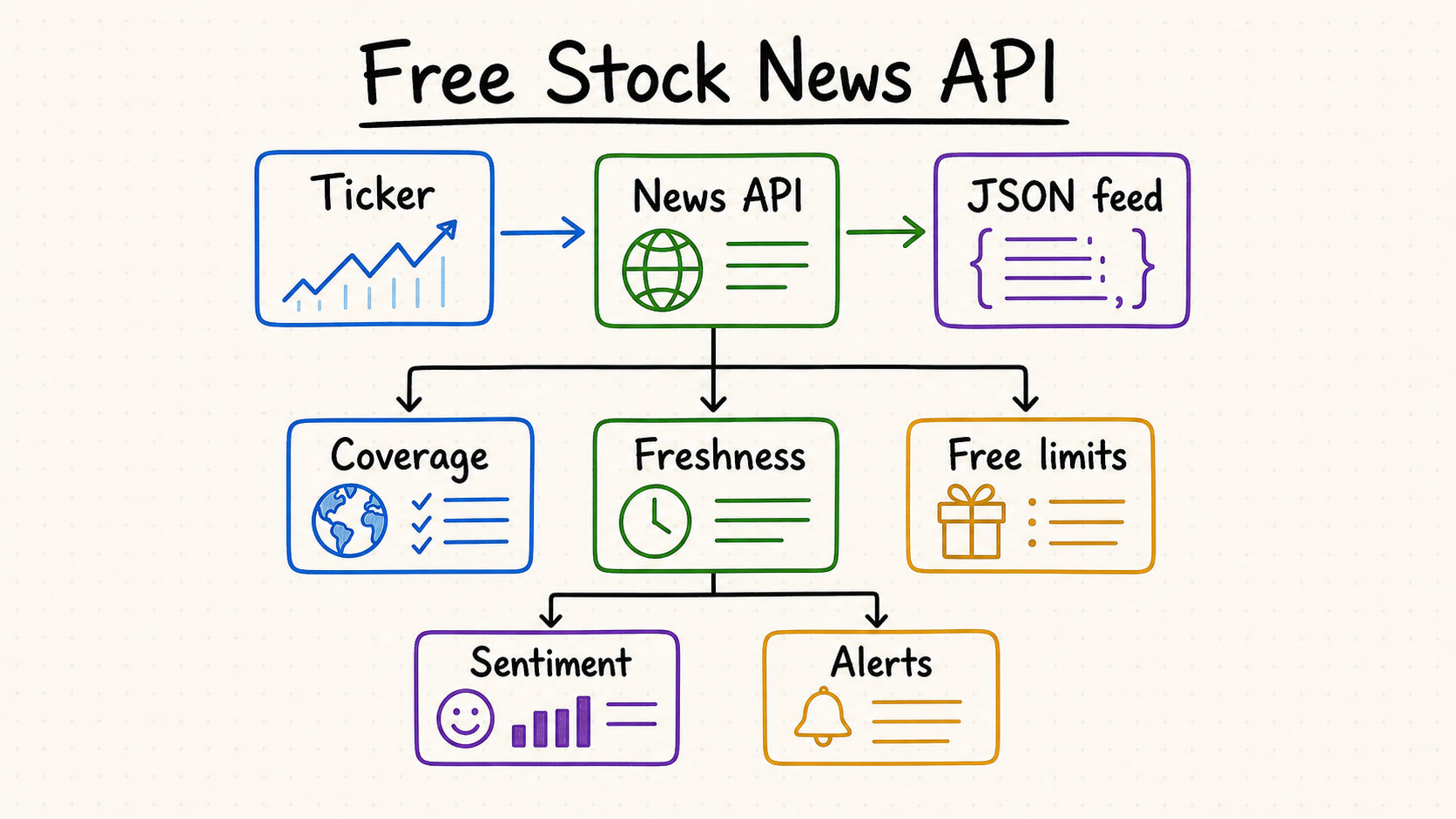
Compare coverage, freshness, sentiment, history, JSON fields, and limits before connecting a stock news feed.
Free stock news API: the short answer
Expect request caps, delayed stories, short history, non-commercial terms, or restricted article text. Verify current plan terms before shipping.
A useful stock news API maps stories to symbols and exchanges instead of returning a broad business-news feed.
Measure publication-to-API delay and polling limits; a “real-time” label alone does not establish latency.
Keep title, URL, source, timestamp, symbols, and optional sentiment in a stable internal model.
What users need from a free stock market news API
The practical task is to find a free tier, confirm company or ticker filtering, inspect the JSON response, and decide whether the limits fit a dashboard, alert, research notebook, or trading app. General news, stock prices, and social posts are adjacent but different datasets.
Coverage: exchanges, symbols, languages, and sources
Check exchange-qualified identifiers, delisted-symbol behavior, countries, languages, publishers, and whether duplicate syndication is removed.
Freshness, history, sentiment, and licensing
A free real-time stock news API may still delay content or restrict polling. Historical news, full text, redistribution, and sentiment often have separate limits.
Calculate whether the free quota fits
Estimate requests from watchlist size, polling interval, active market hours, pagination, retries, and any per-symbol endpoint behavior. Polling one shared feed every minute is very different from calling 100 ticker endpoints every minute. Reserve quota for startup backfills and incident recovery, then test the provider's burst limit as well as its daily allowance. If the budget only works when every request succeeds and returns one page, it is not a sustainable free integration.
Prefer stories tagged to the requested company and exchange, with the source URL preserved for verification.
Confirm stable cursors or page tokens, deterministic sorting, and clear published timestamps.
Record daily and per-minute quotas, response headers, overage behavior, and whether commercial apps are allowed.
Ticker-level sentiment, topic labels, entities, highlights, and historical search can reduce downstream processing.
Require an issuer or security identifier in addition to a bare ticker. Test symbols that are ordinary words, appear on multiple exchanges, changed after a merger, or were reused after delisting. Preserve the provider's match confidence and evidence instead of accepting every text mention as a company relationship.
Separate earnings, guidance, filings, analyst actions, corporate actions, M&A, litigation, and trading halts. Also distinguish an official filing or exchange notice from a press release, wire story, publisher analysis, or social repost so an agent can cite the strongest available evidence.
Store original publication time, provider ingestion time, update time, timezone, and the related trading session. A story published before the open, during regular trading, or after the close can support different alerts even when all three arrive on the same calendar date.
Model the complete news lifecycle
A single timestamp cannot explain how quickly information became usable. Preserve the event time when the source states it, the first publisher time, the API's first-seen time, each update or correction time, and your retrieval time. Event time may be absent or approximate; keep that uncertainty instead of copying the publication time into every field.
Event says when the underlying fact occurred; published and first seen measure delivery; updated tracks changing content; retrieved proves what the application knew.
Keep one canonical story ID plus article-version IDs. Syndicated copies belong to the same cluster, while a material correction must remain a new version with a link to the earlier claim.
Distinguish “no matching news” from an unknown ticker, unsupported exchange, expired history window, permission failure, quota exhaustion, and provider outage. These states require different user messages and retries.
How to compare the best free stock news API options
| Requirement | Verify | Common free limit | Test |
|---|---|---|---|
| Ticker filtering | Symbol and exchange mapping | Narrow market coverage | Query an ambiguous symbol |
| Freshness | Published time vs API time | Delay or low polling quota | Record latency for a week |
| JSON fields | URL, source, time, symbols | Missing body or images | Validate nulls and pages |
| Sentiment and history | Score level and lookback | Paid add-on or short history | Inspect methods and dates |
Turn the comparison into an acceptance test. Build a small dated corpus of earnings releases, guidance changes, SEC filings, analyst actions, mergers, dividends, splits, and trading halts. Add negative cases: an ambiguous ticker, an unrelated article that only mentions the company, a syndicated duplicate, and a corrected headline. For each event, record the correct issuer and exchange, first publisher timestamp, first API appearance, duplicate group, later correction, and whether the article was materially about the company. Then measure missed-event rate, wrong-ticker rate, duplicate rate, correction latency, and publication-to-API latency at the median and 95th percentile. Report premarket, regular-session, and after-hours results separately; one daily average can hide the exact period when alerts matter most. A provider that returns many articles but misses high-impact events—or repeatedly assigns ambiguous symbols—should not win on volume alone.
Make your first stock news API JSON request
Use the documented symbol parameter, a result limit of five, and server-side authentication. Never expose a private API key in browser code.
Require a title, canonical source URL, publisher, published timestamp, and exchange-aware symbol; handle nullable summaries and images.
Convert times to UTC and deduplicate by canonical URL plus title before saving or displaying articles.
Log quota headers and retry 429 and transient 5xx responses with bounded exponential backoff.
Rank by verified entity relevance, event type, novelty, source quality, and timing rather than sentiment alone. Set separate rules for first publication, material update, correction, and duplicate follow-up. Preserve the decision features so a reviewer can explain why an alert fired or was suppressed.
Keep stable article and story-cluster IDs, compare updated timestamps or hashes, and link every correction or retraction to the earlier version. If an alert was based on information later corrected, notify downstream users instead of merely replacing the stored headline.
Use QVeris to discover stock news capabilities
QVeris helps agents discover and inspect callable capabilities. Open the Alpha Vantage News Sentiment tool details to inspect the declared inputs and outputs while keeping provider-specific choices separate from application logic.
- Inspect tool schemas before calling a stock news capability.
- Keep source attribution and article URLs in every normalized record.
- See the Python implementation guide and news sentiment guide for adjacent intents.
FAQ
Yes, but quotas, delay, history, fields, and commercial rights vary. Confirm the current official plan before relying on one.
Look for documented symbol or entity parameters and exchange-aware identifiers. Test ambiguous symbols.
Sometimes for testing or low volume, but ingestion delay and polling limits still apply. Measure end-to-end latency.
Some do. Check whether sentiment is article-level or ticker-level, its method, and free-plan availability.