
Financial News API Free Python: A Practical Guide
Choose a testable news API, send a ticker request with Python, and verify limits, history, sentiment, sources, and JSON before production.
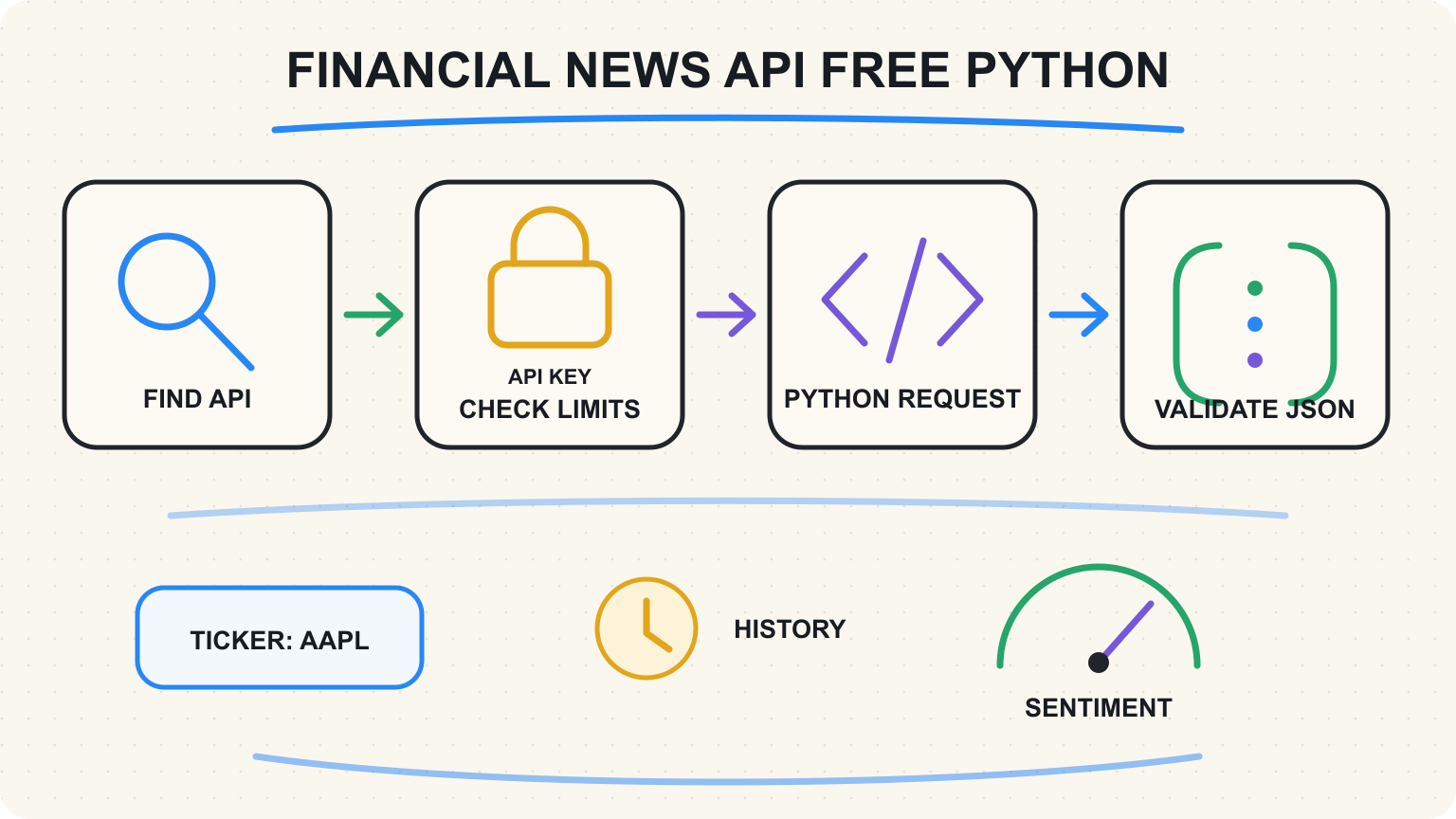
The implementation goal for a Python financial-news collector
A Python developer who has already chosen financial news as an input needs more than a one-off request. The collector should survive pagination, throttling, duplicate stories, schema changes, partial failures, and process restarts. Provider breadth is secondary here; the primary outcome is a small but production-shaped ingestion loop that can later swap APIs without changing every downstream workflow.
Persist cursors and checkpoints only after a batch is committed, so a process restart neither skips articles nor advances past failed work.
Convert every response into one internal article model and validate required fields before NLP, alerts, or storage.
Combine backoff, stable identifiers, URL normalization, and database uniqueness so replaying a request cannot duplicate output.
Choose an API that supports a reliable Python ingestion loop
Prefer cursor pagination over fragile page numbers
A Python collector must resume after interruption without skipping or replaying an unstable result set. Test whether the API returns an opaque next cursor, a deterministic sort order, and a documented end condition. Persist the cursor only after the corresponding batch is committed.
Normalize articles before downstream NLP
Map provider fields into a typed record containing provider ID, canonical URL, title, publication time, source, language, entities, symbols, and retrieval time. Keep the raw payload for debugging, but do not let every model or notebook depend on provider-specific JSON.
Build retries, deduplication, and checkpoints together
Retry transient failures with backoff, honor Retry-After, and deduplicate by provider ID plus canonical URL. A retry should be idempotent: rerunning one page must not create duplicate alerts or duplicate rows.
Use publication watermarks with overlap
Store both the provider cursor and a publication-time watermark. On restart, query a small overlap window and deduplicate it rather than beginning exactly at the last timestamp; late-arriving or corrected articles can otherwise fall behind the checkpoint. Keep publication, provider ingestion, and retrieval times as separate fields.
Quarantine schema and content failures
Do not discard an entire page because one article is malformed, and do not silently accept a breaking field change. Save invalid records with provider, request ID, raw payload, validation error, and retry status. Continue only when the page cursor itself remains trustworthy, then review the quarantine queue.
Separate collection from enrichment
Fetch and commit source records before summarization, translation, sentiment, embeddings, or alert ranking. Downstream enrichment can be retried and versioned independently, while the collector remains a deterministic record of what the provider returned and when.
| Check | Questions to answer | Evidence |
|---|---|---|
| Python ergonomics | Requests-compatible REST, SDK, typing, async support? | Minimal synchronous and async prototypes |
| Pagination | Cursor stability, order, page size, resumability? | Two-page replay and resume test |
| Rate limiting | 429 body, Retry-After, reset headers, burst rule? | Recorded headers under controlled load |
| Idempotency | Can a page be replayed without duplicate output? | Provider ID, URL hash, database constraint |
| Observability | Can you measure lag, failures, null fields, and quota? | Structured logs and collection metrics |
| Testing | Can responses be recorded and replayed offline? | Fixture, schema test, and failure cases |
Financial news API free Python request example
Keep the API key outside source code
Load the key from an environment variable. Set a finite timeout and avoid printing secrets in logs or notebooks.
Validate status, content type, and fields
Raise on HTTP errors, confirm JSON content, and reject items that lack the minimum fields your application requires.
Handle pagination and rate limits explicitly
Follow documented cursors, respect 429 and Retry-After, deduplicate by stable URL or provider ID, and preserve source timestamps.
Wrap requests in a small provider client
Centralize base URL, authentication, timeout, session reuse, error mapping, cursor extraction, and response validation behind one interface. Return normalized batches plus checkpoint metadata instead of exposing raw provider JSON throughout the application. This keeps an API swap local and testable.
Test restarts and partial failures
Record representative responses and replay them without network access. Cover two-page success, timeout before commit, 429 with Retry-After, malformed JSON, one invalid article, duplicate replay, empty results, correction arrival, and a schema field removal. Assert both stored rows and the final checkpoint.
Expose collection health
Measure request latency, publication-to-ingestion lag, success rate, retries, quota remaining, articles per page, duplicate rate, quarantined items, and checkpoint age. Alert on stale progress or sudden source loss even when requests still return HTTP 200.
import os
import time
from dataclasses import dataclass
from datetime import datetime, timezone
from urllib.parse import urldefrag

import requests


@dataclass(frozen=True)
class Article:
    provider_id: str
    canonical_url: str
    title: str
    published_at: datetime
    source: str
    language: str
    retrieved_at: datetime

    @property
    def dedupe_key(self) -> tuple[str, str]:
        return self.provider_id, self.canonical_url


class FinancialNewsClient:
    def __init__(self, base_url: str, api_key: str) -> None:
        self.base_url = base_url
        self.session = requests.Session()
        self.session.headers.update({"Authorization": f"Bearer {api_key}"})

    def fetch_page(self, cursor: str | None) -> tuple[list[Article], list[dict], str | None]:
        params = {"symbols": "AAPL", "language": "en", "limit": 100}
        if cursor:
            params["cursor"] = cursor

        for attempt in range(4):
            response = self.session.get(self.base_url, params=params, timeout=(5, 20))
            if response.status_code == 429:
                retry_after = response.headers.get("Retry-After", "1")
                delay = int(retry_after) if retry_after.isdigit() else 1
                time.sleep(min(delay, 30))
                continue
            if 500 <= response.status_code < 600 and attempt < 3:
                time.sleep(2 ** attempt)
                continue

            response.raise_for_status()
            if "application/json" not in response.headers.get("Content-Type", ""):
                raise ValueError("Expected a JSON response")

            payload = response.json()
            raw_items = payload.get("results")
            if not isinstance(raw_items, list):
                raise ValueError("Expected results to be a list")

            retrieved_at = datetime.now(timezone.utc)
            valid, quarantine = [], []
            for raw in raw_items:
                try:
                    required = {"id", "title", "published_at", "source_url", "source"}
                    if not required.issubset(raw):
                        raise ValueError("Missing a required article field")
                    published = datetime.fromisoformat(raw["published_at"].replace("Z", "+00:00"))
                    if published.tzinfo is None:
                        raise ValueError("published_at must include a timezone")
                    valid.append(Article(
                        provider_id=str(raw["id"]),
                        canonical_url=urldefrag(raw["source_url"])[0],
                        title=raw["title"].strip(),
                        published_at=published.astimezone(timezone.utc),
                        source=raw["source"].strip(),
                        language=raw.get("language", "und"),
                        retrieved_at=retrieved_at,
                    ))
                except (KeyError, TypeError, ValueError) as error:
                    quarantine.append({"raw": raw, "error": str(error)})

            return valid, quarantine, payload.get("next_cursor")

        raise RuntimeError("The provider remained unavailable after bounded retries")


def collect(client, start_cursor, commit_batch):
    cursor = start_cursor
    while True:
        articles, quarantine, next_cursor = client.fetch_page(cursor)
        unique = {article.dedupe_key: article for article in articles}

        # This function must commit articles, quarantine records, and the
        # next cursor in one database transaction. Advance no checkpoint first.
        commit_batch(list(unique.values()), quarantine, next_cursor)

        if not next_cursor:
            break
        cursor = next_cursor


client = FinancialNewsClient(
    "https://provider.example/v1/financial-news",
    os.environ["FINANCIAL_NEWS_API_KEY"],
)
# Wire in application-owned transactional functions before running:
# collect(client, start_cursor=load_checkpoint(), commit_batch=commit_batch)
Checkpoint invariant: commit_batch must apply a database uniqueness constraint and save valid articles, quarantined records, and next_cursor atomically. If the process stops before commit, the same page is replayed safely; if it stops after commit, the saved cursor resumes at the next page. Never persist the cursor before its records.
The hostname and field names are illustrative so the example does not invent a QVeris or provider endpoint. Replace them with the selected provider's current documentation.
How QVeris helps with financial news API discovery
QVeris helps agents discover callable capabilities and inspect their inputs and outputs. It does not guarantee that a provider is free, real-time, complete, or licensed for every use; those facts must be verified against current provider documentation.
- Open the QVeris tool details for financial or stock news capabilities.
- Inspect authentication, ticker parameters, result fields, and error behavior before connecting a workflow.
- Use the QVeris Python SDK documentation for the supported QVeris integration pattern.
FAQ
Yes. Some services expose a free tier or trial. Compare quota, delay, history, fields, supported markets, attribution, and commercial-use rules before choosing one.
Send an authenticated request with requests, pass a ticker or query, check the HTTP status, validate JSON fields, and handle pagination and rate limits.
Many finance-specific APIs expose ticker filters, but symbol formats and exchange mapping differ. Confirm parameters and test a known symbol in the current documentation.
Sometimes. Free history is often limited by date range, result count, or delayed access. Do not assume that a free current-news endpoint includes an archive.
Some return sentiment, entities, or relevance scores; others return raw articles only. Check field definitions, confidence, methodology, and supported languages.
RSS can suit permitted headline monitoring, but an API is usually easier for ticker filters, pagination, normalized JSON, history, and structured enrichment.
Authoritative references
Provider plans change. Use current documentation as evidence and treat this page as an evaluation workflow, not a promise about a specific free allowance.