
Free Stock Data
for Backtesting
Compare free APIs, CSV downloads, and hosted platforms, then validate adjustments, delisted stocks, timestamps, gaps, and licenses before trusting a result.
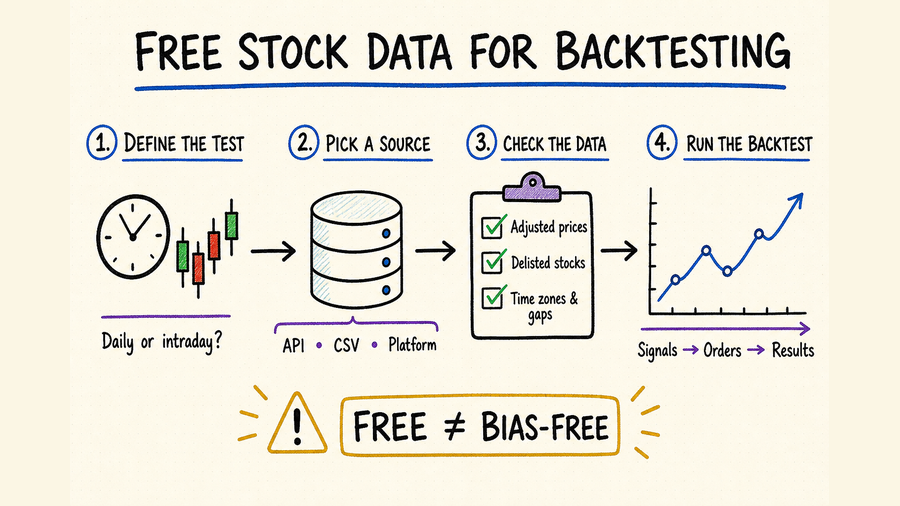
TL;DR
Daily OHLCV from a documented API or CSV archive is enough for many first backtests. Intraday strategies need finer bars and stricter timestamp checks.
Expect history limits, request caps, fewer exchanges, delayed updates, or usage restrictions. Free access does not mean complete coverage.
A clean price chart can still contain survivorship bias, bad adjustments, missing sessions, or look-ahead information.
Keep the raw snapshot, normalize once, validate automatically, and version the exact dataset used for every result.
Choose free stock data that fits the backtest
Start with the test specification: market, universe, bar interval, history depth, adjustment method, and whether you need delisted securities. The right source is the one that meets those requirements reproducibly.
Best for repeatable symbol and date-range queries. Compare bar intervals, maximum rows, adjusted versus raw prices, corporate actions, and rate limits.
Best for large portfolio sweeps because files can be versioned and queried locally without repeated API calls. Check schema, compression, and update cadence.
Use the symbols that were eligible on each historical date, including later delistings. A present-day constituent list creates survivorship bias before the strategy runs.
Execution simulations generally need tradable raw prices plus explicit corporate actions. Total-return research may use adjusted series, but the adjustment method must be consistent across OHLC fields.
Fundamentals and classifications need the date and time they became knowable. Fiscal period end or revised values alone can leak future information.
Python example: prepare bars for a backtest
Normalize every source into the same OHLCV schema, sort in event-time order, and reject duplicate timestamps before calculating a signal. Replace the example endpoint with a documented provider.
import os
import requests
import pandas as pd

url = "https://api.example.com/v1/daily"
params = {"symbol": "AAPL", "apikey": os.environ["STOCK_API_KEY"]}
response = requests.get(url, params=params, timeout=20)
response.raise_for_status()

rows = response.json()["data"]
df = pd.DataFrame(rows)
df["date"] = pd.to_datetime(df["date"], utc=True)
df = df.sort_values("date").drop_duplicates("date")
print(df[["date", "open", "high", "low", "close", "volume"]].tail())| Step | Why it matters | Minimum check |
|---|---|---|
| Request | Timeouts and HTTP errors prevent silent failures. | Status code and provider error body. |
| Normalize | Stable columns isolate analysis from provider schemas. | Types, UTC dates, numeric columns. |
| Validate | Bad rows can produce believable but wrong charts. | Order, duplicates, nulls, price bounds. |
Build a signal only from values available at that decision time, then apply the fill at a later tradable event. A same-bar close signal filled at that close is usually look-ahead.
Generate expected sessions from the relevant venue, not weekdays. Handle holidays, early closes, halts, and daylight-saving transitions explicitly.
Include delistings, symbol changes, liquidity filters, spreads, fees, and realistic order size. Missing failed companies can dominate an apparently strong result.
Split by time before tuning, fit transformations only on the training window, and keep a final untouched period. Random row splits are unsafe for serial market data.
Use QVeris for provider-flexible stock data access
There is no single verified QVeris result that supplies every point-in-time field a backtest may require. Use the QVeris documentation for the execution model and the Playground to inspect candidate historical capabilities before freezing a dataset.
- Discover stock-data capabilities and inspect their inputs before calling them.
- Keep application code focused on symbols, dates, and normalized outputs.
- Use auditable capability calls when agents need current financial data.
FAQ
Start with a documented historical-data API, downloadable archive, or platform dataset. Match market, interval, depth, adjustments, and license to your test.
It can support prototypes and daily-price research, but independently verify adjustments, gaps, symbol history, and terms before relying on it.
Yes when testing a historical universe. Excluding securities that disappeared can materially overstate performance and understate risk.
It depends on the strategy. Total-return studies may use documented adjustments; execution simulations need raw tradable prices and separate corporate actions.
References and next steps
Massive stocks flat-file documentation
Alpha Vantage API documentation
Twelve Data API documentation
Free stock data with Python
QVeris Playground