
Free Stock API
for Personal Use
Choose a free stock API that fits your hobby app, notebook, portfolio tracker, or backtest without overlooking limits or data rights.
TL;DR
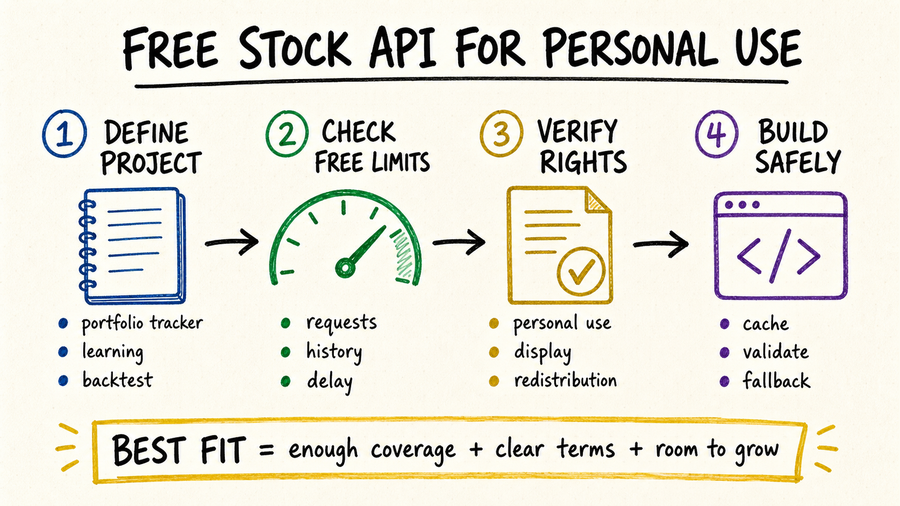
For a personal project, daily prices and a modest request allowance are often more useful than a “real-time” label with narrow coverage.
Confirm requests per minute and day, history depth, symbol coverage, delay, and whether an API key is required.
A free plan may allow private analysis while restricting dashboards, redistribution, automated downloads, or commercial use.
Cache responses, validate timestamps, isolate provider code, and keep a fallback so a hobby project survives plan changes.
What “free” should include for personal use
Do not choose from a pricing badge alone. Write down the smallest dataset your project needs, then test the free tier against that workload. A weekend portfolio tracker and a minute-by-minute backtest have very different requirements.
Check your exchanges, asset types, delisted symbols, intervals, and earliest available date. “Stocks” may mean US equities only.
Separate burst limits from daily or monthly quotas. Estimate requests for refreshes, retries, multiple symbols, and development tests.
Verify whether quotes are real-time, delayed, or end-of-day and whether historical prices account for splits and dividends.
Read the terms for private analysis, stored copies, derived results, public display, and redistribution separately. A personal account does not automatically permit publishing a dashboard.
Test missing symbols, market holidays, time zones, pagination, and error responses. A generous quota is not useful if silent gaps make the dataset hard to trust.
Match the API to your personal project
| Project | Minimum data | Priority | Common trap |
|---|---|---|---|
| Portfolio tracker | Daily close, splits, dividends | Reliable adjustments | Treating delayed data as live |
| Learning app | A few symbols and endpoints | Clear docs and stable schema | Exposing the API key in a browser |
| Backtest notebook | Long adjusted history | Bulk access and consistency | Survivorship and look-ahead bias |
| Personal alert bot | Recent quotes and timestamps | Refresh limits and latency | Polling faster than the feed updates |
Estimate quota before choosing a plan: symbols × refreshes per day × endpoints, plus room for retries and development. If a 20-symbol tracker requests quote, profile, and dividend data separately, one screen refresh can consume 60 calls rather than 20. Batch endpoints can change that calculation, so confirm whether one batch counts as one request or many.
A safe setup for a free stock API
Load secrets from environment variables and call the provider from a server, local script, or notebook. Never commit a key or ship it in public frontend code.
Daily bars do not need second-by-second requests. Cache immutable history and refresh only the newest period to preserve quota.
Convert timestamps, symbols, null values, and adjusted-price fields into your own small schema as data enters the project. Keep the raw response for debugging.
Store the provider timestamp and retrieval time, reject impossible values, and surface missing symbols instead of quietly carrying an old quote forward.
Handle 429 responses, retry hints, and daily exhaustion explicitly. Back off with jitter and show the last successful update rather than looping aggressively.
When to use QVeris
There is no single verified QVeris result that represents every free personal-use stock plan. Use the QVeris documentation to understand the execution model, then test candidate capabilities in the Playground before adding one to your project.
- Search available capabilities before committing to one provider-specific integration.
- Inspect inputs, outputs, and execution details before calling a financial-data tool.
- Keep an auditable path from an agent request to the external capability used.
FAQ
Yes, some providers offer ongoing free tiers, but coverage, delay, quota, attribution, and usage rights vary. Test the exact symbols and endpoints you need.
A few public datasets or endpoints may work without a key, but keyed APIs usually offer clearer quotas and support. Never treat “no key” as permission to scrape or redistribute.
Not necessarily. Public display and redistribution may have separate exchange or provider conditions. Check the plan terms for the exact endpoint and intended audience.
Upgrade when quota workarounds distort the product, delayed data no longer fits the use case, you need broader history, or the project becomes public or commercial.
References and next steps
Alpha Vantage API documentation
Finnhub API documentation
Twelve Data API documentation
Alpaca Market Data
Free Stock API Guide
Free Stock API Without a Key