
Free Stock API
Without an API Key
Use public CSV or JSON stock data for a quick prototype, then account for rate limits, delays, CORS, and reliability before production.
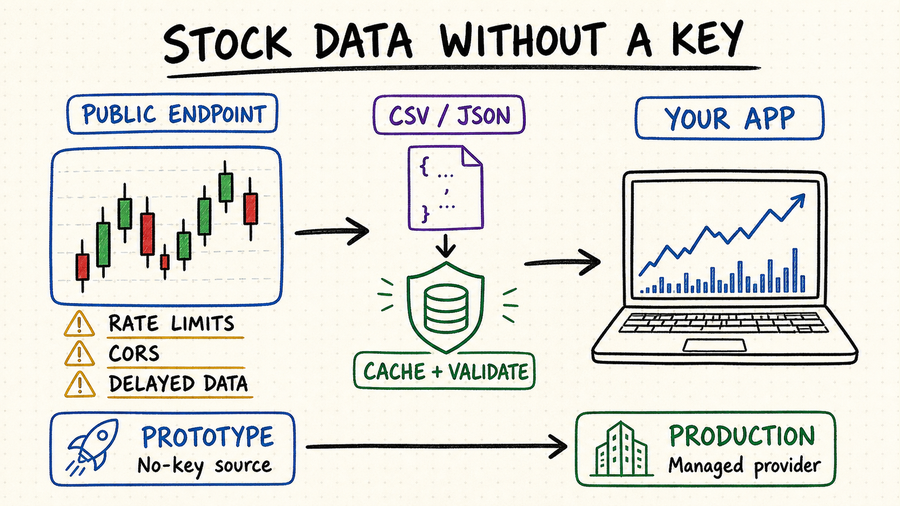
TL;DR
No-key stock endpoints are useful for demos, spreadsheets, classroom projects, and low-traffic prototypes.
Common formats include downloadable CSV files and simple JSON responses for daily or delayed prices.
Expect undocumented limits, delayed quotes, restricted symbols, unstable schemas, or blocked browser requests.
Cache responses, validate fields, identify the source, and move to a contracted provider when reliability matters.
What “without an API key” really means
A no-key endpoint accepts a request without account credentials. That removes signup friction, but it does not guarantee real-time data, unlimited calls, commercial rights, long-term availability, or browser access. Some sources are files rather than formal APIs; others use cookies, IP limits, or undocumented controls.
A stable CSV URL is often the simplest no-key source. It works well for scheduled daily imports and reproducible analysis.
JSON is easier for apps, but public endpoints may change fields or throttle traffic without notice.
Many no-key sources identify traffic by IP address. A shared cloud egress address can therefore hit a limit even when your own process sends few requests.
A URL that opens without credentials may still impose attribution, caching, automation, display, or redistribution conditions. Keep a copy of the applicable terms with the project.
Free stock data options that may work without a key
| Option | Typical format | Best for | Watch for |
|---|---|---|---|
| Stooq | CSV | Historical daily prices and lightweight research. | Symbol conventions, coverage, delay, and source terms. |
| SEC EDGAR | JSON / XML | US company filings and structured company facts. | Not a quote feed; identify your user agent and respect fair access. |
| Exchange downloads | CSV / ZIP | Official symbol lists, reports, and selected end-of-day files. | Different licenses, schemas, calendars, and retention windows. |
| Community datasets | CSV / Parquet | Learning, backtests, and offline experiments. | Stale snapshots, survivorship bias, and unclear redistribution rights. |
Evaluate a no-key source with a small acceptance test: request several valid and invalid symbols, include a market holiday, verify ascending or descending date order, compare timestamps with the stated delay, and repeat the request from the environment that will actually run the job. Browser success does not prove a scheduled cloud worker will receive the same response.
Code examples for a no-key stock data prototype
import pandas as pd
url = "https://stooq.com/q/d/l/?s=aapl.us&i=d"
prices = pd.read_csv(url)
print(prices.tail())
const response = await fetch(sourceUrl, { headers: { "User-Agent": appId } });
if (!response.ok) throw new Error(`Upstream ${response.status}`);
const csv = await response.text();
Require the expected columns, parse every timestamp in a declared time zone, reject duplicate symbol-date rows, and stop the import when an HTML error page arrives with a 200 status.
Let one backend job fetch and cache the source, then serve your application from that cache. This avoids CORS surprises and prevents every browser session from multiplying upstream traffic.
Use QVeris to find a production-ready stock API
There is no verified QVeris result dedicated to every no-key stock source. When a prototype outgrows a public file or endpoint, read the QVeris documentation and test candidate authenticated capabilities in the Playground.
- Search by capability instead of guessing provider names.
- Inspect authentication, coverage, formats, and operational constraints before writing integration code.
- Keep the no-key source as a fallback or research input only when its terms and reliability allow it.
FAQ
Usually not with dependable coverage and production guarantees. No-key sources are more commonly delayed, end-of-day, limited, or unofficial.
Only if the source permits cross-origin requests. A backend proxy is safer for caching, validation, attribution, and rate control.
The source may have changed its schema, blocked your IP, introduced authentication, or applied an undocumented traffic limit. Check the response body and source terms before retrying.
Only when the source license permits public display and your update pattern respects its access rules. Technical access alone is not permission.
References and next steps
Stooq data download
QVeris documentation
QVeris Playground
Free stock API guide