
Free Options Quote API
Evaluate bid, ask, last price, timestamps, Greeks, delay, rate limits, and licensing before you build around a free endpoint.
TL;DR
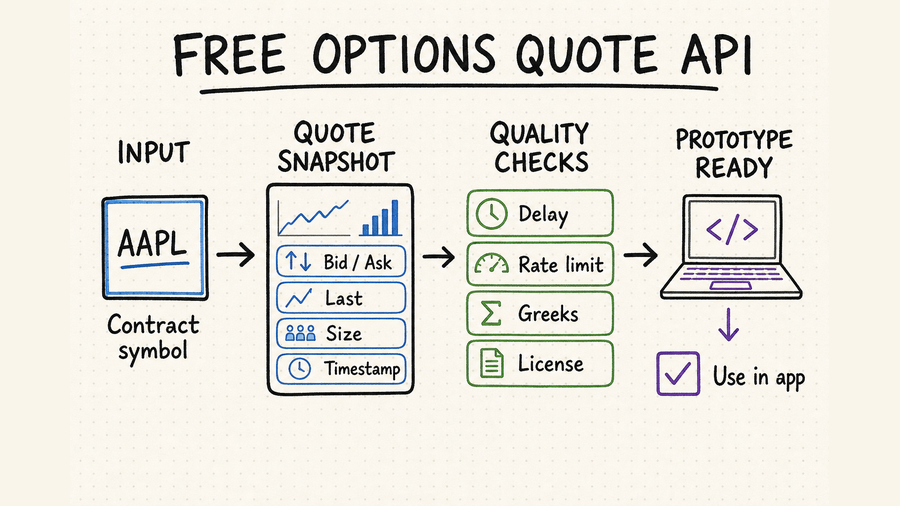
“Free” often means delayed or end-of-day quotes. Read the response timestamp, not the marketing headline.
A useful snapshot identifies the contract and returns bid, ask, sizes, last price, and an exchange or provider timestamp.
Delta, gamma, theta, vega, and implied volatility may be absent, delayed, or model-derived rather than exchange fields.
Test one liquid and one illiquid contract, then measure limits, stale data behavior, and permitted use.
Fields a useful options quote API should return
An option quote is more than a last-traded price. Your application needs enough context to distinguish a tradable market from a stale or one-sided snapshot.
Look for underlying symbol, expiration, strike, call or put type, and an unambiguous contract identifier.
Bid, ask, bid size, ask size, last price, last size, and quote timestamp form the minimum useful snapshot.
Volume and open interest help explain liquidity, while the underlying price makes moneyness and validation easier.
Identify whether the quote is consolidated, venue-specific, indicative, delayed, halted, regular-session, or extended-session. A bid and ask without source semantics can be misleading.
Quote, trade, open-interest, underlying, provider-generation, and receipt times describe different events. Preserve each available timestamp instead of collapsing them.
A consolidated quote is not the same as a venue quote
For US listed options, an API may expose a consolidated best bid and offer, one venue's top of book, or a provider-derived snapshot. Compare the documented feed with the application need. A single-venue quote can look wider or one-sided even when another venue has a better price; a consolidated quote still does not guarantee the displayed size will be available when an order arrives.
What “free” can mean for options quotes
| Free access type | What you receive | Best for | Main limitation |
|---|---|---|---|
| Delayed quotes | Bid and ask may lag the live market. | Learning, demos, non-live analytics. | Unsafe for live execution decisions. |
| Daily quota | A fixed number of requests or credits. | Small scripts and proof of concept. | Full-chain polling consumes quota fast. |
| Sandbox data | Stable samples or a few symbols. | Schema and integration testing. | May not represent live market behavior. |
| Trial access | Temporary access to paid features. | Load, coverage, and freshness tests. | Not a permanent free production tier. |
A practical free options quote API test
Use a known liquid underlying, expiration, strike, and option type. Confirm the returned contract identifier matches your input.
Record bid, ask, sizes, last price, quote timestamp, provider timestamp, and the HTTP status. Reject silently missing timestamps.
Compare freshness, crossed or locked markets, null fields, and error behavior during busier periods.
Count pages, unique contracts, missing strikes, calls and puts, quote ages, and two-sided coverage. Repeat the request to detect unstable pagination.
Test an invalid contract, exhausted quota, timeout, empty response, and partial page. Preserve the last valid quote and expose its age rather than replacing it with zero.
Multiply contracts by expirations, symbols, users, and refresh frequency, then include retries. Use streaming when available and licensed; otherwise poll only at the cadence the application truly needs.
Use QVeris to discover options quote capabilities
The exact QVeris Realtime Options Tool is the strongest verified match. Review the Alpha Vantage Provider profile, then test a known contract before assuming quote source, freshness, full-chain coverage, or entitlement.
- Inspect symbol and contract parameters, returned bid/ask fields, timestamps, and empty-result behavior.
- Save the tool ID, request, raw response, retrieval time, and quote-quality result together.
- Use the Options Chain API Guide when expanding from one quote to a full chain.
FAQ
Sometimes through a broker, limited feed, trial, or sandbox, but exchange entitlements and usage restrictions often apply. Verify the timestamp and license.
Contract identity, bid, ask, bid size, ask size, last price, and a reliable quote timestamp are a practical minimum.
No. It records a completed trade at its own timestamp and may be outside the present spread or from an earlier session.
Only as often as the application needs and the license permits. Budget by complete chains, not by one successful contract request.
References and next steps
Alpha Vantage options documentation
Market Data free accounts
Alpaca options data