
Free Options Chain API
Data, Greeks & Limits
Learn which options-chain fields matter, what free tiers omit, and how to validate a provider before your prototype reaches production.
TL;DR
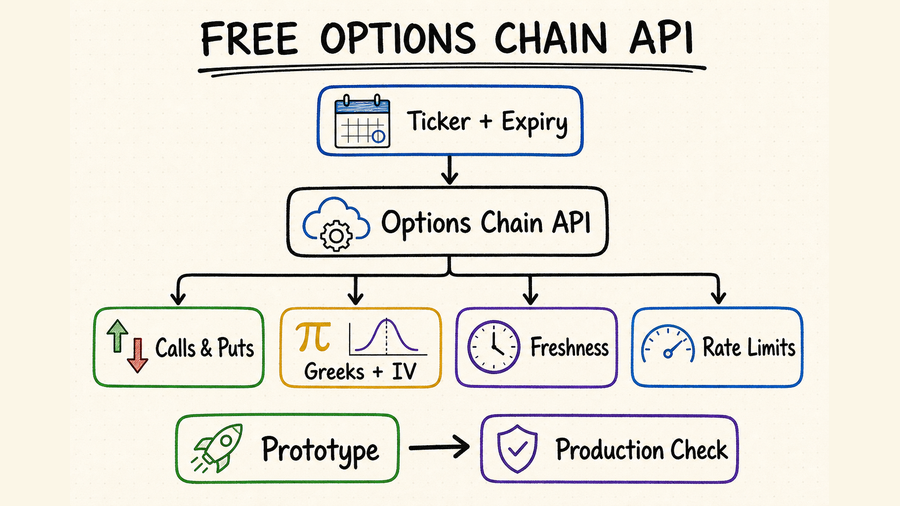
A free options chain API is usually best for learning, prototypes, screening tools, and low-frequency research.
Look for contract symbols, expirations, strikes, call/put type, bid, ask, last price, volume, and open interest.
Greeks and implied volatility save calculation work, but are often delayed, estimated, or excluded from free tiers.
Confirm licensing, exchange coverage, data freshness, rate limits, and support before using any feed in production.
Fields a useful options chain API should return
An options chain is more than a list of strikes. Your application needs enough identifiers, quotes, trading activity, and timing metadata to compare contracts without guessing what each value means.
Require the underlying symbol, OCC-style contract symbol where available, expiration date, strike price, option type, and exercise style.
Bid, ask, last price, quote timestamp, and quote condition are more useful than a single last-traded value.
Volume, open interest, bid-ask spread, and contract size help you distinguish a listed contract from a realistically tradable one.
Implied volatility and Greeks need a calculation timestamp. If possible, retain the underlying price, interest rate, dividend assumption, and model version used to derive them.
A chain response should reveal whether all expirations and strikes are present, which contracts were filtered, and how to request the next page without duplicates or gaps.
Do not force calls and puts into false pairs
Many interfaces present calls and puts beside the same strike for convenience, but listings, quote states, and returned coverage can differ by side. Key every record by its full contract identity. Treat the paired display as a view, not as the storage model, and preserve contracts that exist on only one side of an incomplete response.
What “free” usually means for options data
| Free access type | What you get | Best for | Key limitation |
|---|---|---|---|
| Delayed chain | Quotes may lag the market by minutes. | Learning, UI prototypes, end-of-day review. | Not suitable for live execution. |
| Limited requests | Low per-minute or daily quotas. | A few symbols or scheduled jobs. | Whole-market scans throttle quickly. |
| Basic fields | Contracts and quotes without Greeks or IV. | Custom analytics pipelines. | You must source rates and calculate metrics. |
| Trial access | Fuller data for a short evaluation window. | Testing schema and integration quality. | Not a permanent free plan. |
A practical API test workflow
Use a heavily traded symbol and request several expirations. Confirm pagination, expiration formats, strike ordering, and call/put pairing.
Record the response time, quote timestamp, market session, timezone, and every nullable field. A documented null is safer than an unexplained zero.
Compare expirations and contract counts with a contract-reference source. Test an adjusted contract, a weekly expiration, a zero-bid strike, and the last page of results.
Include pagination, retries, expiration discovery, underlying quotes, and per-contract analytics. Convert the quota into complete chains per refresh interval.
Force an invalid symbol, a rate-limit response, and a timeout. The application should retain the last valid chain, expose its age, and never label a partial response complete.
Use QVeris to discover options data capabilities
The exact QVeris Options Chain Tool is a direct task match. Its capability record describes calls and puts organized by expiration and strike, including last price, bid, ask, volume, and open interest. Use a small request to verify actual symbol coverage, null behavior, timestamps, pagination, and entitlement before relying on it.
- Test one known symbol and expiration in the QVeris Playground before automating a market-wide scan.
- Inspect required parameters, nested call/put structure, field types, and null states.
- Keep the tool ID, parameters, response, retrieval time, and validation result together.
FAQ
Sometimes a provider offers limited or trial access, but exchange licensing and redistribution costs make unrestricted real-time options data uncommon.
Yes. You need a pricing model plus the underlying price, strike, time to expiry, risk-free rate, dividends, and an implied-volatility estimate.
It depends on pagination and follow-up endpoints. Count every page, expiration lookup, retry, underlying quote, and contract-level analytics call.
Not by itself. Backtests require point-in-time historical chains, including expired and delisted contracts and the data known on each date.
References and next steps
Tradier option chains
Polygon options API
Alpha Vantage options documentation
Cboe delayed quotes