
Choose a Free Options Price API
for Reliable Quotes
Learn which quote fields matter, what “free” excludes, and how to validate an options pricing endpoint before you build.
TL;DR
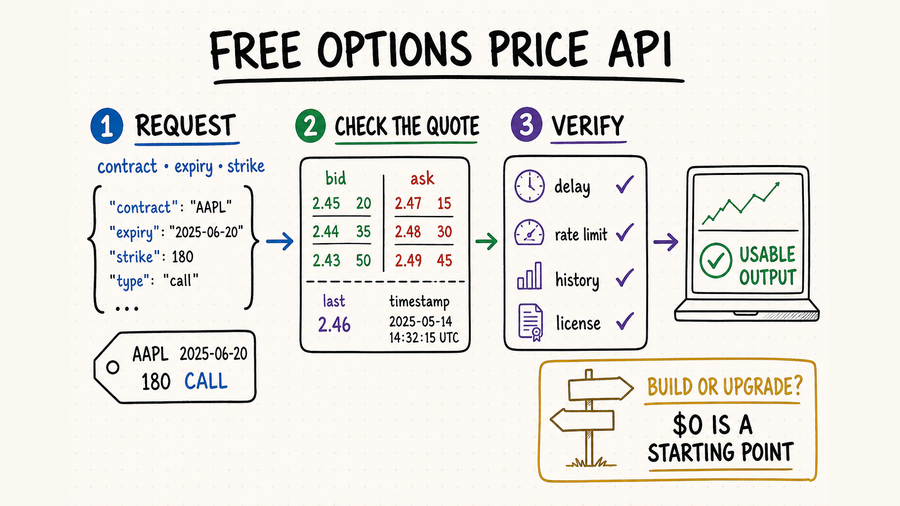
A usable endpoint returns bid, ask, last price, quote sizes, and a precise market timestamp for one contract.
Free access often means delayed data, a small symbol set, low request quotas, sandbox responses, or personal-use terms.
Never infer real-time coverage from a field name. Compare the response timestamp with the market clock and documented delay.
Estimate calls per chain, user, and refresh cycle so the production tier is known before the prototype succeeds.
Fields a free options price API should return
An options “price” is not one number. The bid and ask describe the executable market, while the last trade may be stale. Your response also needs enough contract identity and timing data to prevent a valid-looking quote from being attached to the wrong option.
Require underlying symbol, option symbol or contract ID, expiration, strike, and call/put type. Confirm the symbol format is stable across endpoints.
Capture bid, ask, bid size, ask size, last trade price, and last trade size. Derive mid-price only when both sides are valid.
Store quote timestamp, trade timestamp, timezone, session status, and data delay. A server receipt time is not a market timestamp.
Label midpoint, mark, model value, intrinsic value, and extrinsic value as calculations. Preserve the source inputs and never overwrite observed bid, ask, or trade fields.
Keep multiplier, deliverable, currency, exercise style, settlement style, root symbol, and adjustment status so the quote cannot be attached to a different economic contract.
Choose the right price for the question
Use bid and ask to describe the visible market, last trade to describe a completed transaction at its own timestamp, midpoint as a neutral reference only when both sides are valid, and a theoretical value for model comparison. None is a guaranteed fill. A historical close also needs a documented selection rule because vendors may choose last, midpoint, settlement, or a proprietary mark.
Validate an options price endpoint with real contracts
1. Test a small but difficult contract set
Use one liquid at-the-money contract, one thin wing, one near expiration, one longer-dated contract, and an adjusted contract if available. Request them during the session and after the close to reveal how quote, trade, open-interest, and mark fields behave across clocks.
2. Measure quote age and market validity
- Calculate quote age from the source timestamp, not the HTTP receipt time.
- Flag missing, zero-sided, locked, crossed, and unusually wide markets separately.
- Compare option and underlying timestamps before deriving moneyness or theoretical value.
- Retain quote condition, exchange or feed, session, and advertised delay where available.
- Do not forward-fill a missing quote across a market halt or session boundary.
3. Calculate full-chain capacity
Count contract lookups, pagination, expiration discovery, underlying quotes, retries, and refresh frequency. A free plan that comfortably prices one contract may not support hundreds of contracts per underlying. Define cache keys by contract and source time, and never hide a partial refresh behind a current timestamp.
4. Set an explicit production acceptance rule
Define maximum quote age, minimum two-sided coverage, tolerated null fields, completion time, retry rate, and allowed error classes. Preserve the last valid snapshot and show its age when a refresh fails. Verify storage, display, non-display, team, and redistribution rights before exposing prices to users or agents.
What “free” options pricing usually includes
| Access type | Typical benefit | Common limit | Good for |
|---|---|---|---|
| Free tier | Repeatable API access with a real key and documented schema. | Low daily quota, delayed quotes, limited contracts, or no history. | Prototypes and field validation. |
| Sandbox | Stable sample payloads without exchange-data obligations. | Synthetic, cached, or narrow symbol coverage. | Integration and error handling. |
| Broker access | Quotes may accompany account or paper-trading access. | Account eligibility, entitlements, and display rules. | Personal trading tools. |
| Free trial | Broader production-like coverage for a short evaluation. | Expires, may require billing details, and is not a permanent free plan. | Vendor evaluation and load tests. |
Use QVeris to discover options pricing capabilities
The exact QVeris Realtime Options Tool is the strongest verified match for this task. Inspect the Alpha Vantage Provider profile and test one contract before assuming quote freshness, full-chain coverage, history, or entitlement.
- Inspect contract identifiers, quote fields, timestamps, optional Greeks, and error behavior before integration.
- Save the tool ID, parameters, raw response, retrieval time, and quote-quality result together.
- Use the Options Chain API Guide when the workflow expands from one contract to a complete chain.
FAQ
Sometimes a broker account or limited developer plan includes access, but exchange entitlements, symbol limits, quotas, and usage rights still apply. Verify the current plan terms.
Last price can be stale. Mid-price is often more useful for analysis when both bid and ask are current, nonzero, and not unusually wide.
No. It is a model output. Keep its inputs and compare it with a valid two-sided market rather than treating it as a guaranteed fill.
Not alone. A backtest needs point-in-time historical quotes, expired contracts, corrections, and a realistic fill model.
References and next steps
Alpha Vantage options documentation
Market Data free accounts
Cboe options statistics