
Free Forex Data API
Selection and Integration Guide
Find a free forex data API, compare limits and rate meaning, test its JSON, and validate the result before integration.
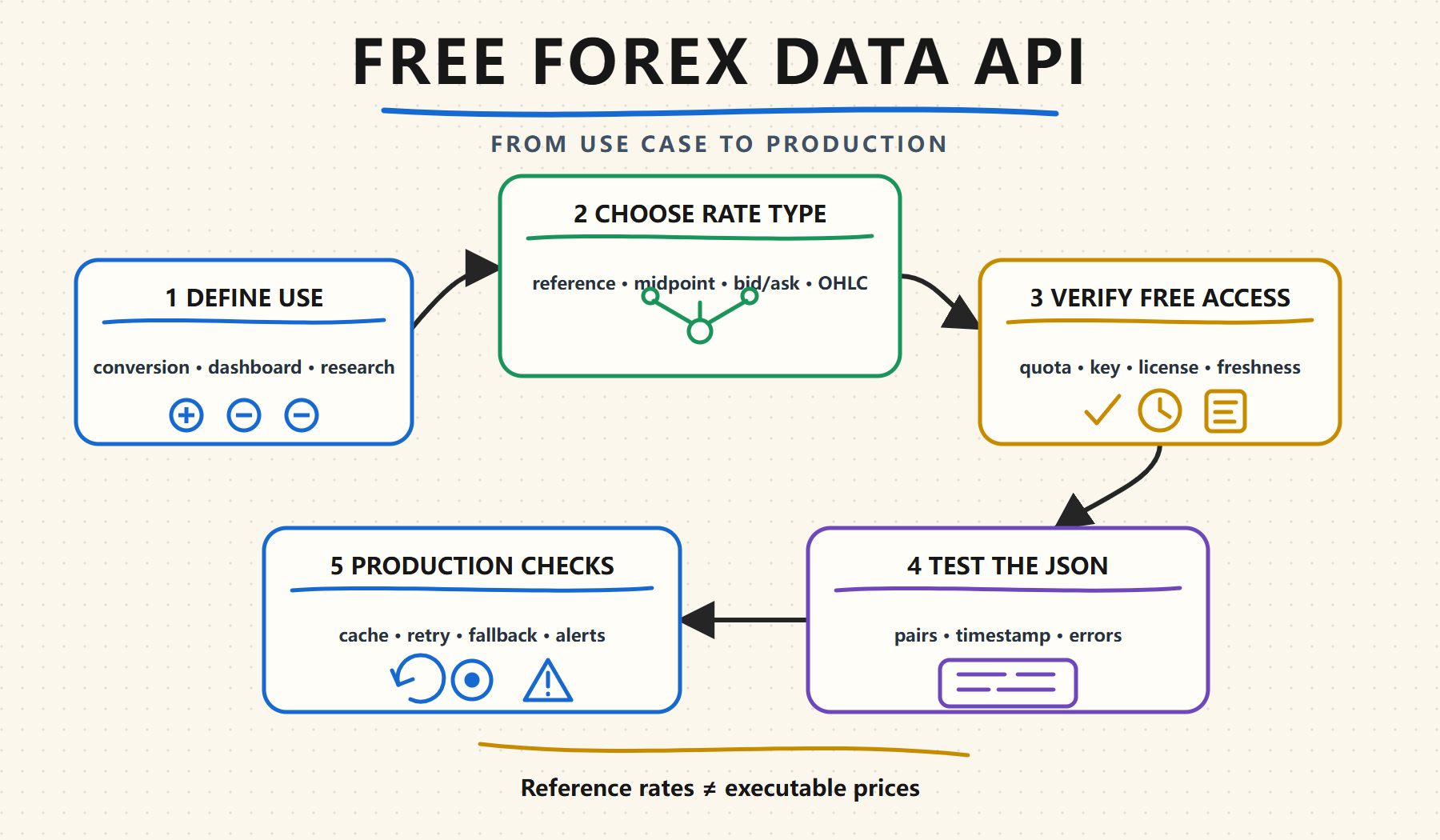
Free forex data API: what to check first
A useful free forex data API documents its rate type, source time, currency coverage, update schedule, quota, license, and errors. “Free” may mean an open endpoint, a limited plan, or a trial, so confirm the current terms first.
Define the job before choosing a forex API
Current rates, historical data, or live quotes?
“Latest” can mean a daily reference, hourly aggregate, delayed snapshot, or intraday quote. Set the acceptable data age and decide whether the application needs a reference value, midpoint, bid/ask, or OHLC history.
| Product job | Data contract to request | Common mistake |
|---|---|---|
| Accounting or daily conversion | Named reference source, effective date, publication time, base and quote. | Using a screen quote without a reproducible fixing policy. |
| Portfolio valuation | Synchronized midpoint or reference rates, valuation time, and missing-rate policy. | Mixing rates from different timestamps in one valuation. |
| Live market display | Source timestamp, cadence, bid, ask, midpoint, and stale threshold. | Calling a daily reference feed “real time.” |
| Historical research | Bar input, interval, timezone, rollover, revisions, and complete date range. | Comparing OHLC series built from different sessions or quote sides. |
| Payment or executable conversion | Executable bid/ask, size, fees, expiry, counterparty, and settlement terms. | Treating an informational midpoint as a guaranteed conversion rate. |
If the application specifically needs streaming quotes, continue with the real-time forex data guide. If it needs date ranges and bars, use the historical forex data guide. This page remains the decision layer: it helps define which contract is appropriate before a provider is selected.
Pairs, base currency, and identifiers
Check supported currencies, pair direction, base restrictions, precision, and whether crosses are direct or derived. Normalize identifiers with the ISO 4217 standard. Date-range needs belong in the historical-data guides.
Trading week, sessions, and bar boundaries
Forex trades across overlapping global sessions rather than one centralized exchange day. For intraday or OHLC data, confirm the provider's week open and close, timezone, daylight-saving treatment, daily rollover, Sunday bars, and whether an interval is built from trades, quotes, or sampled midpoints.
Compare free forex API limits and rights
No API key does not mean no restrictions
A keyless endpoint can require attribution, enforce limits, restrict redistribution, or change without a guarantee. Record the terms review date and plan for exhausted quotas or downtime.
Compare the usable dataset, not the marketing headline. Test the exact pairs, intervals, historical depth, maximum symbols per request, pagination, source timestamps, bid/ask availability, and free-plan endpoint exclusions. Estimate calls from peak users and refresh behavior; one dashboard request can fan out into dozens of pair requests.
Model requests as pairs per refresh × refreshes per hour × active hours × environments, then account for batching, retries, cache misses, health checks, and background jobs. A screen showing 30 pairs every minute can require 43,200 pair observations per day before retries; a batch endpoint may turn that into 1,440 calls, while a one-pair endpoint may not. Compare both call count and per-endpoint credit cost.
Permission to call an endpoint does not automatically allow permanent storage, public display, resale, or downstream redistribution. Record whether attribution is required, how long values may be cached, whether derived results can be stored, and whether commercial use is included. The strictest condition may come from the upstream data source rather than the API wrapper.
Save the documentation URL, plan name, reviewed date, and assumptions used in the cost model. Alert when a response loses fields or a quota header changes. A free tier is suitable for production only when the application has an explicit response to reduced limits, endpoint removal, or a required upgrade.
Choose the right forex rate type
Reference rates, aggregated midpoints, and venue bid/ask can all be valid yet differ because of fixing times, contributors, spreads, and methods. Store the rate type and source with each observation.
| Rate source | What the value represents | Suitable use |
|---|---|---|
| Official reference or fixing | A rate produced under a published schedule and methodology, often once per business day. | Reporting and conversions that explicitly adopt that reference; not intraday execution. |
| Aggregated midpoint | A vendor calculation across contributors, often with outlier and weighting rules. | Dashboards, monitoring, and valuation when methodology and freshness are acceptable. |
| Venue or dealer bid/ask | A source-specific two-sided quote that may depend on size, account, or relationship. | Spread monitoring and execution analysis when the quote is actually available to the workflow. |
| Derived cross rate | A calculation from two or more synchronized source pairs. | Coverage expansion when derivation path, timestamps, and precision are retained. |
Direct pairs and derived cross rates
Some free plans allow one base currency. A cross calculation expands coverage but adds rounding and timestamp risk. Record whether the pair was supplied directly or derived, the intermediate currency, and the precision used.
Reproducible cross-rate example: if the feed defines EUR/USD = 1.0800 and USD/JPY = 150.20 at the same observation time, then EUR/JPY = 1.0800 × 150.20 = 162.216. The inverse is JPY/EUR = 1 ÷ 162.216, not the same number with a relabelled pair. Calculate with decimal arithmetic, preserve full intermediate precision, and round only for the final display or business rule. Do not combine legs observed minutes apart during a fast market.
Bid, ask, midpoint, last, and OHLC are different fields
A tradable quote needs a bid and ask from a stated source; a midpoint is a calculation, and “last” may be undefined or vendor-specific in a decentralized market. OHLC bars also depend on input type and bar timezone. Preserve field semantics rather than collapsing every value into a generic price.
Test a free forex data API response
Provider-neutral JSON example
GET /latest?base=USD&symbols=EUR,JPY
Accept: application/json

{
  "base": "USD",
  "timestamp": "SOURCE_TIMESTAMP",
  "rates": {
    "EUR": "RATE_VALUE",
    "JPY": "RATE_VALUE"
  }
}
The endpoint and values are placeholders. Against the selected provider’s documentation, verify pair direction, source time, timezone, numeric type, missing-symbol behavior, and machine-readable errors. A server response time is not a substitute for the market observation time.
Minimum integration checks
- Validate currency codes before sending a request.
- Handle 4xx, 5xx, timeouts, and rate limits separately.
- Store source time, retrieval time, provider, and rate type.
- Use decimal arithmetic and idempotent cache writes.
- Alert on stale data, schema changes, and quota exhaustion.
Turn these checks into an evidence pack rather than an informal test. Include a common direct pair, its inverse, one derived cross, one unsupported currency, a weekend or rollover observation, and a forced quota response. Record the expected status and field semantics. A provider passes only when the application can distinguish “pair not covered,” “market observation unchanged,” “data stale,” “quota exhausted,” and “service unavailable.” Those states require different user messages and different fallback behavior.
Validate forex data before production
Reference rates are not executable prices
A reference value usually excludes bank spreads, card fees, slippage, and venue-specific bid/ask conditions. Label it accurately. Reject non-positive rates, stale timestamps, malformed responses, and unexpected pair directions before data reaches users.
Caching, retries, and fallback
Match cache duration to the provider’s update schedule. Retry only transient failures with backoff; do not retry invalid codes or exhausted quotas as network errors. Before using a fallback, normalize pair direction, timestamps, and rate type.
| Data state | How to identify it | Application response |
|---|---|---|
| Fresh | Observation age is within the contract for the active session. | Display or process it with source and “as of” time retained. |
| Quiet but valid | The source is updating, but the value has not changed within a plausible market window. | Keep the value; do not manufacture movement or mark it failed. |
| Stale | The last observation exceeds the workflow threshold even if HTTP requests succeed. | Label the age, block time-sensitive actions, and try a compatible fallback. |
| Unavailable | No valid observation exists because of coverage, quota, schema, or service failure. | Return a typed reason; never replace it with zero or an unlabeled old rate. |
Run consistency and event-window checks
Compare direct and inverse pairs within a documented tolerance, test a triangular relationship using synchronized timestamps, and inspect bars around daylight-saving changes, weekend reopen, major policy announcements, and upstream outages. Large differences can be legitimate, but the system must explain whether they come from spread, timing, source, or a broken field mapping.
How QVeris helps find a free forex data API
Open the QVeris tool details to inspect callable capabilities and inspect inputs and outputs, then follow the documentation to connect them. Provider prices, licenses, quotas, and service levels still apply.
Free Forex API questions
Yes. Public endpoints and free plans exist, but freshness, coverage, source, attribution, and quotas differ.
Yes, for reference rates and some market data. Verify whether the response is daily, delayed, intraday, midpoint, or bid/ask.
There is no universal best option. Match the provider to required pairs, freshness, source, quota, rights, and reliability.
Some endpoints are keyless, but they may require attribution, enforce limits, or restrict redistribution.
Do not treat a search converter as an official supported API. Choose a documented endpoint with explicit terms.
Not necessarily. “Latest” may be daily, hourly, delayed, or intraday; inspect the source timestamp and methodology.
A quote normally identifies bid and ask at a source and time. An exchange rate may be a daily reference, midpoint, fixing, or derived conversion value without executable liquidity.
Providers may use different timezones, rollover times, input feeds, Sunday-bar policies, and bid, ask, midpoint, or trade data to construct OHLC.
Compare the market observation timestamp with the expected session and cadence, not only the HTTP response time. Alert when source age exceeds the workflow's threshold.