
Free Real-Time Forex API: Live FX Data Guide
Test quote meaning, source clocks, delivery mode, and provider limits before relying on live FX data.
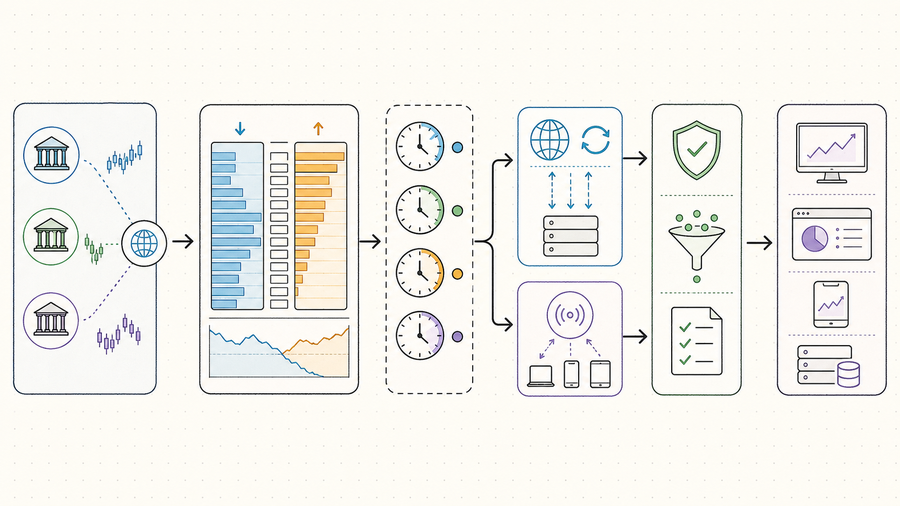
What “real time” must mean in your application
A fast HTTP response is not proof of a fresh FX quote. Compare the provider timestamp, observed update interval, market session, and receipt time before accepting a feed.
FX quote anatomy
| Field | Meaning | Validation |
|---|---|---|
| pair | Base and quote currency, such as EUR/USD | Use ISO codes and preserve direction |
| bid | Price available to sell the base currency | Must carry source and event time |
| ask | Price available to buy the base currency | Reject ask below bid unless explained |
| mid | Calculated midpoint, not an executable price | Store the formula and source bid/ask |
| timestamp | When the provider observed the quote | Do not replace it with request time |
| session | Market state or trading window | Explain weekend and holiday behavior |
Forex quote sources, bid/ask meaning, and market sessions
Spot foreign exchange is decentralized. A bank, broker, ECN, retail venue, central-bank reference source, and multi-provider aggregate can publish different valid rates at the same instant because their contributors, client tier, depth, executable size, and methodology differ. Every normalized record should identify the source and whether the quote is executable, indicative, midpoint, or reference data.
If EUR/USD is quoted at bid 1.0848 and ask 1.0852, the midpoint is (1.0848 + 1.0852) / 2 = 1.0850 and the spread is 0.0004, or 4 pips when one pip is 0.0001. A user selling EUR may face the bid, while a user buying EUR may face the ask, subject to size, venue and fees. Returning only 1.0850 removes the side and spread information needed to estimate execution. Store pair direction, bid, ask, sizes when available, source time, receipt time, venue or contributor set, and quote status.
Do not interpret an unchanged Friday quote on Saturday as a live market update. Preserve market state, last source time, expected session and the provider's holiday calendar.
Spreads and update frequency can change around the daily rollover and between regional sessions. Measure quality by session instead of averaging an entire week into one latency figure.
A valid stream can be quiet, while a broken feed can repeat an old quote with fresh receipt times. Compare source timestamps, heartbeats, related pairs and provider status before choosing the state.
REST polling or WebSocket streaming
| Mode | Good fit | Operational cost | Reject when |
|---|---|---|---|
| REST snapshot | Occasional lookup and dashboards | Quota grows with pairs × refresh rate | No source timestamp or required rate exceeds allowance |
| REST polling | Controlled periodic monitoring | Needs scheduler, backoff, and deduplication | Polling interval is faster than feed updates |
| WebSocket | Event-driven monitoring and alerts | Reconnect, heartbeat, ordering, and gap recovery | No documented replay or reconnect behavior |
Define “real time” before choosing the API
Seconds, minutes, or streaming ticks?
A dashboard refreshed every minute and an automated trading signal do not have the same requirement. Write down the maximum source age, acceptable network lag, required trading hours, and whether a missing update should pause the application. An API updated every 60 seconds may be real time for a currency widget but unsuitable for tick-sensitive logic.
REST polling or forex WebSocket API?
REST is simpler for snapshots and controlled refresh intervals. WebSocket is better when the provider pushes frequent changes, but it adds connection state, subscriptions, heartbeat handling, reconnects, duplicate events, and sequence gaps. A WebSocket URL alone does not prove low latency; measure message timestamps and continuity.
Which fields must a live FX feed return?
At minimum, require an unambiguous pair, rate type, numeric value, source timestamp, and provider or venue. Trading-oriented uses may need bid, ask, spread, and OHLC. Normalize identifiers with the ISO 4217 currency code standard, while preserving the provider’s original symbol.
Provider links and access models
| Provider | Access model | Useful for | Check before use |
|---|---|---|---|
| Alpha Vantage | API key and quota | Exchange-rate snapshots | Timestamp semantics, interval, pair coverage |
| Twelve Data | Plan-based REST/WebSocket | Multi-asset and FX workflows | Credits, streaming entitlement, symbol format |
| ExchangeRate-API | Reference-rate API | Conversion and periodic rates | Not an executable bid/ask feed |
| QVeris FX tool | Inspectable callable capability | Agent discovery and invocation | Provider identity, parameters, output contract |
Compare free live forex data API limits
| Check | Why it matters | Reject when |
|---|---|---|
| Request or message quota | Determines sustainable refresh frequency | Required calls exceed the free allowance |
| Pair and field coverage | A free tier may expose only majors or midpoint | Needed pairs, bid/ask, or OHLC are unavailable |
| Update cadence | API response speed is not data freshness | Source timestamps stay unchanged too long |
| License | Caching, display, and redistribution may differ | Planned use is not permitted |
| Operational behavior | Reconnects, status, limits, and errors affect reliability | Failures are ambiguous or impossible to recover from |
Free tier, trial, and keyless access are different
A trial expires. A free tier may continue with quotas. A keyless endpoint removes signup but can still enforce limits and usage terms. Record the plan name, verification date, monthly and per-minute limits, allowed pairs, and commercial-use rules before selecting a feed.
Calculate whether the free quota is actually usable
Estimate usage before integrating: daily calls = pairs × refreshes per minute × active minutes. Five pairs polled once per minute for eight hours require 2,400 calls a day. If one request can return all five pairs, the same workflow may need only 480 calls. Check whether the provider charges by HTTP request, returned symbol, API credit, or WebSocket subscription—these models produce very different totals.
Practical rule: leave quota headroom for retries, reconnect snapshots, monitoring, development, and traffic spikes. A design that consumes 100% of the advertised allowance during normal operation is not production-safe.
A five-request acceptance test
- 01
Known pair
Request a liquid pair and confirm base/quote direction.
- 02
Repeat
Call several times and observe whether the source timestamp changes.
- 03
Bad symbol
Verify a structured error instead of a misleading empty success.
- 04
Weekend
Confirm whether the provider freezes, rolls, or marks the market closed.
- 05
Quota edge
Exercise retry and backoff before production traffic.
Test whether forex data is really real time
Measure timestamp age and update interval
Capture at least three times for every observation: the provider’s source timestamp, the moment your client receives the response or message, and the moment your system stores it. Source age equals receipt time minus source time. Observe the feed through active and quiet periods so a single fast response is not mistaken for continuous real-time delivery.
Test REST and WebSocket separately
# Provider-neutral verification record — not a live quote
{
  "pair": "EUR/USD",
  "rate_type": "bid_ask",
  "source_time": "SOURCE_TIMESTAMP",
  "received_time": "CLIENT_TIMESTAMP",
  "transport": "rest_or_websocket",
  "sequence": "OPTIONAL_SEQUENCE"
}
For REST, record status, rate-limit headers, source timestamp, and whether repeated requests return new observations. For WebSocket, verify authentication, subscription acknowledgement, heartbeat behavior, event order, duplicate messages, reconnect recovery, and gap detection.
Reject stale, incomplete, or ambiguous quotes
Reject malformed pairs, non-positive values, timestamps outside the allowed age, and responses whose rate type cannot be identified. Do not silently convert a midpoint into bid and ask, invent a missing candle, or combine observations with inconsistent timestamps.
Run a repeatable acceptance test
- Choose two major pairs and one less-active pair supported by the free tier.
- Collect REST responses or WebSocket events through an active market window.
- Record source time, receipt time, pair, rate type, bid, ask, and sequence identifier when available.
- Calculate median and worst source age, observed update interval, duplicate rate, and missing-message count.
- Force a disconnect or timeout, then verify backoff, resubscription, snapshot recovery, and stale-data signaling.
- Compare the results with the written requirements and reject the feed if a mandatory condition fails.
Reject the feed when evidence is missing
| Claim | Evidence required | Reject when |
|---|---|---|
| Free | Permanent tier, quota, pair limit, license | Capacity cannot support the planned refresh rate |
| Real time | Source timestamp and measured update interval | Timestamp remains unchanged or lag is unknown |
| FX quote | Bid, ask, pair direction, source | Only an unexplained scalar rate is returned |
| Reliable | Error model, reconnect, limits, status | Failures are ambiguous or unrecoverable |
Integrate a real time forex API safely
Design around the free quota
Calculate the call budget from pairs × refreshes × clients. Centralize polling when several users need the same snapshot, cache no longer than the allowed freshness window, and slow down when rate-limit headers show the budget is nearly exhausted. For streams, subscribe only to pairs currently needed.
Handle market hours, reconnects, and gaps
Forex is not continuously active every minute of the week. Distinguish a closed or quiet market from a broken feed. Use exponential backoff for transient failures, restore subscriptions after reconnect, compare sequence numbers when available, and request a REST snapshot after a detected stream gap.
Keep a normalized observation record
Store pair direction, rate type, bid, ask, midpoint or OHLC, source time, receipt time, provider, transport, and whether the value was direct or derived. This makes stale-data alerts, provider fallback, audits, and later comparisons possible without losing provenance.
Set explicit go-live gates
| Gate | Evidence | Failure action |
|---|---|---|
| Freshness | Measured source age stays inside your declared limit | Mark stale and stop dependent actions |
| Continuity | Reconnect and gap recovery pass repeatedly | Resync from snapshot or fail over |
| Semantics | Bid, ask, midpoint, OHLC, and timestamps are documented | Do not infer missing meanings |
| Capacity | Normal and recovery traffic fit below the free quota | Reduce scope, cache, or choose another plan |
| Rights | Caching, display, commercial use, and attribution are permitted | Do not launch until terms are compatible |
If your use case also needs date-range candles or backtesting data, keep that intent separate and use the real-time market data guide. This page remains focused on selecting and operating a free live feed.
Inspect the FX capability contract
Use the exact tool detail to inspect pair inputs, provider identity, and returned timestamps before a call. Continue with Alpha Vantage FX tool, then confirm the calling contract in the QVeris REST API reference.
Free real time forex data API questions
Free tiers and trials exist, but pair coverage, update cadence, fields, quotas, and licenses vary. Verify the current plan and test source timestamps.
Compare source and receipt timestamps over many observations, measure update intervals, and check continuity during active market periods.
Use REST for controlled snapshots. Use WebSocket for pushed updates when you can manage subscriptions, heartbeats, reconnects, duplicates, and gaps.
Some free plans expose bid and ask; others provide only a midpoint or reference rate. Check the schema and plan entitlements.
Only if its latency, fields, continuity, license, and reliability match the bot’s requirements. A reference rate is not an executable quote.
Monitor source age, receipt lag, update gaps, reconnects, rate limits, schema changes, missing pairs, and provider status.