
Choose a Free Financial News API
Compare free financial news API options, verify coverage and usage rights, then test a structured request before choosing a provider for your app or agent.
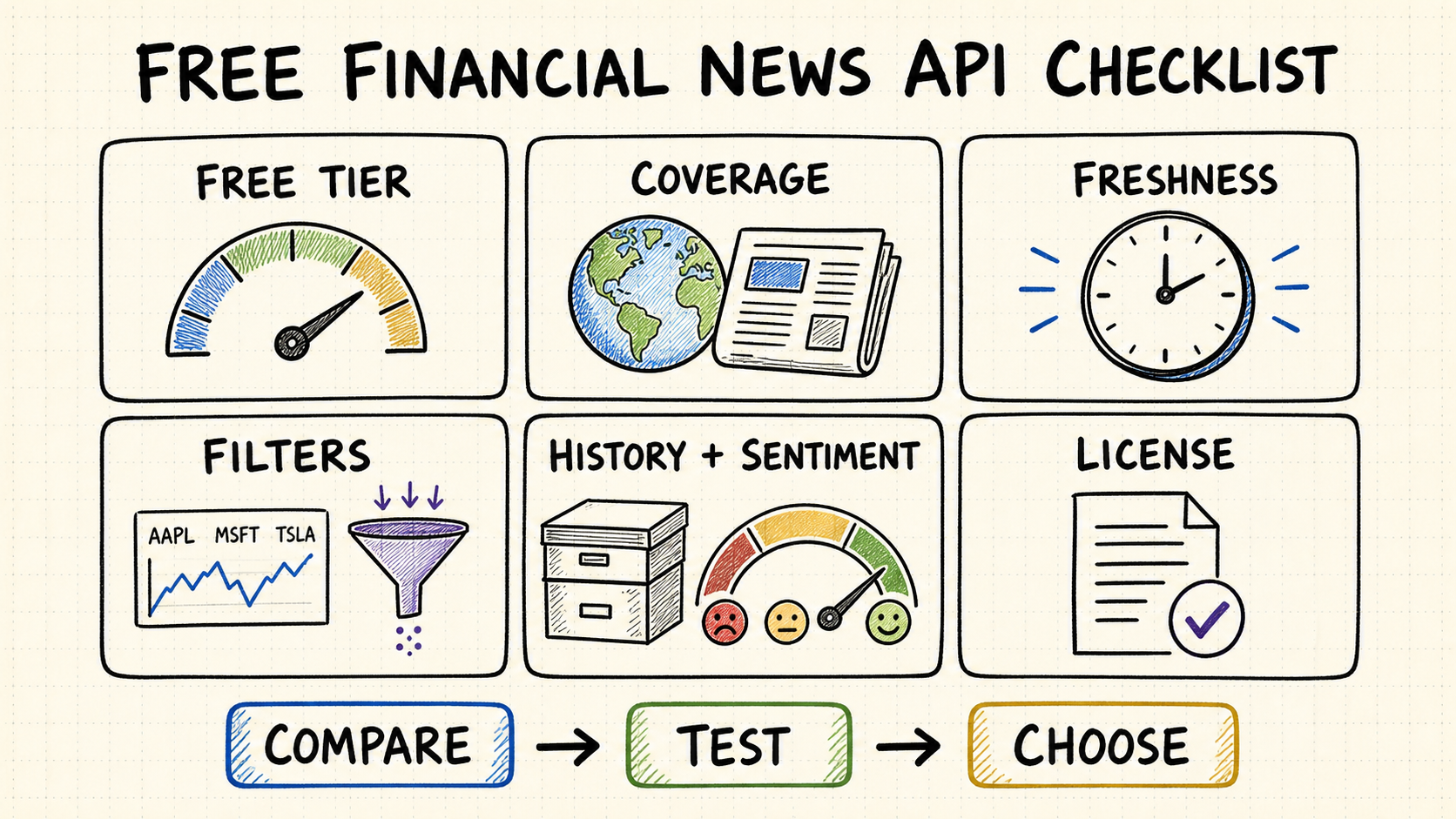
What a free financial news API should support
This is the broad provider-selection page. It helps a product team compare financial-news universes across macroeconomics, companies, markets, regions, languages, publishers, history, enrichment, and content rights. It does not attempt to teach a full Python client or focus only on stock-ticker alerts; those narrower jobs have dedicated guides.
Test macro, policy, rates, currencies, commodities, credit, private-company, and public-market queries—not only one famous ticker.
Measure distinct publishers, geographic concentration, syndication, native languages, and ingestion delay over a fixed window.
Separate permission to fetch metadata from permission to store text, display snippets, redistribute feeds, create embeddings, or train models.
Compare free financial news APIs by editorial coverage and rights
Define the editorial universe first
Decide whether the product needs macroeconomics, central banks, commodities, currencies, rates, credit, private companies, public equities, or all business news. A provider with excellent US ticker coverage may still miss policy and cross-asset events.
Audit source diversity and language coverage
Count distinct publishers over a fixed week, inspect geographic concentration, and separate original reporting from syndication. Test requested language, detected article language, and translated summaries as different fields rather than one “multilingual” claim.
Model article identity and revisions
One market event can produce an original wire story, many syndicated copies, follow-up analysis, and a later correction. Prefer stable article IDs and canonical URLs, but also retain publisher, original source, published time, updated time, language, and related-story links. Define whether corrections replace, version, or flag an earlier record.
Confirm storage, display, and model-input rights
A free response does not automatically permit full-text storage, public display, redistribution, embeddings, or model training. Record whether the API returns licensed text, snippets, metadata, or links and what attribution must accompany each use.
Separate primary documents from reporting
Filings, issuer releases, exchange notices, central-bank statements, and statistical releases are primary evidence; publisher stories add interpretation. Preserve source type and the original document link so a research agent can cite the official number while still using journalism for context.
Keep relevance, novelty, sentiment, and impact distinct
An article can be strongly negative but only mention the requested company, highly relevant but repeat an old event, or novel without being market-moving. Require separate fields or calculate them independently with documented methods. Do not rank alerts using one opaque composite score.
Score against the intended workflow
A public feed needs display rights and clean media assets; a market alert needs low tail latency and correction events; a research agent needs history, source links, and replay; an archive needs retention and redistribution rights. The same provider can be excellent for one and unsuitable for another.
| Check | Questions to answer | Evidence |
|---|---|---|
| Topics | Macro, policy, companies, markets, commodities, credit? | Fixed-query coverage matrix |
| Publishers | How diverse are sources, regions, and publication types? | Distinct-source count and sample URLs |
| Languages | Native articles, translated text, or search-language filter? | Requested and detected language audit |
| Timeliness | How long from publisher time to API availability? | Publisher and ingestion timestamps |
| Content depth | Headline, snippet, licensed full text, entities, topics? | Field-level completeness sample |
| Usage rights | May data be cached, displayed, embedded, or redistributed? | Provider terms and publisher restrictions |
Free financial news API integration example
Keep the API key outside source code
Load the key from an environment variable. Set a finite timeout and avoid printing secrets in logs or notebooks.
Validate status, content type, and fields
Raise on HTTP errors, confirm JSON content, and reject items that lack the minimum fields your application requires.
Handle pagination and rate limits explicitly
Follow documented cursors, respect 429 and Retry-After, deduplicate by stable URL or provider ID, and preserve source timestamps.
Normalize an auditable article contract
Store provider and story IDs, canonical and primary-source URLs, publisher, source type, publication, update and ingestion times, language, entities, topics, event type, rights flags, and raw-response reference. Keep enrichment versions separate from immutable source metadata.
Evaluate with a fixed evidence set
Query known company, macro, policy, rates, commodity, and cross-asset events across two languages. Add duplicates, a correction, an ambiguous entity, an irrelevant mention, and an empty query. Measure recall, false matches, source diversity, duplication, field completeness, and freshness percentiles.
Monitor coverage and contract drift
Replay the evidence set, track disappearing publishers, language mix, correction latency, cursor gaps, null fields, schema changes, quota remaining, and rights updates. A healthy HTTP response can still conceal a materially degraded or newly restricted feed.
import os
import requests

url = "https://provider.example/v1/financial-news"
response = requests.get(
    url,
    headers={"Authorization": f"Bearer {os.environ['FINANCIAL_NEWS_API_KEY']}"},
    params={"symbols": "AAPL", "language": "en", "limit": 10},
    timeout=20,
)
response.raise_for_status()
payload = response.json()

for article in payload.get("results", []):
    required = {"title", "published_at", "source_url"}
    if not required.issubset(article):
        raise ValueError("Unexpected financial news schema")
    print(article["published_at"], article["title"])
The hostname and field names are illustrative so the example does not invent a QVeris or provider endpoint. Replace them with the selected provider's current documentation. For a focused implementation walkthrough, use the free financial news API with Python guide.
How QVeris helps with financial news API discovery
QVeris helps agents discover callable capabilities and inspect their inputs and outputs. It does not guarantee that a provider is free, real-time, complete, or licensed for every use; those facts must be verified against current provider documentation.
- Open the QVeris tool details for financial or stock news capabilities.
- Inspect authentication, ticker parameters, result fields, and error behavior before connecting a workflow.
- Use the QVeris Python SDK documentation for the supported QVeris integration pattern.
FAQ
Yes. Some services expose a free tier or trial. Compare quota, delay, history, fields, supported markets, attribution, and commercial-use rules before choosing one.
Send an authenticated request with requests, pass a ticker or query, check the HTTP status, validate JSON fields, and handle pagination and rate limits.
Many finance-specific APIs expose ticker filters, but symbol formats and exchange mapping differ. Confirm parameters and test a known symbol in the current documentation.
Sometimes. Free history is often limited by date range, result count, or delayed access. Do not assume that a free current-news endpoint includes an archive.
Some return sentiment, entities, or relevance scores; others return raw articles only. Check field definitions, confidence, methodology, and supported languages.
RSS can suit permitted headline monitoring, but an API is usually easier for ticker filters, pagination, normalized JSON, history, and structured enrichment.
Authoritative references
Provider plans change. Use current documentation as evidence and treat this page as an evaluation workflow, not a promise about a specific free allowance.