
Free Crypto Price API
Data, Limits & Integration
Compare free crypto price APIs by coverage, limits, freshness, and history, then test the right REST or WebSocket path.
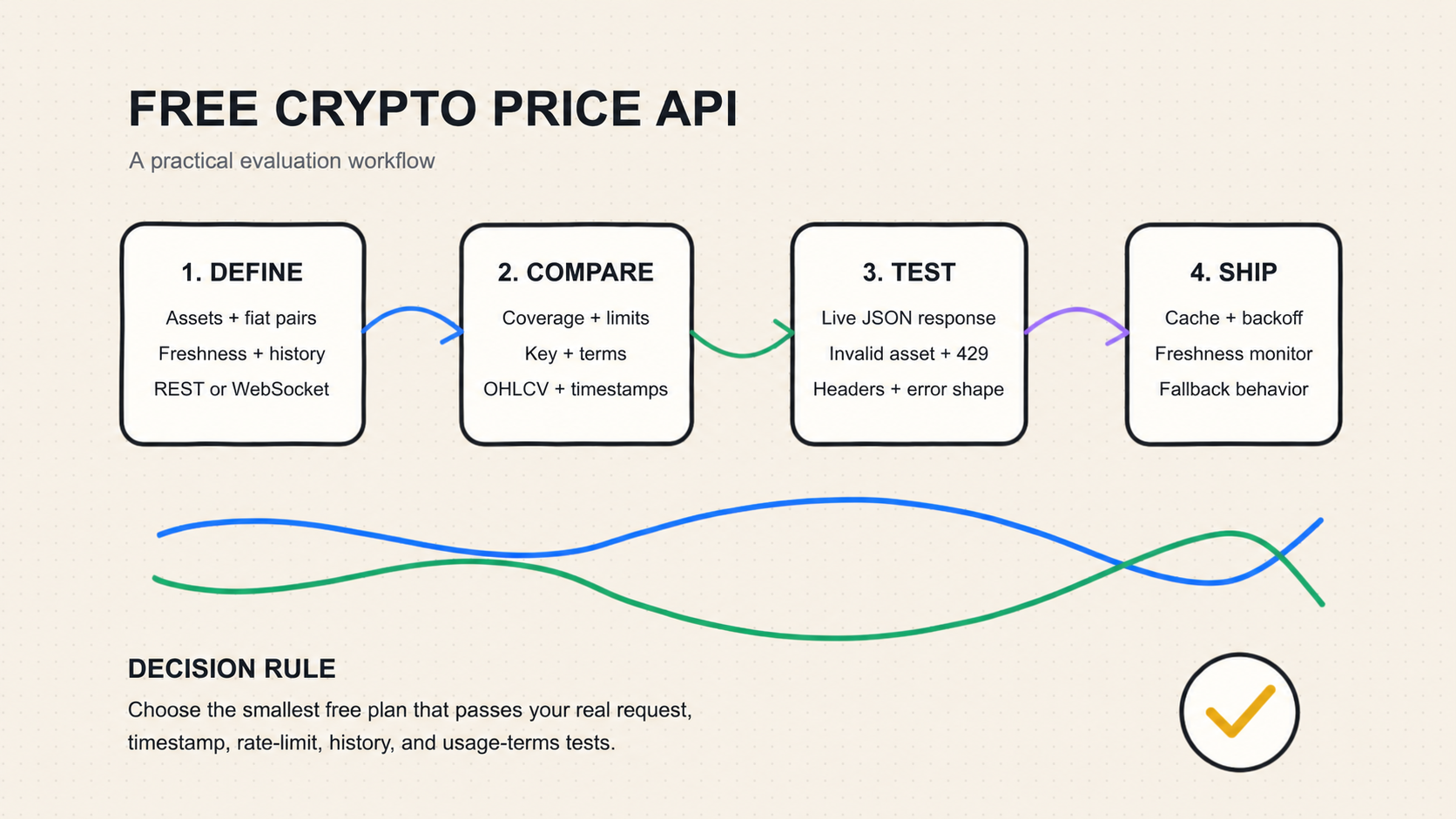
Free crypto price API: what to check first
Confirm the assets, quote currencies, market-cap fields, volume, timestamps, and historical intervals your feature actually needs.
Check requests per minute, monthly credits, attribution, caching rules, and whether commercial use is allowed.
REST suits snapshots and periodic refreshes. WebSocket is better for continuous updates when the free plan includes it.
Run one real request, inspect the timestamp and error shape, then test throttling and an unknown asset.
Define the crypto market data your app needs
The phrase “real-time crypto price API” can describe very different products. A portfolio widget may need a cached USD snapshot every minute; an alerting system may need exchange-level timestamps; a backtest needs consistent historical OHLCV rather than only the latest price.
Live cryptocurrency price API fields
List the symbol or provider ID, quote currency, price, source timestamp, 24-hour change, volume, and market cap. Treat “live” as a claim to verify: compare the response timestamp with the provider's documented update cadence.
Historical crypto price API depth
Record the earliest available date, candle interval, timezone, missing-data policy, adjustment rules, and whether OHLCV is included on the free tier. “Historical data available” may still mean a short retention window.
Match the endpoint to the product task
A provider can advertise thousands of assets and still be a poor fit if the endpoint shape does not match your workload. Decide whether the application needs one latest price, a batch market snapshot, exchange-specific trades, candles, or a continuous stream before comparing plans.
| Data task | Typical endpoint | Important fields | Common pitfall |
|---|---|---|---|
| Single asset price | /price/{id} | price, quote, timestamp | Ticker symbols may be ambiguous; many APIs require a provider-specific ID. |
| Portfolio or dashboard | /markets?ids=… | price, change, volume, market cap | Calling once per asset wastes credits when a batch endpoint exists. |
| Historical chart | /market_chart / /ohlcv | open, high, low, close, volume, interval | Free retention and interval granularity may change with the requested range. |
| Price alert | REST polling or WebSocket ticker | event time, source, reconnect state | A fast poll can exceed limits; a stream needs heartbeat and reconnect logic. |
Asset identity matters: “BTC” is usually clear, but smaller tokens can share symbols or exist on several networks. Store provider ID, symbol, contract address, network, and quote currency together.
A field named “price” is not a complete market-data definition
| Price type | Meaning | Use and limitation |
|---|---|---|
| Bid / ask | Displayed buying and selling interest on one venue, at a stated depth. | Closest to execution context, but top-of-book size, latency, fees, and slippage still matter. |
| Last trade | The most recent matched trade on the stated market. | Useful for trade history; it may be older than the current order book or unusually small. |
| Aggregated spot | A provider-defined reference combined from selected spot markets. | Good for dashboards and valuation reference; not automatically executable on any venue. |
| Index / mark price | A derivatives benchmark or risk-control value derived under venue rules. | Used for funding, margin, and liquidation logic; it is not a spot last trade. |
Worked quote state: a venue reports 62,000 bid, 62,020 ask, and a last trade of 61,980. The top-of-book midpoint is (62,000 + 62,020) ÷ 2 = 62,010, while the quoted spread is 20. The last trade can be lower simply because it occurred earlier; the midpoint is not itself an executed trade; and neither guarantees the price available for a large order. Return field type, venue, event time, received time, quote currency, size or depth where available, and market status with the number.
Test a free crypto price API with real requests
The examples below demonstrate the validation pattern rather than promising a permanent provider limit. Use the current official documentation to confirm the endpoint, authentication requirement, attribution, and production terms.
REST snapshot with curl
Request a small payload first and inspect the HTTP status, content type, timestamp, and unit before reading the price.
curl --fail-with-body \
  "https://api.coinlore.net/api/ticker/?id=90"
JavaScript validation with timeout and field checks
Treat the upstream response as untrusted input. Check status, shape, numeric parsing, and freshness before returning data to the UI.
const response = await fetch(endpoint, {
  signal: AbortSignal.timeout(5000)
});
if (!response.ok) throw new Error(`HTTP ${response.status}`);

const payload = await response.json();
const price = Number(payload[0]?.price_usd);
if (!Number.isFinite(price)) throw new Error("Invalid price");
WebSocket lifecycle checklist
For streaming feeds, verify subscribe acknowledgements, sequence or event timestamps, heartbeat behavior, reconnect backoff, resubscription, duplicate messages, and the maximum number of symbols per connection.
Evaluate crypto price data quality, not just price
Two APIs can return different but individually valid prices because they aggregate different exchanges, weight markets differently, exclude low-liquidity pairs, or update on different schedules. The goal is not to find a magical universal price; it is to choose a documented methodology that fits the product.
Compare source or event time—not only the time your server received the response.
Know whether the value comes from one exchange, a volume-weighted aggregate, or an onchain pool.
Thin markets can distort an aggregate. Check how stale or abnormal pairs are removed.
Test newly listed and inactive assets. A missing value should not silently become zero.
Use decimal-safe parsing for very small token prices and large market-cap values.
Do not assume a fixed 1.00 value when depeg detection or risk monitoring matters.
Compare free cryptocurrency API options by constraint
Compare coverage, authentication, rate limits, historical depth, REST endpoints, WebSocket availability, and usable code examples together. Provider limits change, so treat the table as a decision framework and verify the current CoinGecko API documentation, CoinLore API reference, or OKX API documentation before shipping.
| Option | Useful for | Verify before use | Access pattern |
|---|---|---|---|
| CoinGecko API | Broad price, market, metadata, and historical discovery. | Current demo-plan credits, historical depth, attribution, and commercial terms. | REST; key requirements depend on endpoint and plan. |
| CoinLore | Public market snapshots, coin metadata, exchanges, and OHLCV exploration. | Fair-use guidance, update cadence, field definitions, and production reliability. | Public REST endpoints. |
| Exchange public APIs | Venue-specific tickers, order books, candles, and streaming market data. | Symbol format, regional availability, rate limits, and whether the feed is exchange-only. | REST plus WebSocket on many exchanges. |
| QVeris Coin Price tool | Inspecting a callable crypto-price capability for agents and applications. | The provider's limits, terms, data provenance, and response semantics. | Exact tool details plus a documented call path. |
How to integrate a free crypto price API safely
Test a crypto price API without an API key
Start with a provider's documented public endpoint. Save the raw JSON, HTTP status, response headers, timestamp, and any rate-limit headers. A successful browser response is only the first test; also request an invalid symbol and repeat calls until you understand the failure contract.
Build for rate limits, caching, and fallbacks
Cache by asset and quote currency, deduplicate concurrent requests, use exponential backoff for 429 responses, and avoid embedding private keys in client-side code. Define what the UI shows when data is stale or unavailable.
Keep API keys and provider logic on the server
A backend adapter prevents secret exposure, normalizes provider-specific IDs and fields, enforces a shared cache policy, and gives the frontend one stable response contract. Restrict keys by environment and rotate them when a team member or integration changes.
Monitor the upstream contract
Track latency, HTTP status, freshness lag, schema validation failures, missing assets, cache hit rate, and monthly credit use. Alert separately on provider outage, stale-but-successful responses, and a breaking field change.
Minimal validation sequence: read the official endpoint documentation → send one request → verify fields and timestamps → test 4xx/429 behavior → add caching → monitor freshness and error rate.
Inspect and call crypto price capabilities with QVeris
QVeris helps developers and AI agents inspect and call external capabilities. For this task, start with the strongly matched Coin Price by IDs tool, then review the CoinGecko Pro provider profile for its broader crypto-data coverage.
- Inspect the Coin Price by IDs tool instead of hardcoding an unverified provider before requirements are clear.
- Inspect the selected API's parameters and response contract, then validate it directly against official provider documentation.
- When the schema is confirmed, follow the Call a capability API reference to execute the selected tool with its exact
tool_id. - Keep provider selection separate from your product logic so a limit or terms change is easier to handle.
Free crypto price API questions
Is there a free crypto price API?
Yes. Several providers offer free plans or public endpoints. Compare coverage, request limits, attribution, historical depth, reliability, and commercial-use terms before choosing one.
Can I get crypto prices without an API key?
Some providers expose keyless endpoints. They are convenient for evaluation, but you still need to review throttling, caching, reliability, and terms before production use.
How do I get real-time crypto prices via API?
Use REST for periodic snapshots or WebSocket for continuous updates. Verify the response timestamp and documented update cadence instead of assuming every “live” feed is tick-level.
Which crypto API is best for historical price data?
Choose by required date range, interval, asset coverage, OHLCV availability, timezone, and free-tier retention. Test the exact historical endpoint with your target assets.
Should I use REST or WebSocket for crypto prices?
Use REST for pages, reports, and refresh intervals measured in seconds or minutes. Use WebSocket when the product needs continuous updates and can correctly handle heartbeat, reconnect, resubscription, and duplicate events.
Can a free crypto API be used in production?
Sometimes, but “free” is not a production guarantee. Confirm commercial-use terms, attribution, uptime expectations, rate limits, support, data licensing, caching rights, and the cost of moving to a paid plan.