
Free Stablecoin Data API
Compare price and supply methodology, chain coverage, history, authentication, and free-tier limits.
Stablecoin API data model: price, supply, chains, and history
A useful stablecoin data API should tell you what the value represents, where it came from, and when it was observed. A numeric response without provenance is difficult to validate or audit.
Price, peg, and depeg signals
- Price: quote currency, venue set, aggregation method, timestamp, and cache age.
- Peg reference: USD, EUR, gold, or another asset; do not assume every stablecoin targets one US dollar.
- Depeg signal: threshold, observation window, liquidity filter, and whether the signal is calculated by the provider or your application.
Circulating supply and per-chain distribution
For multichain assets, verify whether the API identifies native contracts, canonical bridges, third-party wrapped tokens, locked bridge inventory, and excluded addresses. Summing every contract balance can double count the same economic supply.
Historical coverage and revisions
Check the earliest date, interval, timezone, missing-value policy, pagination, and whether historical records can be revised after contract mappings or methodology change. Price history and supply history may have different retention limits.
TL;DR: what “free stablecoin data API” should mean
Separate a public endpoint, an ongoing free tier, and a time-limited trial. Record the quota, authentication, license, and upgrade trigger.
Total supply, circulating supply, bridged supply, and per-chain balances are not interchangeable. Confirm how each field is calculated.
A stablecoin price may be an exchange quote, an aggregate, an oracle value, or a cached snapshot. Keep its source and timestamp.
Track stale data, missing chains, quota exhaustion, schema changes, and fallback behavior—not only HTTP success.
Reconcile stablecoin supply and depeg signals before using them
Worked supply example: do not count bridged tokens twice
Assume 1.0 billion native tokens exist on Chain A. A canonical bridge locks 200 million of them and mints 200 million representations on Chain B. Adding every visible contract balance produces 1.2 billion, but the economic supply is still 1.0 billion: 800 million freely circulating on Chain A, 200 million locked in the bridge, and 200 million corresponding representations on Chain B.
A normalized record therefore needs a relationship such as native, canonical_bridge, or third_party_wrapped, plus the backing contract and mapping version. Third-party wrappers require another decision: report them as distribution of the original asset, as a separate derivative asset, or both in separate fields. Never bury that policy inside an undocumented total.
Worked depeg example: combine price, liquidity, and time
Suppose three liquid venues show 0.997, 0.999, and 1.000 USD while one thin venue briefly prints 0.970. A minimum-price rule would trigger a severe alert, but a volume-aware median remains 0.999. A defensible monitor records every venue, excludes only by a documented liquidity rule, and requires the consolidated deviation to persist for a defined window such as five minutes before escalating.
Define both entry and recovery conditions. For example, enter a warning when the consolidated price stays below 0.995 for five minutes, but clear it only after price remains above 0.998 for ten minutes. Separate thresholds reduce alert flapping. These numbers are design examples, not universal risk limits; the peg asset, venue liquidity, product purpose, and loss tolerance determine the real policy.
Use three source layers for different claims
| Source layer | What it can support | What it cannot prove alone |
|---|---|---|
| Issuer disclosure | Authorized contracts, issuance totals, reserve reports, redemption terms, and policy changes | Current secondary-market price or complete cross-chain state |
| On-chain data | Balances, mint and burn events, bridge locks, contract activity, and block time | Off-chain reserves, legal redemption rights, or the economic owner of every address |
| Market-data API | Venue prices, consolidated quotes, volume, history, identifiers, and operational delivery | Reserve quality or guaranteed redemption at the quoted peg |
Reserve disclosure is not the same as redemption certainty. Record the reporting date, reporting entity, asset categories, auditor or attestation scope, frequency, and redemption eligibility. A historical reserve report cannot by itself establish current liquidity or a retail holder's ability to redeem directly.
Choose the right stablecoin data source type
Stablecoin-specific analytics API
Best when your product needs stablecoin lists, per-chain supply, peg history, issuer metadata, or stablecoin-specific risk fields. Verify how the provider handles bridged supply and methodology revisions.
General crypto market data API
Useful when stablecoins are one part of a broader asset universe and you need a consistent price, market-cap, volume, and metadata schema. It may offer less stablecoin-specific supply detail.
Blockchain explorer or direct on-chain API
Useful for contract events, token balances, mint and burn activity, and chain-specific verification. Your application must maintain contract mappings and define how raw events become circulating supply.
Oracle or exchange price feed
Useful for a specific market or on-chain decision. It should not automatically be treated as a complete stablecoin market dataset because supply, issuer, and cross-chain context may be absent.
How to compare a free stablecoin data API
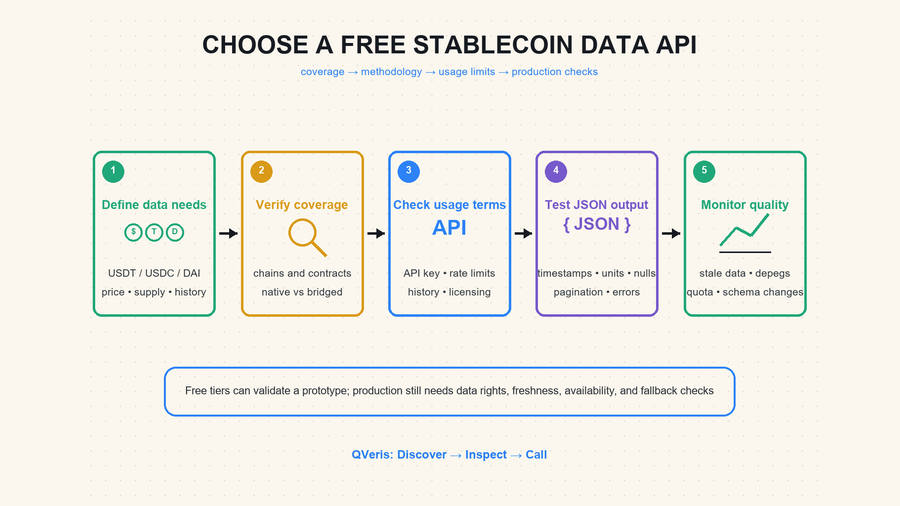
Use the same six checks for every candidate so a generous-looking free plan does not hide missing assets, stale data, restricted rights, or a weak production path.
| Criterion | Questions to ask | Failure if ignored |
|---|---|---|
| Asset coverage | Are USDT, USDC, DAI, USDe, FDUSD, and required regional stablecoins included? | Missing symbols or inconsistent identifiers. |
| Network coverage | Which chains and contract versions are mapped? Are bridged forms separated? | Incomplete or double-counted supply. |
| Freshness | What do source timestamp, cache interval, and update schedule mean? | A fast response containing stale data. |
| Free limits | Requests per minute, monthly credits, endpoint exclusions, and history limits? | Unexpected 429 errors or blocked features. |
| Usage rights | Can data be cached, displayed, redistributed, or used commercially? | A technically working but noncompliant integration. |
| Reliability | Status page, version policy, changelog, support, and fallback options? | Silent breakage after upstream changes. |
Integrate a stablecoin data API step by step
List symbols, chains, fields, historical window, refresh schedule, latency tolerance, and commercial use before choosing an API.
Record key location, quota scope, pagination, endpoint-specific pricing, error codes, and rate-limit headers.
Test a large asset, a multichain asset, a less common asset, a missing symbol, an old date, and a quota error.
Keep provider ID, contract address, chain, source timestamp, receive timestamp, units, methodology version, and raw response reference.
Align cache TTL with source updates, detect stale records, watch quota consumption, and define what the product shows during upstream failure.
Minimum normalized record
{
  "asset": "USDC",
  "chain": "ethereum",
  "contract": "provider-verified-address",
  "price": 1.0001,
  "quote": "USD",
  "circulating_supply": "provider-value",
  "source_timestamp": "ISO-8601",
  "received_at": "ISO-8601",
  "provider": "selected-provider",
  "methodology_version": "provider-version"
}
The values above are structural examples, not live market data. Use the provider’s documented identifiers, numeric precision, and timestamps.
Production checklist for stablecoin data
Freshness and data-quality controls
- Reject or mark data older than the application’s explicit freshness threshold.
- Validate quote currency, units, decimals, and negative or impossible values.
- Compare supply changes with mint, burn, and bridge events when the use case is sensitive.
- Do not turn a single venue price into a market-wide depeg conclusion without liquidity context.
Quota and error handling
Handle 400-series validation errors separately from 429 quota responses and 500-series provider failures. Use bounded retries only for retryable conditions, respect Retry-After when provided, and prevent multiple workers from causing a retry storm.
Licensing, attribution, and retention
Confirm whether the plan permits internal analytics, public display, persistent storage, derived metrics, AI-agent use, and redistribution. Technical access does not by itself grant every downstream data right.
Use QVeris to discover and inspect stablecoin data capabilities
Use the CoinGecko Pro provider details in QVeris to inspect stablecoin price, supply, and historical crypto-data capabilities before calling one. For integration, follow the QVeris REST API reference.
- Search by the required output, not only by a provider name.
- Inspect parameter schemas and declared response fields before generating code.
- Use a small representative request before connecting the capability to an agent loop.
- Verify current provider licensing, limits, and methodology in official documentation.
Free stablecoin data API FAQ
Is there a free API for stablecoin prices?
Yes. Some general crypto-data providers and stablecoin-specific services expose public endpoints or ongoing free tiers. Confirm quotas and usage rights.
Can I get stablecoin supply by blockchain?
Use an endpoint with explicit per-chain supply and contract mappings. Verify how native, bridged, locked, and wrapped supply are treated.
Does a free stablecoin API require a key?
Some public endpoints do not; other free plans require an account and API key. Never expose a private key in public browser code.
Does the free tier include historical data?
Sometimes. Price history, supply history, retention, and interval limits often differ, so inspect each endpoint rather than the plan label alone.
How do I detect a stablecoin depeg?
Define the peg reference, price sources, liquidity filters, deviation threshold, and observation window. One isolated quote is not enough.
Can a free API be used in production?
Possibly, but only after checking availability, limits, data rights, support, change policy, monitoring, and fallback requirements.