
Financial News API Free
Selection & Validation Guide
Use this financial news API free guide to compare coverage, freshness, quotas, licensing, filters, and response fields before committing to an integration.
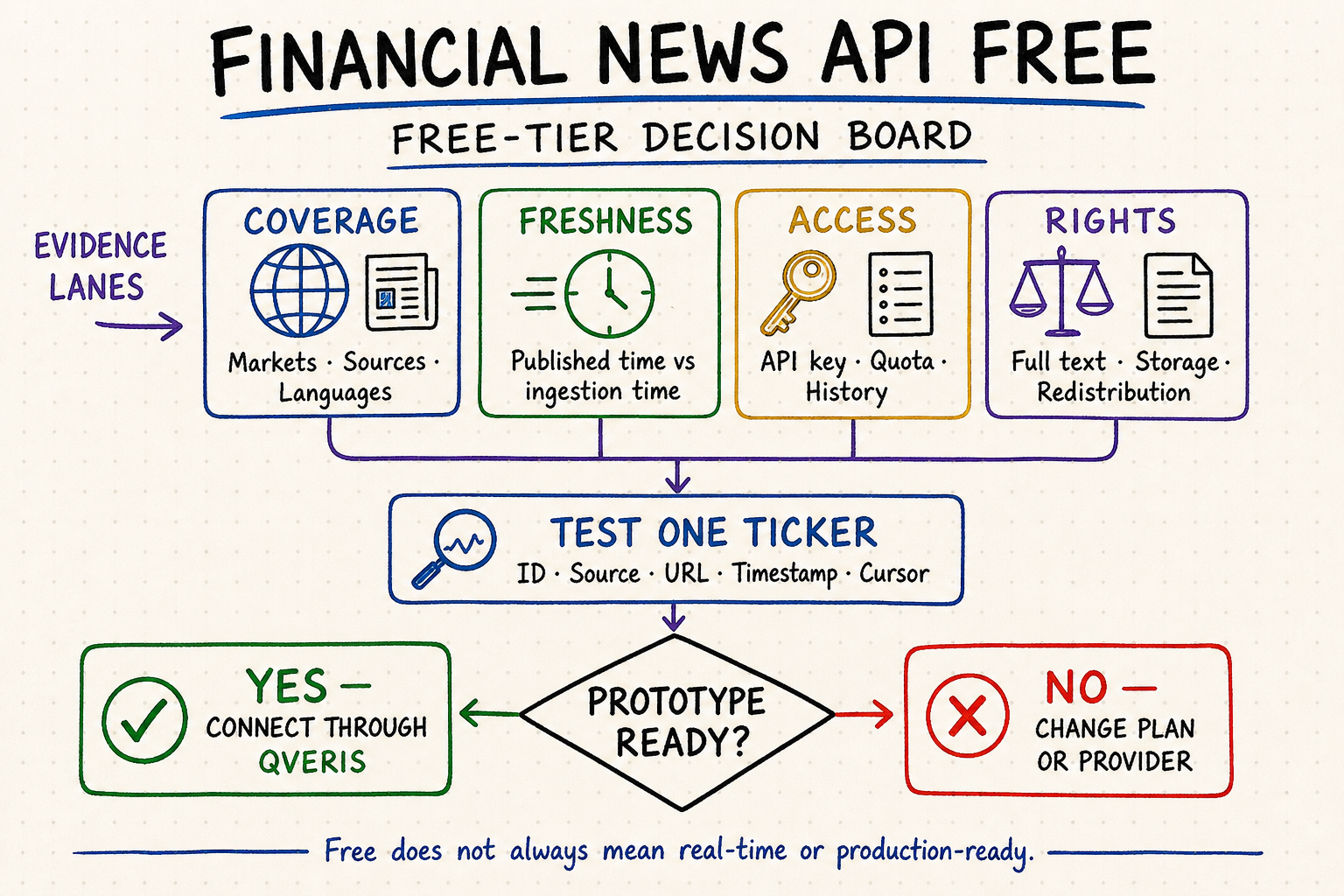
TL;DR
A useful free tier must fit the required markets, delay, request volume, content rights, and integration workflow—not merely appear on a provider list.
It may mean a permanent quota, trial, delayed feed, sample dataset, or headlines-only access. Verify the current plan.
Request one ticker and time window, then validate source, publication time, URL, pagination, and rate-limit behavior.
QVeris helps agents discover and call relevant finance capabilities; provider terms and output still require verification.
What a financial news API free plan must disclose
The word “free” does not describe whether news is live, delayed, complete, redistributable, or suitable for production. Treat the pricing page, API documentation, and license as part of the data contract.
Classify the access model before comparing quotas. A no-key public endpoint, recurring account-based free tier, time-limited trial, sandbox, sample dataset, and promotional credit are different products. Record signup and card requirements, renewal period, endpoint exclusions, regional restrictions, and what happens at the limit: HTTP 429, delayed data, paid overage, or suspension. Only a recurring allowance with documented terms should be modeled as ongoing free access; trials and credits are evaluation paths.
Financial news API coverage
Check supported markets, languages, publishers, asset classes, and whether results cover company news, macroeconomics, funds, forex, or crypto.
Real-time financial news API latency
Compare the original publication timestamp with the API ingestion time. A free endpoint may be delayed, cached, sampled, or updated on a schedule.
Free API key, quotas, and history
Record daily and monthly requests, burst limits, pagination cost, date-range limits, retention, and whether a payment card is required.
Full text and redistribution rights
A response may include only a headline, teaser, and source link. Confirm attribution, storage, display, commercial-use, and full-text rights before shipping.
Article identity and revision history
Prefer stable article and story-cluster IDs, canonical URLs, original publisher, publication and update timestamps, and correction or retraction status. Deduplicate syndication without discarding the first source or later material updates.
Entity and event semantics
Confirm whether tickers are exchange-aware, whether company relevance differs from a simple mention, and whether events such as earnings, filings, guidance, M&A, rates, and macro releases use documented labels. Keep sentiment separate from relevance and event importance.
Treat one event, many URLs, and later updates as a story cluster
Suppose a company publishes guidance at 08:00, a wire service reports it at 08:02, two portals syndicate the wire at 08:04, and the original publisher adds the CFO's explanation at 08:18. Five URLs do not necessarily represent five independent events. Cluster candidates by canonical URL, publisher lineage, normalized headline, named entities, event type, and close publication time—but retain every source record and its rights. The 08:18 article is a material update, not a duplicate to discard.
| Timestamp | Meaning | Use in evaluation |
|---|---|---|
published_at | When the publisher first made the item public | Start of publisher-to-API latency |
ingested_at | When the API captured the item | ingested_at − published_at measures delivery delay |
updated_at | When the publisher or feed materially changed it | Detect corrections, added facts, and retractions |
retrieved_at | When your application fetched the record | Diagnose polling and cache delay; it is not publication time |
Measure initial delivery and update delivery separately. An API may surface the first headline quickly but miss a correction for hours. Preserve the provider's timezone or normalized UTC value, the original timestamp string, and a flag for estimated or missing times. Never replace an unknown publication time with retrieval time, because doing so makes a late historical article appear current.
How to compare free financial news API options
| Criterion | What to verify | Useful fields | Common free-tier limit |
|---|---|---|---|
| Relevance | Ticker, entity, topic, market, source, and language filters. | symbols, entities, topics, source | Some filters or markets may be paid. |
| Freshness | Publication time, ingestion time, update cadence, and corrections. | published_at, updated_at | Delayed or cached results. |
| Content | Headline, summary, body, original URL, image, and language. | title, description, url, language | Headlines or teasers only. |
| Operations | Authentication, quotas, pagination, errors, status, and support. | next_cursor, rate-limit headers | Low quotas or development-only use. |
Test a free stock market news API before integration
Start with financial news by ticker
Query one documented symbol such as AAPL and a short date window. Confirm exchange mapping, duplicate stories, stable IDs, source URLs, and timezone handling.
Validate the financial news JSON API contract
Require a stable article ID, headline, source, URL, publication timestamp, language, and pagination marker. Treat sentiment and full text as optional unless documented.
Exercise rate limits and pagination
Follow documented cursors, handle 429 and Retry-After, set finite timeouts, retry only safe requests, and record gaps instead of interpreting them as no news.
Re-check production and commercial rights
Before launch, confirm whether the free plan permits production traffic, persistent storage, public display, model training, summarization, and redistribution.
Build a dated evaluation corpus
Use known company events, macro releases, multilingual stories, ambiguous tickers, duplicate wire copies, corrected articles, and an intentionally empty query. Measure relevant-event recall, wrong-entity rate, duplicate rate, missing fields, correction delivery, and median plus 95th-percentile ingestion delay.
Run the projected workload
Calculate requests from symbols, topics, polling intervals, active hours, pagination, and retries. Exercise the burst limit and a full quota cycle, then verify that caching and storage comply with the license. Keep capacity headroom for backfills and incident recovery.
Build an evidence packet before an AI agent summarizes the story
A production record should carry the stable article and cluster IDs, original publisher, canonical URL, headline, permitted excerpt, publication and update times, retrieved time, language, linked entity IDs, event label, relevance evidence, correction status, and content-rights flags. Store the provider response separately from extracted claims so a later correction can be traced to the exact version the agent saw.
📌 Reported fact
A value, date, action, or quotation explicitly supported by the linked source. Keep the source and passage location.
🗣️ Source interpretation
An analyst, executive, publisher, or other named source's judgment. Attribute it rather than presenting it as settled fact.
🧠 Model inference
A conclusion formed by combining evidence. Label the inference, cite the supporting records, and avoid inventing certainty when evidence conflicts.
Release gate: reject or hold the answer when the entity match is ambiguous, the source URL is missing, a material correction has not propagated, licensing blocks the intended output, or the retrieved set has an unexplained time gap. Sentiment is a secondary annotation; it must never substitute for source evidence.
How QVeris helps discover financial news APIs
QVeris is a capability routing layer, not the publisher of every financial news feed. It can help an application or AI agent discover, inspect, and call relevant finance capabilities through a consistent workflow.
- Open the QVeris tool details for financial news or related finance capabilities.
- Inspect the selected capability's parameters and response contract before the first live call.
- Keep source URLs and timestamps in downstream summaries so results remain traceable.
FAQ
Is there a free API for financial news?
Yes. Current search results include providers advertising a free tier or free access. The quota, delay, fields, history, and usage rights differ, so verify the current documentation.
Can a free financial news API provide real-time data?
Sometimes, but “free” does not guarantee real time. Measure the gap between the source publication time and API ingestion time, and check whether the plan is delayed or cached.
Can I get financial news by ticker through an API?
Many finance-focused endpoints support ticker or entity filters. Test symbol mapping, exchange identifiers, duplicates, and whether the ticker match refers to the main subject or a passing mention.
Do free financial news APIs include full article text?
Not always. Some return headlines, teasers, metadata, and a source link. Full text, history, redistribution, and commercial display may require different rights or a paid plan.
Do I need an API key for a free financial news API?
Often yes, although some endpoints are keyless. Keep keys out of client code, inspect quota headers, and never assume keyless access permits unrestricted production use.
What should I validate before using news in an AI agent?
Validate the source, URL, timestamps, entity match, pagination, missing periods, and license. Preserve citations and avoid presenting sentiment or summaries as investment advice.