
AI Document Analysis Agent with OCR and File Intelligence
Give your AI agent the ability to read, parse, extract, and reason over real-world documents through one unified capability routing layer.
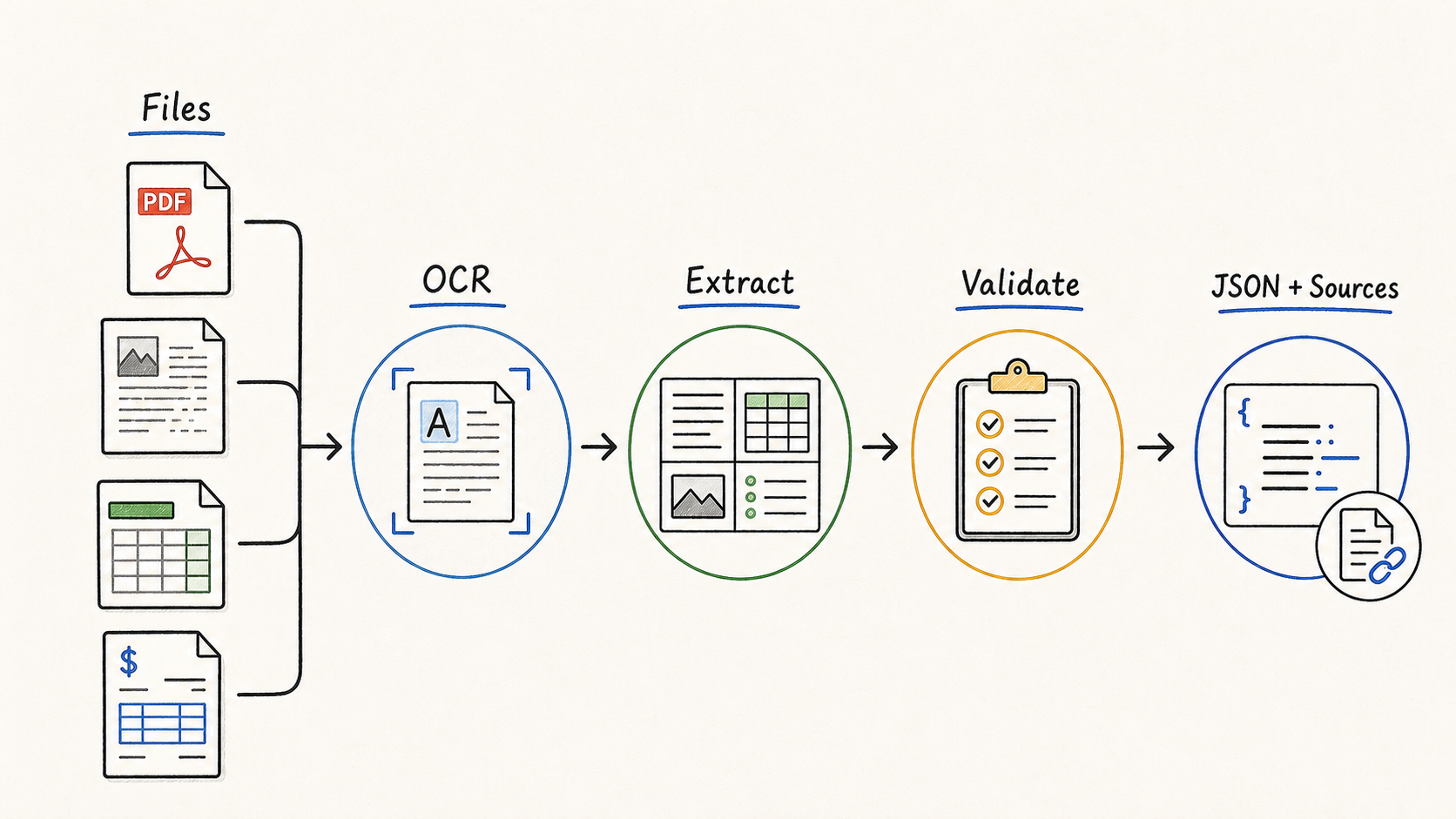
Why Document Agents Need More Than an LLM
Large language models can reason over text, but real-world document analysis involves scanned PDFs, invoices, contracts, reports, receipts, forms, tables, screenshots, and mixed-format files. An LLM alone cannot perform OCR on a scanned image, extract structured fields from a table-heavy PDF, or validate whether a document is missing required information.
QVeris connects your AI agent to real document intelligence capabilities — OCR, PDF parsing, table extraction, document classification, field extraction, and file analysis — through one unified capability routing layer, powered by the Model Context Protocol (MCP). The agent discovers the right tool, inspects its schema and cost before calling, and receives structured, review-ready output.
What QVeris Enables for Document Analysis Agents
Three capabilities every document intelligence agent needs to handle real-world files at scale.
Discover the Right Document Capability
Not every document is the same. QVeris lets the agent discover the most relevant OCR, parsing, or extraction capability for the specific file type, structure, and task — instead of hardcoding one tool.
Inspect Schema Before Execution
Before calling a capability, the agent inspects required inputs, supported file types, output fields, cost signals, and provider metadata. No blind calls to unknown document tools.
Call and Return Structured Intelligence
The agent calls the selected capability and receives structured output — extracted fields, table data, classification labels, risk notes, and missing-field flags — ready for downstream review or automation.
Example Workflow: Invoice Analysis from Start to Finish
How an AI agent uses QVeris to process a real-world document through seven structured steps.
Identify the document type
The agent inspects the file and determines it is a vendor invoice in PDF format requiring OCR and field extraction.
Discover relevant OCR or document parsing capabilities
The agent queries QVeris for capabilities matching the document type, file format, and extraction goals.
Inspect schema, inputs, outputs, latency, and cost
Before calling, the agent inspects required parameters, supported file types, expected output fields, and billing signals.
Call the selected capability
The agent executes the OCR and field extraction capability with the inspected parameters.
Extract structured fields
The agent receives structured output containing vendor name, invoice number, dates, amounts, line items, and payment terms.
Reason over missing fields and risks
The agent checks the extracted fields, identifies missing or low-confidence items, and flags potential payment risks.
Generate a review-ready brief
The agent compiles a structured brief with all extracted fields, risk notes, missing-field flags, and suggested actions for human review.
Example Structured Output
Illustrative output from a document analysis agent. Not extracted from a real private document or invoice.
This is an illustrative example. It does not represent real private documents, invoices, or customer data. All extracted outputs should be reviewed and verified by qualified humans before use in financial or legal workflows.
Common Use Cases for Document Analysis Agents
Six real-world document intelligence workflows powered by QVeris capabilities.
Invoice Processing
Extract vendor, amounts, dates, line items, and payment terms from invoices. Flag missing fields and payment risks for review.
Contract Review
Identify parties, effective dates, obligations, renewal terms, and risk clauses from contract documents through structured extraction.
Financial Report Analysis
Parse tables, extract key metrics, and structure financial data from reports, filings, and statements for downstream analysis.
Receipt and Expense Extraction
Process receipts, extract merchant, date, amount, and category, and route structured output to expense management workflows.
Form Processing
Map form fields to structured data, handle checkboxes, signatures, and handwritten inputs, and export for database insertion.
Compliance Document Review
Classify documents, extract compliance-relevant fields, and flag missing or inconsistent information for auditor review.
Why Use QVeris for Document Intelligence Agents
| Requirement | Hardcoded document APIs | QVeris capability routing |
|---|---|---|
| Tool discovery | Developers manually search and wire each OCR or parsing provider | ✓Agent discovers relevant document capabilities based on the file type and task |
| Schema inspection | Developer reads and maintains provider-specific docs | ✓Agent inspects inputs, outputs, cost signals, and supported formats before calling |
| Multi-format support | Each file type may require a separate integration | ✓Agent can route different document types to different capabilities through one layer |
| Structured output | Often raw text or provider-specific JSON | ✓Structured output with fields, risks, missing flags, and suggested actions |
| Usage visibility | Spread across multiple provider dashboards | ✓Usage history and credits ledger in one place |
Example Agent Prompt
How a developer might instruct an AI agent to use QVeris for document analysis.
Who This Is For
AI Agent Builders
Developers building intelligent document processing agents that need OCR, parsing, and extraction capabilities beyond what an LLM provides.
Operations and Finance Teams
Teams processing invoices, receipts, contracts, and reports who need structured, review-ready output without manual data entry.
Legal and Compliance Teams
Professionals reviewing contracts, regulatory filings, and compliance documents who need structured extraction with audit trails.
Platform and Workflow Builders
Teams embedding document intelligence into larger automation pipelines, dashboards, or enterprise workflows through a unified API layer.
Continue Exploring QVeris
All Tools Directory
Browse the complete catalog of AI agent tools and document capabilities.
Best MCP Tools
Discover top MCP platforms for document intelligence and data extraction.
AI Agents for Document Processing
Explore PDF parsing, OCR, extraction, and document-to-workflow automation.
Build a Document Processing Agent in OpenClaw
See a concrete implementation of document intelligence in an agent environment.
Frequently Asked Questions
What is an AI document analysis agent?
How does QVeris help with document analysis?
What file types can a document analysis agent handle?
Is QVeris a standalone OCR tool?
Can document analysis outputs be used without human review?
Does the agent inspect tools before calling them?
Start Building Your Document Analysis Agent
Use QVeris to give your AI agent access to OCR, document parsing, table extraction, and file intelligence capabilities — all through one unified layer.