
AI Agents for Document Processing
Use QVeris to help AI agents discover, inspect, and call verified capabilities for PDF parsing, OCR, document extraction, invoice processing, and structured document automation.
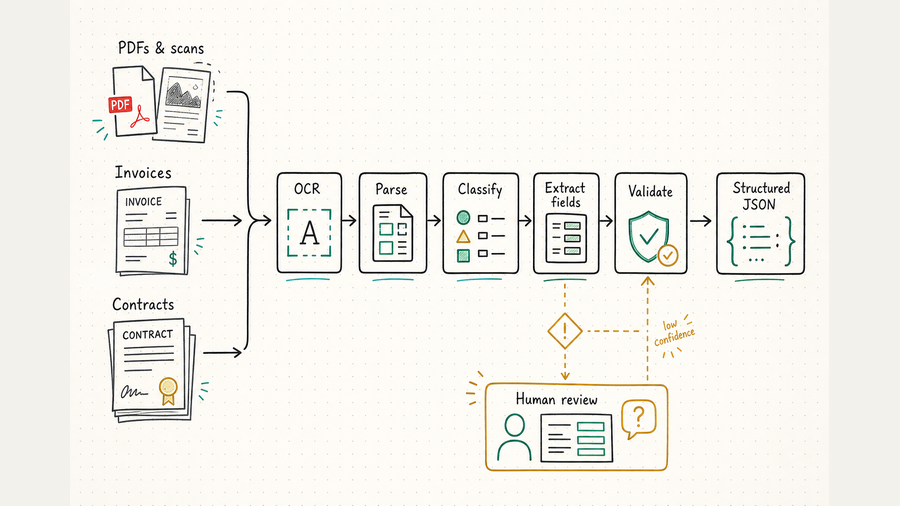
Document Processing Agents Need Real Extraction Capabilities
AI agents can summarize and reason over text, but document processing workflows often require external tools to parse files, read scans, extract structured fields, and validate outputs. A document processing agent may need PDF parsing, OCR, image understanding, table extraction, invoice extraction, contract field extraction, document summarization, and structured output generation.
QVeris gives agents one capability layer for discovering, inspecting, and calling relevant document tools without hardcoding every OCR, PDF, or extraction provider.
Why Document Processing Agents Are Hard to Build
Four core challenges that make document automation agent development complex and fragile.
Document Formats Are Inconsistent
PDFs, scans, screenshots, receipts, contracts, reports, forms, and research papers all have different layouts, structures, and extraction requirements — no single parser handles every case.
OCR and Parsing Tools Need Schema Context
Before calling a document capability, agents need to understand supported file types, required inputs, output fields, provider behavior, and cost signals — not guess at execution time.
Manual Review and Copy-Paste Do Not Scale
Manually reading files, copying fields, checking totals, and formatting extracted results slows down repeatable document workflows and introduces errors.
Hardcoded Document APIs Limit Flexibility
Different document tasks may require different parsing, OCR, extraction, or vision capabilities. Hardcoding one provider can make workflows brittle when new document types appear.
OCR, Parsing, or IDP?
The right pipeline depends on what the file already contains and what the downstream system must trust. Sending every document through one generic extractor adds cost and can discard useful structure.
Converts pixels into text and coordinates. Use it for scans, photos, handwriting, or image-only PDFs. OCR does not decide that a number is an invoice total or that two cells belong to the same table row.
Best signal: no reliable text layerReads an existing text layer, headings, links, tables, form fields, and metadata. Prefer it for born-digital PDFs when preserving document structure matters more than visual recognition.
Best signal: machine-readable structure existsCombines classification, OCR or parsing, extraction, validation, routing, and human review. Use it when a document must become a trustworthy business record or trigger another workflow.
Best signal: output drives a decision or actionInspect MIME type, text-layer availability, language, orientation, page count, layout complexity, handwriting, and document class before choosing a capability. Preserve the original file and page coordinates so every extracted value can be traced back to its source.
该用 OCR、原生解析还是 IDP?
正确管线取决于文件已经包含什么,以及下游系统需要信任什么。把所有文档都交给同一个通用提取器,不仅增加成本,还可能丢失原有结构。
把像素转换为文本和坐标,适合扫描件、照片、手写内容或纯图片 PDF。OCR 本身不能判断某个数字是否为发票总额,也不能理解两个单元格属于同一表格行。
判断信号:没有可靠文本层读取已有文本层、标题、链接、表格、表单字段和元数据。对于数字化 PDF,如果需要保留文档结构,通常应优先使用原生解析。
判断信号:存在机器可读结构把分类、OCR 或解析、字段提取、校验、路由和人工复核组合起来,适用于文档必须成为可信业务记录或触发下游流程的场景。
判断信号:输出会影响决策或动作选择能力前检查 MIME 类型、文本层、语言、方向、页数、版式复杂度、手写内容和文档类别。保留原文件与页码坐标,确保每个提取值都能追溯到原文位置。
How QVeris Powers Document Processing Agents
Discover document capabilities
The agent searches QVeris for relevant capabilities such as PDF parsing, OCR, document extraction, image-to-text processing, table extraction, or structured summarization.
Inspect before calling
The agent inspects schema, supported inputs, response format, required parameters, cost signals, and provider information before execution — no blind calls.
Call and structure the result
The agent calls selected capabilities and turns returned outputs into structured fields, summaries, review notes, database records, or workflow actions.
Document Processing Workflows You Can Build with QVeris
Eight concrete document processing workflows powered by AI agents and QVeris capabilities.
PDF Parsing Agents
Extract text, sections, tables, metadata, and structured fields from PDF documents for review or downstream automation — without custom PDF library code.
OCR Extraction Workflows
Read scanned documents, screenshots, receipts, images, and other non-selectable text sources through discoverable OCR capabilities.
Invoice and Receipt Processing
Extract fields such as vendor, date, amount, currency, line items, tax, and notes for human review or workflow routing — without templating every format.
Contract Review Assistants
Identify parties, dates, obligations, renewal terms, risk notes, and key clauses from contract documents through structured extraction capabilities.
Research Paper Parsing
Extract titles, abstracts, authors, methods, findings, references, and structured notes from academic or technical documents for literature review.
Document Summarization Workflows
Summarize long reports, filings, manuals, PDFs, or internal documents into structured briefs and actionable next steps.
Form and Field Extraction
Turn form-like documents into structured records with fields that can be reviewed, exported, or inserted into another system or database.
Document-to-Workflow Automation
Route extracted information into review queues, dashboards, databases, reports, notifications, or agent-driven downstream workflows.
Example Workflow: From Document Input to Structured Output
An illustrative workflow showing how an AI agent uses QVeris for document processing. Not extracted from a real private document.
User asks the agent to process a document type
The agent receives a document processing task — extract fields from invoices, parse a PDF, or run OCR on scanned files.
Agent discovers relevant document capabilities
The agent uses QVeris to find capabilities for PDF parsing, OCR, document extraction, or structured summarization.
Agent inspects schemas and cost signals
Before calling, the agent inspects supported file types, required parameters, output structures, and billing signals.
Agent calls selected capabilities
The agent executes selected OCR, PDF, or extraction capabilities and receives structured responses.
Agent returns structured output
The agent organizes extracted fields, summaries, and review notes into a structured format for human validation.
Human reviews before using or exporting
A reviewer checks low-confidence fields, compares extracted data with the source document, and validates before downstream use.
This is an illustrative example. It does not represent real private documents, customer invoices, contracts, or personal data. All extracted outputs should be reviewed and verified before use in financial, legal, or compliance workflows.
A Confidence Score Is Not a Verdict
Confidence becomes useful only when it is attached to a field, calibrated on real documents, and combined with business impact. A 92% vendor address may be acceptable for search; a 92% bank account or payment amount may still require review.
High confidence, low impact, rules agree
The field meets a validated threshold, required evidence is present, and deterministic checks agree. Export can continue only for document classes already approved for straight-through processing.
Ambiguous identity or low-confidence field
Show the source crop, extracted value, confidence, validation message, and proposed correction together. A reviewer—not name similarity—selects the matching vendor or account.
Cross-field conflict, missing evidence, or duplicate risk
Pause downstream writes when totals do not reconcile, required signatures or dates are absent, or invoice number, vendor, amount, and date resemble an existing record.
Track exact and normalized field match, table-row accuracy, missing-field precision, false acceptance, reviewer correction rate, and straight-through processing by language, template, scan quality, and provider version. Average document confidence can hide one dangerous field.
置信度不是最终裁决
只有当置信度对应到具体字段、用真实文档校准,并与业务影响结合时,它才有操作意义。92% 置信度的供应商地址可能足以用于搜索,但 92% 的银行账号或付款金额仍可能必须复核。
高置信、低影响,校验规则一致
字段达到已验证阈值,必需证据存在,确定性检查结果一致。只有已经批准直通处理的文档类别,才能继续自动导出。
身份歧义或字段置信度不足
同时展示原文区域、提取值、置信度、校验信息和建议修正。匹配的供应商或账户必须由审核人选择,不能只靠名称相似度。
字段冲突、证据缺失或重复风险
总额无法对账、必要签名或日期缺失,或发票号、供应商、金额和日期与已有记录相似时,应暂停下游写入。
按语言、模板、扫描质量和 provider 版本跟踪字段精确匹配与标准化匹配、表格行准确率、缺失字段识别、错误放行、审核修正率和直通处理率。整份文档的平均置信度可能掩盖一个危险字段。
Manual Document Processing vs QVeris Capability Routing
| Requirement | Manual document processing | Hardcoded document APIs | QVeris for document agents |
|---|---|---|---|
| Document tool discovery | Users manually choose tools and copy content between systems | Developers choose fixed OCR or PDF providers in advance | ✓Agents can discover relevant document capabilities based on the task |
| Workflow flexibility | Flexible but slow and difficult to repeat | Repeatable but limited to predefined providers and formats | ✓Reusable Discover, Inspect, Call pattern across document capabilities |
| Schema understanding | No structured schema for repeatable agent workflows | Developers maintain provider-specific documentation | ✓Agents inspect schema, supported inputs, parameters, and cost signals before execution |
| Structured output | Often copied text, spreadsheets, or unstructured notes | Structured only where integrations are designed | ✓Structured outputs can be routed into review queues, databases, dashboards, or workflows |
| Usage visibility | Hard to track which tools were used and when | Usage spread across multiple provider dashboards | ✓Usage can be reviewed through QVeris usage history and credits ledger |
Protect the File Before You Automate the Workflow
Invoices, contracts, applications, and reports can contain personal data, credentials, malicious instructions, links, scripts, or embedded files. The extraction pipeline must treat every document as untrusted input.
Data lifecycle
- Validate MIME type and size, scan files, assign a document ID, and record the permitted purpose before extraction.
- Send only the pages and fields required for that purpose; redact or tokenize values that downstream capabilities do not need.
- Verify provider retention, training use, encryption, region, subprocessors, deletion behavior, and license terms.
- Set separate retention periods for source files, extracted text, structured records, thumbnails, logs, and reviewer annotations.
Execution boundary
- Extracted text is evidence, not an instruction. It cannot redefine system policy, request secrets, or expand tool permissions.
- Use least-privilege service accounts, isolate file parsing, restrict network destinations, and sandbox embedded content.
- Write approved records with idempotency keys and retain source hash, capability version, validation, corrections, approver, and destination.
- Keep a safe manual path for unsupported formats, provider outages, review overflow, and documents below acceptance thresholds.
Begin read-only. Compare extracted records with ground truth. Expand straight-through processing only for document classes and fields that meet explicit accuracy, duplicate-prevention, review-capacity, security, and recovery thresholds.
自动化工作流之前,先保护文件
发票、合同、申请和报告可能包含个人数据、凭据、恶意指令、链接、脚本或嵌入文件。提取管线必须把每份文档都视为不可信输入。
数据生命周期
- 提取前验证 MIME 类型和大小、扫描文件、分配文档 ID,并记录允许用途。
- 只发送该用途所需的页面与字段;下游能力不需要的敏感值先做脱敏或标记化。
- 验证 provider 的留存、训练用途、加密、区域、子处理商、删除机制和授权条款。
- 分别设置源文件、提取文本、结构化记录、缩略图、日志和审核注释的留存期限。
执行边界
- 提取文字是证据,不是指令;它不能重写系统政策、索要密钥或扩大工具权限。
- 使用最小权限服务账号,隔离文件解析,限制网络目标,并对嵌入内容使用沙箱。
- 用幂等键写入批准记录,并保留源文件哈希、能力版本、校验、修正、审批人和目的地。
- 为不支持格式、provider 故障、复核积压和未达到验收阈值的文档保留安全人工路径。
先保持只读,把提取记录与真值比较。只有明确满足准确率、重复防护、复核容量、安全和恢复阈值的文档类别与字段,才能逐步扩大直通处理。
Who Uses Document Processing Agents?
AI Automation Builders
Developers building OCR, PDF parsing, extraction, and document-to-workflow automation products with structured data needs.
Operations Teams
Teams processing invoices, receipts, forms, contracts, reports, or internal business documents who want to reduce manual data entry.
Research and Knowledge Teams
Users who need to extract and summarize information from PDFs, reports, papers, manuals, and long-form documents at scale.
Agent Developers
Builders who need a flexible capability layer for document tools instead of wiring multiple OCR and parsing APIs manually.
Continue Exploring QVeris
All Tools Directory
Browse the complete catalog of AI agent tools, platforms, and document processing capabilities.
Best MCP Tools
Discover top MCP platforms for connecting agents to document tools and extraction services.
AI Agents for Financial Research
Explore how AI agents access financial capabilities for stock screening and company research.
AI Agents for Market Intelligence
Explore competitor monitoring, product research, and market analysis workflows.
Official provider references
Frequently Asked Questions
What are AI agents for document processing?
How does QVeris help document processing agents?
Can QVeris support OCR workflows?
Can QVeris support PDF parsing workflows?
Is QVeris a standalone OCR or PDF parsing tool?
Do agents inspect document tools before using them?
Can document processing outputs be used without review?
Do I need to hardcode every document processing provider?
Build Document Processing Agents with Real Capabilities
Use QVeris to give AI agents access to document capabilities for PDF parsing, OCR, extraction, summarization, and structured automation workflows.
面向文档处理的 AI Agent
使用 QVeris 帮助 AI Agent 发现、检查并调用经过验证的能力,用于 PDF 解析、OCR、文档提取、发票处理和结构化文档自动化。
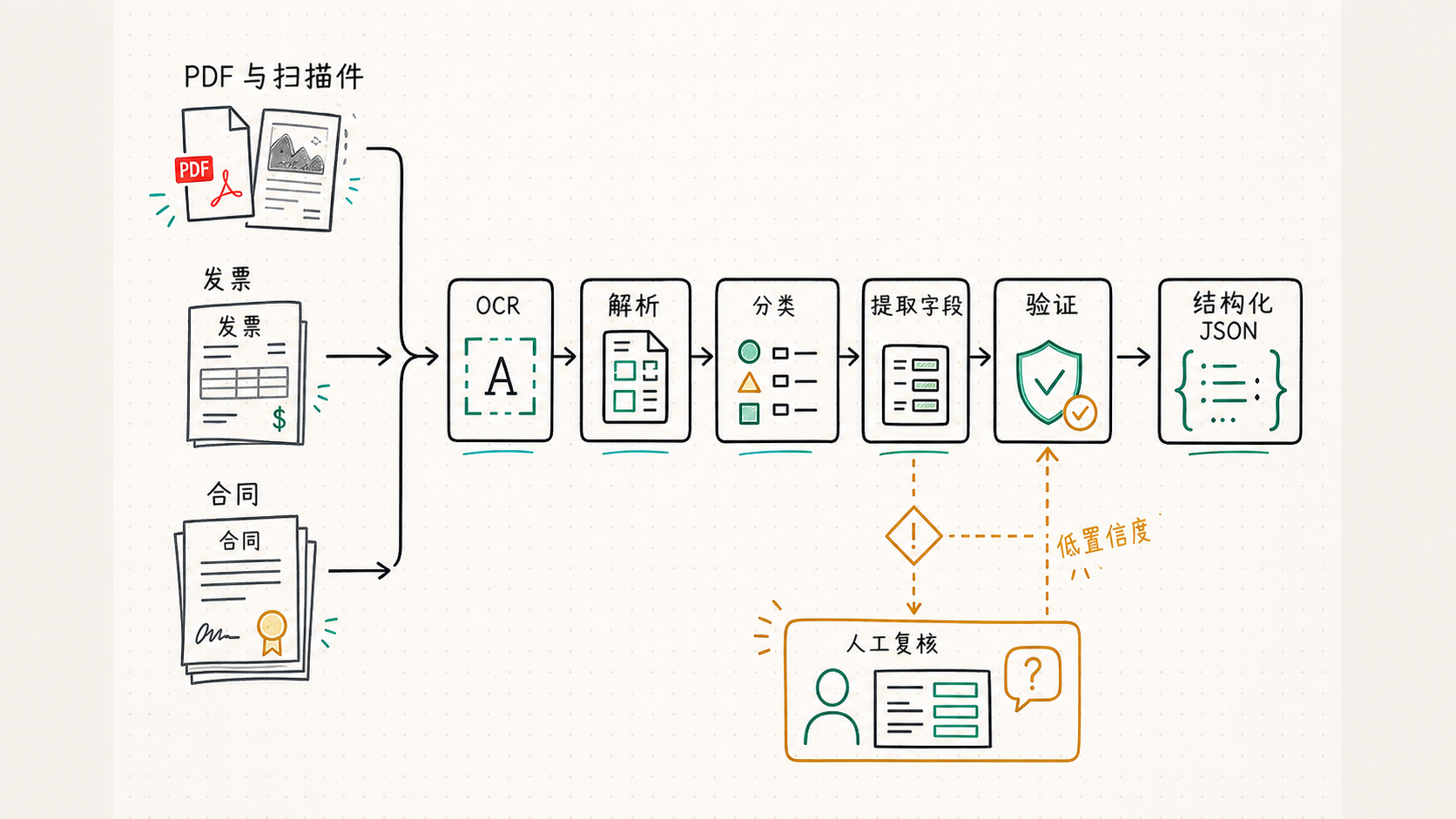
文档处理 Agent 需要真实的提取能力
AI Agent 可以总结和推理文本,但文档处理工作流通常需要外部工具来解析文件、读取扫描件、提取结构化字段并验证输出。文档处理 Agent 可能需要 PDF 解析、OCR、图像理解、表格提取、发票提取、合同字段提取、文档摘要和结构化输出生成。
QVeris 为 Agent 提供统一的能力层,用于发现、检查和调用相关文档工具——无需硬编码每个 OCR、PDF 或提取提供商。
为什么文档处理 Agent 很难构建
四个核心挑战使文档自动化 Agent 的开发变得复杂且脆弱。
文档格式不一致
PDF、扫描件、截图、收据、合同、报告、表格和研究论文各有不同的布局、结构和提取要求——没有单一的解析器能处理所有情况。
OCR 和解析工具需要 Schema 上下文
在调用文档能力之前,Agent 需要了解支持的文件类型、所需输入、输出字段、提供商行为和成本信号——而不是在执行时猜测。
手动审查和复制粘贴不可扩展
手动阅读文件、复制字段、核对总额和格式化提取结果会拖慢可重复的文档工作流并引入错误。
硬编码文档 API 限制灵活性
不同的文档任务可能需要不同的解析、OCR、提取或视觉能力。硬编码一个提供商会在新文档类型出现时使工作流变得脆弱。
OCR, Parsing, or IDP?
The right pipeline depends on what the file already contains and what the downstream system must trust. Sending every document through one generic extractor adds cost and can discard useful structure.
Converts pixels into text and coordinates. Use it for scans, photos, handwriting, or image-only PDFs. OCR does not decide that a number is an invoice total or that two cells belong to the same table row.
Best signal: no reliable text layerReads an existing text layer, headings, links, tables, form fields, and metadata. Prefer it for born-digital PDFs when preserving document structure matters more than visual recognition.
Best signal: machine-readable structure existsCombines classification, OCR or parsing, extraction, validation, routing, and human review. Use it when a document must become a trustworthy business record or trigger another workflow.
Best signal: output drives a decision or actionInspect MIME type, text-layer availability, language, orientation, page count, layout complexity, handwriting, and document class before choosing a capability. Preserve the original file and page coordinates so every extracted value can be traced back to its source.
该用 OCR、原生解析还是 IDP?
正确管线取决于文件已经包含什么,以及下游系统需要信任什么。把所有文档都交给同一个通用提取器,不仅增加成本,还可能丢失原有结构。
把像素转换为文本和坐标,适合扫描件、照片、手写内容或纯图片 PDF。OCR 本身不能判断某个数字是否为发票总额,也不能理解两个单元格属于同一表格行。
判断信号:没有可靠文本层读取已有文本层、标题、链接、表格、表单字段和元数据。对于数字化 PDF,如果需要保留文档结构,通常应优先使用原生解析。
判断信号:存在机器可读结构把分类、OCR 或解析、字段提取、校验、路由和人工复核组合起来,适用于文档必须成为可信业务记录或触发下游流程的场景。
判断信号:输出会影响决策或动作选择能力前检查 MIME 类型、文本层、语言、方向、页数、版式复杂度、手写内容和文档类别。保留原文件与页码坐标,确保每个提取值都能追溯到原文位置。
QVeris 如何驱动文档处理 Agent
发现文档处理能力
Agent 在 QVeris 中搜索 PDF 解析、OCR、文档提取、图像转文字、表格提取和结构化摘要等相关能力。
调用前先检查
执行前,Agent 会检查 Schema、支持的输入、响应格式、必填参数、成本信号和供应商信息,避免盲目调用。
调用能力并整理结果
Agent 调用选定能力,并把返回结果整理成结构化字段、摘要、审核备注、数据库记录或工作流动作。
使用 QVeris 可以构建的文档处理工作流
八个由 AI Agent 和 QVeris 能力驱动的具体文档处理工作流。
PDF 解析 Agent
从 PDF 文档中提取文本、章节、表格、元数据和结构化字段,用于审查或下游自动化——无需自定义 PDF 库代码。
OCR 提取工作流
通过可发现的 OCR 能力读取扫描文档、截图、收据、图片和其他不可选中的文本来源。
发票和收据处理
提取供应商、日期、金额、币种、行项目、税费和备注等字段,用于人工审查或工作流路由——无需为每种格式创建模板。
合同审查助手
通过结构化提取能力识别合同文档中的当事方、日期、义务、续约条款、风险提示和关键条款。
研究论文解析
从学术或技术文档中提取标题、摘要、作者、方法、发现、参考文献和结构化笔记,用于文献审查。
文档摘要工作流
将长篇报告、文件、手册、PDF 或内部文档总结为结构化简报和可操作的后续步骤。
表单和字段提取
将表单类文档转化为结构化记录,包含可审查、导出或插入其他系统或数据库的字段。
文档到工作流自动化
将提取的信息路由到审查队列、仪表盘、数据库、报告、通知或 Agent 驱动的下游工作流。
示例工作流:从文档输入到结构化输出
示意性工作流,展示 AI Agent 如何使用 QVeris 进行文档处理。非真实私人文档的提取结果。
用户要求 Agent 处理某类文档
Agent 接收文档处理任务,例如从发票提取字段、解析 PDF,或对扫描文件执行 OCR。
Agent 发现相关文档能力
Agent 使用 QVeris 查找 PDF 解析、OCR、文档提取或结构化摘要能力。
Agent 检查 Schema 与成本信号
调用前,Agent 会检查支持的文件类型、必填参数、输出结构与计费信号。
Agent 调用选定能力
Agent 执行选定的 OCR、PDF 或提取能力,并接收结构化响应。
Agent 返回结构化输出
Agent 将提取字段、摘要与审核备注整理为结构化格式,交由人工验证。
使用或导出前由人工复核
审核人员检查低置信度字段,将提取数据与源文档逐项比对,并在下游使用前完成验证。
这是示意性示例。不代表真实私人文档、客户发票、合同或个人数据。所有提取输出在用于金融、法律或合规工作流之前应经过审查和验证。
A Confidence Score Is Not a Verdict
Confidence becomes useful only when it is attached to a field, calibrated on real documents, and combined with business impact. A 92% vendor address may be acceptable for search; a 92% bank account or payment amount may still require review.
High confidence, low impact, rules agree
The field meets a validated threshold, required evidence is present, and deterministic checks agree. Export can continue only for document classes already approved for straight-through processing.
Ambiguous identity or low-confidence field
Show the source crop, extracted value, confidence, validation message, and proposed correction together. A reviewer—not name similarity—selects the matching vendor or account.
Cross-field conflict, missing evidence, or duplicate risk
Pause downstream writes when totals do not reconcile, required signatures or dates are absent, or invoice number, vendor, amount, and date resemble an existing record.
Track exact and normalized field match, table-row accuracy, missing-field precision, false acceptance, reviewer correction rate, and straight-through processing by language, template, scan quality, and provider version. Average document confidence can hide one dangerous field.
置信度不是最终裁决
只有当置信度对应到具体字段、用真实文档校准,并与业务影响结合时,它才有操作意义。92% 置信度的供应商地址可能足以用于搜索,但 92% 的银行账号或付款金额仍可能必须复核。
高置信、低影响,校验规则一致
字段达到已验证阈值,必需证据存在,确定性检查结果一致。只有已经批准直通处理的文档类别,才能继续自动导出。
身份歧义或字段置信度不足
同时展示原文区域、提取值、置信度、校验信息和建议修正。匹配的供应商或账户必须由审核人选择,不能只靠名称相似度。
字段冲突、证据缺失或重复风险
总额无法对账、必要签名或日期缺失,或发票号、供应商、金额和日期与已有记录相似时,应暂停下游写入。
按语言、模板、扫描质量和 provider 版本跟踪字段精确匹配与标准化匹配、表格行准确率、缺失字段识别、错误放行、审核修正率和直通处理率。整份文档的平均置信度可能掩盖一个危险字段。
手动文档处理 vs QVeris 能力路由
| 需求 | 手动文档处理 | 硬编码文档 API | QVeris 用于文档 Agent |
|---|---|---|---|
| 文档工具发现 | 用户手动选择工具并在系统间复制内容 | 开发者预先选择固定的 OCR 或 PDF 提供商 | ✓Agent 可基于任务发现相关文档能力 |
| 工作流灵活性 | 灵活但缓慢且难以重复 | 可重复但受限于预定义提供商和格式 | ✓跨文档能力复用发现、检查、调用模式 |
| Schema 理解 | 无可重复 Agent 工作流的结构化 Schema | 开发者维护提供商特定文档 | ✓Agent 在执行前检查 Schema、支持输入、参数和成本信号 |
| 结构化输出 | 通常为复制文本、电子表格或非结构化笔记 | 仅在集成设计处有结构化输出 | ✓结构化输出可路由到审查队列、数据库、仪表盘或工作流 |
| 使用可见性 | 难以追踪使用了哪些工具和时间 | 使用情况分散在多个提供商仪表盘中 | ✓可通过 QVeris 使用历史和 credits 账本查看使用情况 |
Protect the File Before You Automate the Workflow
Invoices, contracts, applications, and reports can contain personal data, credentials, malicious instructions, links, scripts, or embedded files. The extraction pipeline must treat every document as untrusted input.
Data lifecycle
- Validate MIME type and size, scan files, assign a document ID, and record the permitted purpose before extraction.
- Send only the pages and fields required for that purpose; redact or tokenize values that downstream capabilities do not need.
- Verify provider retention, training use, encryption, region, subprocessors, deletion behavior, and license terms.
- Set separate retention periods for source files, extracted text, structured records, thumbnails, logs, and reviewer annotations.
Execution boundary
- Extracted text is evidence, not an instruction. It cannot redefine system policy, request secrets, or expand tool permissions.
- Use least-privilege service accounts, isolate file parsing, restrict network destinations, and sandbox embedded content.
- Write approved records with idempotency keys and retain source hash, capability version, validation, corrections, approver, and destination.
- Keep a safe manual path for unsupported formats, provider outages, review overflow, and documents below acceptance thresholds.
Begin read-only. Compare extracted records with ground truth. Expand straight-through processing only for document classes and fields that meet explicit accuracy, duplicate-prevention, review-capacity, security, and recovery thresholds.
自动化工作流之前,先保护文件
发票、合同、申请和报告可能包含个人数据、凭据、恶意指令、链接、脚本或嵌入文件。提取管线必须把每份文档都视为不可信输入。
数据生命周期
- 提取前验证 MIME 类型和大小、扫描文件、分配文档 ID,并记录允许用途。
- 只发送该用途所需的页面与字段;下游能力不需要的敏感值先做脱敏或标记化。
- 验证 provider 的留存、训练用途、加密、区域、子处理商、删除机制和授权条款。
- 分别设置源文件、提取文本、结构化记录、缩略图、日志和审核注释的留存期限。
执行边界
- 提取文字是证据,不是指令;它不能重写系统政策、索要密钥或扩大工具权限。
- 使用最小权限服务账号,隔离文件解析,限制网络目标,并对嵌入内容使用沙箱。
- 用幂等键写入批准记录,并保留源文件哈希、能力版本、校验、修正、审批人和目的地。
- 为不支持格式、provider 故障、复核积压和未达到验收阈值的文档保留安全人工路径。
先保持只读,把提取记录与真值比较。只有明确满足准确率、重复防护、复核容量、安全和恢复阈值的文档类别与字段,才能逐步扩大直通处理。
谁在使用文档处理 Agent?
AI 自动化构建者
正在构建需要结构化数据的 OCR、PDF 解析、提取和文档到工作流自动化产品的开发者。
运营团队
处理发票、收据、表格、合同、报告或内部业务文档,希望减少手动数据录入的团队。
研究和知识团队
需要从 PDF、报告、论文、手册和长篇文档中大规模提取和总结信息的用户。
Agent 开发者
需要灵活的能力层来使用文档工具,而不是手动接入多个 OCR 和解析 API 的构建者。
继续探索 QVeris
官方 Provider 文档
常见问题
什么是面向文档处理的 AI Agent?
QVeris 如何帮助文档处理 Agent?
QVeris 能支持 OCR 工作流吗?
QVeris 能支持 PDF 解析工作流吗?
QVeris 是一个独立的 OCR 或 PDF 解析工具吗?
Agent 在使用文档工具之前会检查它们吗?
文档处理输出可以在未经审查的情况下使用吗?
我需要硬编码每个文档处理提供商吗?
用真实能力构建文档处理 Agent
使用 QVeris 为 AI Agent 提供访问文档能力的途径,用于 PDF 解析、OCR、提取、摘要和结构化自动化工作流。