
Best Fiscal.ai Alternatives for Investors and AI Developers
The right Fiscal.ai alternative depends on what you are replacing. Investors may want a comparable research terminal with global fundamentals, dashboards, screeners and exports. Developers may instead need a financial API, an MCP server or a multi-provider layer for an AI research agent. This guide separates those two decisions, compares realistic options, and explains when keeping Fiscal.ai is still the better choice.
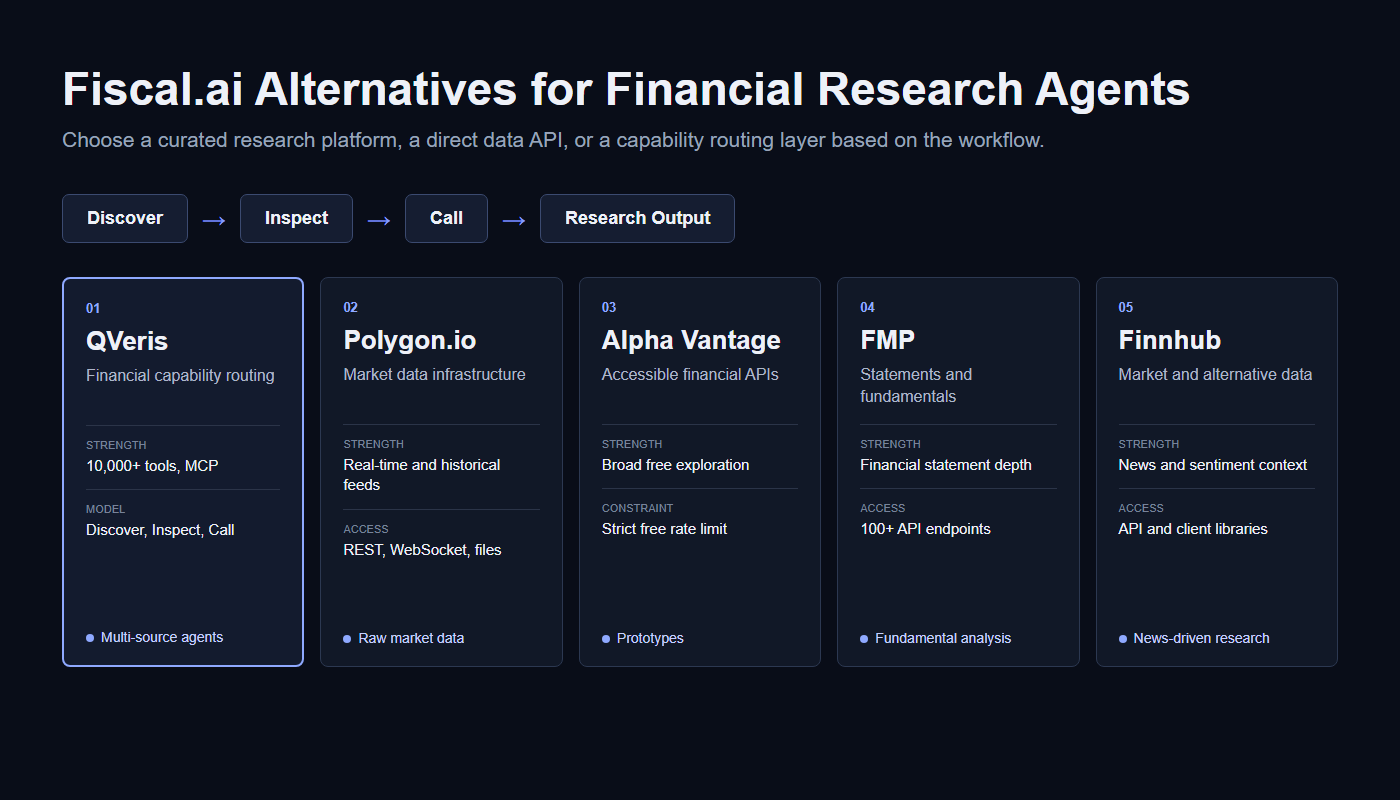
Koyfin is the closest choice for visual dashboards and multi-asset analysis; TIKR is strong for global fundamentals and estimates; Stock Rover fits North American screening and portfolio analysis; ROIC.ai offers an accessible fundamentals API and MCP path; and GeminIQ emphasizes filing-level traceability for U.S. research. Choose QVeris when the goal is not another terminal but a financial AI agent that can discover and call capabilities across multiple providers. Keep Fiscal.ai when its proprietary KPI coverage, global company universe and integrated Copilot already match the job.
What Fiscal.ai Does—and Why People Evaluate Alternatives
Fiscal.ai, formerly known as FinChat, combines a financial research terminal with an AI Copilot, company dashboards, standardized statements, estimates, filings, transcripts, screeners and proprietary segment or KPI data. It now also provides a REST API and an official MCP connector, so it should not be described as a closed, UI-only product.
As of July 2026, Fiscal.ai advertises a free terminal plan, a Pro plan at $39 per month and an Enterprise plan at $199 per month when billed monthly. The free API documentation lists up to 45 supported companies, 50 burst requests per minute and 250 requests per day. Paid commercial limits are defined by contract. Pricing, entitlements and coverage can change, so production teams should verify the official pages before purchasing or migrating.
People still compare Fiscal.ai competitors because “financial research” can mean very different workloads. A long-term investor may care about charting, estimates and portfolio dashboards; a developer may care about schemas, redistribution rights, automation and predictable API behavior. A fair comparison must separate those needs.
A developer may need to combine fundamentals with exchange-grade quotes, macro series, crypto data, sentiment, or specialized document tools. One provider rarely supplies the ideal source for every research step.
Screening thousands of companies, reacting to new filings, or running portfolio-wide research requires queues, caching, retries, and provider-aware rate handling beyond an interactive terminal workflow.
Fintech teams often need to expose data and analysis inside their own application, internal research system, or customer workflow. Licensing, redistribution rights, schemas, and latency become as important as the interface.
Fiscal.ai now has native MCP support for Claude, Cursor, and other clients. A team may still want an MCP layer that discovers capabilities across multiple sources instead of exposing one provider’s endpoint catalog.
Research terminals commonly price by plan or seat, while APIs may charge by endpoint, request, data entitlement, or commercial license. Agent workloads benefit from comparing total execution cost rather than subscription price alone.
The decision should begin with the workload. A human analyst using dashboards has different needs from an autonomous process that evaluates 500 companies overnight and writes results into a proprietary application.
Best Fiscal.ai Alternatives for Investors and Analysts
These products are the most relevant choices when the search intent is “replace the Fiscal.ai research experience,” rather than “assemble a new data stack.” None is a perfect clone. The useful question is which Fiscal.ai job—visual analysis, global fundamentals, screening, source verification or AI-assisted research—matters most.
Koyfin: Best for Dashboards and Multi-Asset Research
Koyfin is a strong direct alternative for analysts who value configurable dashboards, charting, watchlists and cross-asset context. It is closer to a visual research workstation than an API platform. Choose it when macro, equities, funds and portfolio views need to live in one polished interface.
Trade-off: Koyfin is not designed as a public API or MCP-first infrastructure layer. Teams building autonomous agents will still need another programmable data source.
Best for: investors replacing Fiscal.ai’s visual workspace rather than its AI or developer access.
TIKR: Best for Global Fundamentals and Estimates
TIKR is a practical option for investors comparing global companies, historical financials, valuation multiples, analyst estimates and earnings information. It competes more directly with the research-terminal side of Fiscal.ai than a raw market data API does.
Trade-off: TIKR’s main value is the analyst interface. It is not a substitute for a cross-provider MCP catalog or an embedded agent execution layer.
Best for: fundamental investors who need international coverage and forward estimates in a familiar research workflow.
Stock Rover: Best for Screening and Portfolio Analytics
Stock Rover focuses on deep screening, portfolio analytics, custom metrics and comparative research for North American equities. It is useful when the reason for leaving Fiscal.ai is a need for more filtering depth or portfolio-centered analysis rather than conversational AI.
Trade-off: geographic scope is narrower than Fiscal.ai’s global company coverage, and it is not an API-first agent platform.
Best for: investors who prioritize repeatable screens, watchlists and portfolio diagnostics.
ROIC.ai: Best Free-Entry Option for Fundamentals, API and MCP
ROIC.ai is relevant to both investors and developers because it combines financial-statement research with programmatic access. It can be a lower-friction starting point for teams that want to query fundamentals from an AI client without adopting a broad routing platform.
Trade-off: free access, history depth, real-time entitlements and commercial usage vary by plan. Verify the current contract against the exact companies and periods required.
Best for: individual researchers and prototypes that want a fundamentals-focused Fiscal.ai API or MCP alternative.
GeminIQ: Best for U.S. Filing Traceability
GeminIQ is a focused alternative for researchers who want to trace reported numbers back to filing data and inspect U.S. company fundamentals with a stronger primary-source orientation. That is a different value proposition from Fiscal.ai’s global Copilot and proprietary KPI layer.
Trade-off: it is less suitable when conversational research, global coverage and company-specific KPI depth are the primary reasons for using Fiscal.ai.
Best for: U.S.-focused analysts who put auditability and as-filed evidence ahead of a broad AI terminal.
Best Fiscal.ai API and MCP Alternatives for Developers
A developer replacing Fiscal.ai may not need another analyst terminal. The alternatives below are building blocks for custom products, scheduled research, embedded analytics and financial AI agents. Compare them by data rights, latency, coverage, rate limits and orchestration burden—not by the number of dashboard features.
1. QVeris: Fiscal.ai Alternative for Financial AI Agents
QVeris is a financial capability routing network for AI agents. It does not try to replace a research terminal with another dashboard. Instead, it gives agents one workflow for finding and executing financial tools:
This approach is useful when a research agent needs different sources for different stages. A single workflow may require company fundamentals, a live quote, an SEC filing, an earnings transcript, macroeconomic context, and market news. With direct integrations, developers must maintain multiple credentials, schemas, retry policies, and provider-specific clients. QVeris places discovery and routing above those capabilities and exposes the same model through MCP, Claude Desktop, Cursor, OpenCode, a Python SDK, and REST.
Discover and Inspect are always free. The current program includes 1,000 signup credits and 100 daily login credits, while Call consumes credits according to the capability. Developers should confirm current limits on the pricing page because offers can change.
from qveris import QVeris

client = QVeris(api_key="YOUR_API_KEY")

tools = client.discover("latest SEC filing and revenue trend for NVDA")
schema = client.inspect(tools[0]["capability_id"])
result = client.call(
    tools[0]["capability_id"],
    {"ticker": "NVDA", "period": "annual"}
)

print(result)
The example illustrates the intended pattern; developers should use the exact current SDK methods from the official documentation. QVeris is strongest when the research process spans many capability categories. If a team only needs Fiscal.ai’s curated fundamentals and filing-linked data, using Fiscal.ai directly may be simpler.
Best for: developers and fintech teams that want to build a financial research agent with dynamic tool selection and unified execution.
2. Polygon.io: Fiscal.ai Alternative for Raw Market Data
Polygon.io is a developer-focused market data platform. Its stock offering covers real-time and historical prices, trades, quotes, aggregates, reference data, corporate actions, news, and data from major U.S. exchanges and reporting facilities. Developers can use REST APIs, WebSocket streams, and flat files, making it suitable for research systems that need detailed or low-latency market observations.
Polygon.io is often a better fit than a research terminal when the application needs raw market events, historical bars, or streaming prices. The tradeoff is integration responsibility. Developers still design their own research abstractions, combine fundamentals or filings from other providers, map schemas, and decide which endpoint an agent should call. It is a data source rather than a cross-provider agent routing layer.
Best for: trading, charting, alerting, backtesting, and research products that need reliable underlying market data.
3. Alpha Vantage: Budget Fiscal.ai Alternative
Alpha Vantage provides APIs for global equities, options, forex, crypto, commodities, economic indicators, fundamentals, and technical indicators. Most endpoints can be explored with a free API key, which makes it attractive for prototypes, student projects, and individual developers.
The standard free limit is currently 25 requests per day, and real-time or delayed U.S. intraday data may require a premium entitlement. Those constraints make large batch jobs difficult. Coverage is broad, but developers must understand separate endpoint functions and handle throttling carefully. Alpha Vantage now also documents MCP-related integrations, so it should not be described as purely legacy REST; however, it does not provide the same cross-provider capability discovery model as QVeris.
Best for: low-budget experiments, proof-of-concept applications, technical indicators, and modest research tasks.
4. Financial Modeling Prep: Fundamentals-Focused Fiscal.ai Alternative
Financial Modeling Prep, commonly called FMP, offers a large financial data API catalog covering income statements, balance sheets, cash flows, ratios, historical prices, company profiles, news, SEC filings, earnings transcripts, insider activity, and other datasets. Its depth in standardized financial statements makes it useful for valuation models and fundamental screening.
FMP’s current documentation advertises more than 100 endpoints and a free Basic tier with 250 calls per day. Paid plans raise limits and unlock additional history and coverage. Developers still need to select endpoints, normalize outputs, and build the orchestration layer that turns data into an agent workflow. FMP is an effective direct API source, but AI agent discovery is not its central abstraction.
Best for: analysts and developers building statement analysis, valuation, screening, and company fundamental workflows.
5. Finnhub: News and Alternative-Data Fiscal.ai Alternative
Finnhub provides real-time market data, company fundamentals, economic data, news, estimates, ownership information, and alternative datasets. Its company news endpoint offers historical and current North American company news on the free tier, while some sentiment and premium feeds require paid access. Official client libraries are available for Python, JavaScript, Go, and other languages.
Finnhub is useful when a research agent needs news context, market status, or sentiment-related inputs alongside standard company data. As with other direct APIs, the developer is responsible for matching user intent to endpoints, controlling tool schemas, and combining results from other providers. It supplies strong ingredients but not a general capability discovery layer.
Best for: applications that combine market data with company news, event context, estimates, or alternative signals.
Fiscal.ai Alternatives Comparison: Terminal vs API
Do not compare a dashboard product and an API as if they solve the same problem. The first table covers ready-to-use research experiences; the second covers infrastructure for developers.
| Platform | Primary strength | Market scope | AI / natural language | API or MCP | Best reason to choose it |
|---|---|---|---|---|---|
| Fiscal.ai | Global fundamentals, KPIs and Copilot | Global; 100,000+ securities advertised | Yes | REST API + MCP | Keep it for an integrated AI research terminal |
| Koyfin | Dashboards, charting and multi-asset context | Global, multi-asset | Not the main workflow | Not API-first | Visual investment research |
| TIKR | Global fundamentals and estimates | Global equities | Not the main workflow | Not API-first | Company comparison and valuation |
| Stock Rover | Deep screening and portfolio analytics | United States and Canada | Limited | Not API-first | Repeatable screens and portfolio review |
| ROIC.ai | Fundamentals with programmatic access | Global company data | Through compatible AI clients | API + MCP | Free-entry fundamentals workflows |
| GeminIQ | As-filed and XBRL-oriented traceability | U.S. public companies | Not the main differentiator | Check current plan | Primary-source verification |
| Platform | MCP native | Agent tool discovery | Financial coverage | Free access | Pricing model | Best fit |
|---|---|---|---|---|---|---|
| QVeris | Yes | Discover + Inspect | 10,000+ routed capabilities | 1,000 signup + 100 daily credits | Credit / usage based | Multi-source finance agents |
| Fiscal.ai | Yes | Fiscal.ai endpoint tools | Curated fundamentals, KPIs, filings, prices | 45 companies; 250 requests/day | Free; Pro $39/month; Enterprise $199/month for the terminal, plus commercial API terms | Fundamental research and sourced data |
| Polygon.io | Not the primary interface | No cross-provider discovery | Strong market and reference data | Free stock plan; plan limits apply | Asset-class subscriptions | Raw and real-time market data |
| Alpha Vantage | Integration support available | No cross-provider discovery | Broad, lighter-depth API catalog | 25 requests/day | Free and monthly plans | Prototypes and individual developers |
| FMP | Not the primary interface | No cross-provider discovery | Strong statements and fundamentals | 250 calls/day | Free and subscription tiers | Financial statement analysis |
| Finnhub | Not the primary interface | No cross-provider discovery | Market, news, fundamentals, alternative data | Free API access; endpoint limits vary | Free and premium access | News and market context |
Why QVeris Is a Fiscal.ai Alternative for Agent Infrastructure
The clearest distinction is product scope. Fiscal.ai provides a high-quality research terminal plus direct access to its own financial data through API and MCP. QVeris acts as infrastructure above many financial capabilities. It helps an agent identify a suitable tool, understand its contract, and execute it without the developer maintaining a separate discovery experience for every provider.
That distinction matters when building a finance AI agent API layer. A research request such as “explain why margins changed, compare management commentary, and show the market reaction” can require statements, filing sections, transcripts, news, and intraday prices. Direct APIs remain valuable, but each adds authentication, rate limits, data contracts, errors, and licensing considerations. QVeris unifies the interaction pattern while preserving structured calls.
MCP support lets developers connect compatible clients without defining every tool manually. The Python SDK and REST API support application-side orchestration, scheduled jobs, and embedded products. Because Discover and Inspect are free, a team can test whether a capability fits before consuming credits on Call. This model is especially useful during development, when engineers repeatedly inspect schemas and compare tools but execute relatively few production calls.
QVeris is not automatically cheaper or better for every workload. A team that repeatedly queries one Fiscal.ai endpoint at high volume should compare direct API pricing, licensing, latency, and reliability with routed execution. The strongest case for QVeris appears when capability diversity and integration maintenance cost exceed the value of a single-provider contract.
How to Choose the Best Fiscal.ai Alternative
Start with a representative workflow and list every decision the user or agent must make. Choose Fiscal.ai when curated fundamental data, source-linked filings, company KPIs and an integrated Copilot match the task. Choose Koyfin for visual multi-asset dashboards, TIKR for global fundamentals and estimates, Stock Rover for screening and portfolio analytics, ROIC.ai for a lower-friction fundamentals API or MCP path, and GeminIQ for U.S. filing traceability.
For a custom product, choose Polygon.io for detailed market feeds, Alpha Vantage for economical experiments, FMP for statement-heavy applications, and Finnhub for market news and alternative context. Choose QVeris when the agent must discover and coordinate capabilities across categories through one interface rather than remain tied to a single provider catalog.
Then measure total cost under realistic volume: provider fees, exchange entitlements, commercial redistribution rights, engineering time, retries, storage, and monitoring. Validate data freshness and source traceability rather than comparing endpoint counts alone. Finally, test how the system behaves when a provider returns an error or lacks coverage for a company.
Prioritize dashboards, charting, watchlists, estimates, exports and collaboration. Shortlist Fiscal.ai, Koyfin, TIKR and Stock Rover.
Compare the free tiers of Fiscal.ai, Koyfin, TIKR, Stock Rover and ROIC.ai against the exact history, export and company limits you need.
Evaluate Fiscal.ai and ROIC.ai for direct fundamentals, then QVeris when a workflow needs discovery across multiple capability providers.
Start with market-data licensing and latency. Polygon.io or another exchange-entitled feed may be more suitable than a research terminal.
A well-designed fiscal.ai alternative for developers should fit the architecture, not merely reproduce a terminal screen. For a custom research agent, programmable discovery and stable tool contracts can matter as much as the underlying dataset. Teams evaluating fiscal.ai alternatives should prototype the complete research loop before committing to a migration.
Fiscal.ai Alternatives FAQ
What is the best Fiscal.ai alternative?
There is no universal winner. Koyfin is a strong choice for visual dashboards, TIKR for global fundamentals and estimates, Stock Rover for North American screening, ROIC.ai for accessible fundamentals through API or MCP, and QVeris for multi-provider financial AI agents. Fiscal.ai remains a strong option when its global Copilot, proprietary KPIs and integrated terminal fit the workflow.
Is there a free Fiscal.ai alternative?
Yes, several products offer free access, but the restrictions differ. Compare company coverage, history depth, AI prompt limits, dashboards, exports and API quotas rather than treating “free” as equivalent. Fiscal.ai itself also has a free terminal plan and a limited free API tier.
How much does Fiscal.ai cost?
As of July 2026, the official monthly pricing page lists Free, Pro at $39 per month and Enterprise at $199 per month. Annual billing and commercial API agreements can differ. Always confirm the current price and data entitlements on Fiscal.ai before making a procurement decision.
Does Fiscal.ai have an API and MCP server?
Yes. Fiscal.ai publishes a REST API and an official remote MCP endpoint. The MCP server exposes the same financial data and plan entitlements as the account’s API access; it does not bypass company, feature or rate-limit restrictions.
Is Fiscal.ai the same product as FinChat?
Fiscal.ai is the current brand of the product previously known as FinChat. People still searching for “FinChat alternatives” are generally evaluating the same category: AI-assisted fundamental research, company dashboards, filings, estimates and financial data access.
What is the best Fiscal.ai alternative for developers?
Use a direct provider when one dataset satisfies the entire workload. Choose QVeris when the application must discover, inspect and call different financial capabilities across providers. The correct choice depends on licensing, latency, schema stability, failure handling and total engineering cost—not keyword-level feature parity.
Test a Fiscal.ai Alternative with Your Research Workflow
Review QVeris usage pricing, then use the documentation to prototype Discover, Inspect, and Call against a real financial research task.
Official Sources for This Fiscal.ai Alternatives Review
- Fiscal.ai platform and official API documentation
- Fiscal.ai terminal pricing and official API rate limits
- Fiscal.ai MCP integration guide
- Koyfin, TIKR, Stock Rover, ROIC.ai, and GeminIQ product pages
- Polygon.io documentation
- Alpha Vantage documentation
- Financial Modeling Prep documentation
- Finnhub API documentation
选择 Fiscal.ai 替代方案之前,先要明确自己在替换什么。投资者通常需要全球基本面、仪表盘、筛选器、预测与导出;开发者可能更需要金融 API、MCP Server,或能够连接多家数据源的 AI 研究 Agent 基础设施。本指南把这两种需求分开比较,也会说明哪些情况下继续使用 Fiscal.ai 反而更合适。
重视可视化仪表盘和多资产研究,可优先比较 Koyfin;重视全球基本面和分析师预测可看 TIKR;需要北美股票筛选和组合分析可看 Stock Rover;希望通过 API 或 MCP 低门槛获取基本面数据可看 ROIC.ai;重视美国公司公告与 XBRL 可追溯性可看 GeminIQ。如果目标不是换一个终端,而是构建能够跨供应商发现并调用金融能力的 Agent,QVeris 更匹配。若 Fiscal.ai 的全球覆盖、专有 KPI 和 Copilot 已满足需求,则没有必要为了“替代”而替代。
Fiscal.ai 是什么,以及为什么寻找替代方案
Fiscal.ai 的前身是 FinChat。它把金融研究终端、AI Copilot、公司仪表盘、标准化财务报表、分析师预测、公告、电话会、筛选器以及公司分部和 KPI 数据放在同一产品中。Fiscal.ai 现在还提供 REST API 和官方 MCP Connector,因此不能再把它描述为只能手工操作界面的封闭终端。
截至 2026 年 7 月,Fiscal.ai 官方页面列出的月付终端套餐包括免费版、每月 39 美元的 Pro 和每月 199 美元的 Enterprise。免费 API 文档显示,当前支持最多 45 家公司、每分钟 50 次突发请求以及每天 250 次请求;付费商业方案的限额以合同为准。价格、授权与覆盖会变化,正式采购或迁移前应再次核实官方页面。
用户继续搜索 Fiscal.ai competitors,是因为“金融研究”并不是单一任务。长期投资者关心的是图表、预测和组合仪表盘;开发者则更关心 schema、商业再分发权、自动化和 API 稳定性。只有把这两类意图分开,比较才有意义。
应用可能同时依赖基本面、交易所行情、宏观数据、加密货币、情绪分析和文档工具,单一提供商未必在每个环节都最合适。
批量筛选公司、监听公告或运行组合级分析,需要队列、缓存、重试与针对不同供应商的限流处理。
金融科技团队需要把数据和分析嵌入自有应用、内部研究系统或客户工作流,授权、再分发权、schema 与延迟都很重要。
Fiscal.ai 已支持 Claude、Cursor 等 MCP 客户端,但团队可能需要在多个数据源之间发现能力,而不只是暴露单一平台端点。
终端常按套餐或席位收费,API 可能按端点、请求量或数据授权收费。Agent 工作流应比较完整执行成本。
选择应从真实任务开始。人工分析师使用仪表板,与自动处理 500 家公司的夜间研究任务,对系统的要求完全不同。
面向投资者和分析师的 Fiscal.ai 替代方案
下面这些产品适合“替换 Fiscal.ai 的研究体验”这一意图,而不是让开发者重新搭建数据栈。它们并非完全复制 Fiscal.ai,真正需要比较的是自己更重视可视化分析、全球基本面、深度筛选、来源验证,还是 AI 辅助研究。
Koyfin:更适合可视化仪表盘与多资产研究
Koyfin 适合重视自定义仪表盘、图表、观察列表和跨资产背景的分析师。它更接近一个成熟的可视化研究工作台,而不是面向开发者的数据接口。
取舍:Koyfin 不是以公开 API 或 MCP 为核心的基础设施。构建自动研究 Agent 时,通常仍需要其他可编程数据源。
适合:希望替换 Fiscal.ai 可视化工作区,而不是替换其 AI 或开发者接口的投资者。
TIKR:更适合全球基本面与分析师预测
TIKR 适合比较全球公司、历史财务数据、估值倍数、分析师预测和财报信息。与原始行情 API 相比,它与 Fiscal.ai 的研究终端属性更接近。
取舍:TIKR 的主要价值在分析界面,不是跨供应商 MCP 目录或嵌入式 Agent 执行层。
适合:需要国际公司覆盖、前瞻预测和标准研究流程的基本面投资者。
Stock Rover:更适合深度筛选与组合分析
Stock Rover 强调深度筛选、组合诊断、自定义指标和北美股票横向比较。当离开 Fiscal.ai 的原因是需要更强过滤能力或组合管理,而不是对话式 AI 时,它更值得考虑。
取舍:地区覆盖比 Fiscal.ai 的全球公司库更窄,也不是 API-first 的 Agent 平台。
适合:重视可重复筛选、观察列表和组合健康检查的投资者。
ROIC.ai:适合低门槛基本面 API 与 MCP 工作流
ROIC.ai 同时与投资者和开发者相关,因为它把财务报表研究与可编程访问结合起来。对于希望从 AI 客户端查询基本面,但暂时不需要完整跨源路由平台的团队,它是较低门槛的起点。
取舍:免费范围、历史深度、实时授权和商业用途会随套餐变化,应根据目标公司和周期核实当前合同。
适合:希望获得基本面 Fiscal.ai API 或 MCP 替代方案的个人研究者和原型项目。
GeminIQ:更适合美国公告与 XBRL 可追溯研究
GeminIQ 适合希望把财务数字追溯到公告数据、并以第一手来源检查美国公司基本面的研究者。它与 Fiscal.ai 的全球 Copilot 和专有 KPI 层属于不同价值方向。
取舍:如果最看重对话式研究、全球覆盖和公司特定 KPI 深度,Fiscal.ai 通常仍然更完整。
适合:把公告可审计性和 as-filed 证据放在综合 AI 终端之前的美国市场分析师。
面向开发者的 Fiscal.ai API 与 MCP 替代方案
开发者替换 Fiscal.ai 时,未必需要另一个分析终端。下面这些方案更适合自有产品、定时研究、嵌入式分析和金融 AI Agent。比较时应重点查看数据授权、延迟、覆盖、限流与编排成本,而不是仪表盘功能数量。
1. QVeris:构建金融 AI Agent 的 Fiscal.ai Alternative
QVeris 是面向 AI Agent 的金融能力路由网络。它并不试图用另一个仪表板替代研究终端,而是通过统一流程让 Agent 寻找并执行金融工具。
一项投研任务可能需要公司基本面、实时行情、SEC 文件、财报电话会、宏观背景和市场新闻。直接接入时,开发者需要维护多套凭证、schema、重试和客户端。QVeris 在这些能力之上提供发现和路由,并支持 MCP、Claude Desktop、Cursor、OpenCode、Python SDK 和 REST。
Discover 和 Inspect 永久免费。目前注册可获得 1,000 积分,每日登录可获得 100 积分,Call 根据能力消耗积分。活动可能调整,应以 价格页面为准。
from qveris import QVeris

client = QVeris(api_key="YOUR_API_KEY")
tools = client.discover("获取 NVDA 最新 SEC 文件并分析营收趋势")
schema = client.inspect(tools[0]["capability_id"])
result = client.call(
    tools[0]["capability_id"],
    {"ticker": "NVDA", "period": "annual"}
)
print(result)
示例表达的是 Discover → Inspect → Call 模式,准确方法名应以最新 SDK 文档为准。如果任务只需要 Fiscal.ai 的精选基本面和公告来源,直接使用 Fiscal.ai 可能更简单;当研究流程跨越多类能力时,QVeris 更有优势。
适合:希望构建自定义金融研究 Agent、动态选择工具并统一执行的开发者和金融科技团队。
2. Polygon.io:原始市场数据 Fiscal.ai Alternative
Polygon.io 面向开发者提供实时和历史价格、逐笔成交、报价、聚合数据、参考数据、公司行动与新闻,可通过 REST、WebSocket 和 flat files 使用。它适合需要细粒度或低延迟市场数据的研究系统。
如果应用需要原始市场事件、历史 K 线或实时流,Polygon.io 比研究终端更直接。但开发者仍要自行组合基本面和公告数据、映射 schema,并决定 Agent 应调用哪个端点。它是强数据源,不是跨供应商能力路由层。
适合:交易、图表、预警、回测及需要可靠底层行情的研究产品。
3. Alpha Vantage:低预算 Fiscal.ai Alternative
Alpha Vantage 覆盖全球股票、期权、外汇、加密货币、商品、宏观指标、基本面和技术指标,大部分端点可以通过免费 API Key 试用。
当前标准免费额度为每天 25 次请求,美国实时或延迟盘中数据可能需要付费授权,因此并不适合大规模批处理。开发者还需要理解不同 function 并处理限流。Alpha Vantage 已提供 MCP 相关集成说明,但没有 QVeris 的跨供应商能力发现模型。
适合:低成本原型、个人项目、技术指标和小规模研究。
4. Financial Modeling Prep:财务报表 Fiscal.ai Alternative
Financial Modeling Prep(FMP)提供利润表、资产负债表、现金流、比率、历史价格、公司档案、新闻、SEC 文件、电话会和内部人交易等大量 API。
其文档目前提供 100 多个端点,免费 Basic 方案为每天 250 次调用。付费方案提升限额并增加历史和地区覆盖。开发者仍需自行选择端点、归一化结果并构建 Agent 编排层。
适合:财务报表分析、估值、筛选和公司基本面应用。
5. Finnhub:新闻与另类数据 Fiscal.ai Alternative
Finnhub 提供实时市场数据、公司基本面、经济数据、新闻、预测、持仓和另类数据。公司新闻端点在免费层提供北美公司历史与更新,部分情绪和高级数据需要付费。
当研究 Agent 需要新闻背景、市场状态或情绪输入时,Finnhub 很有价值。和其他直接 API 一样,开发者需要自行把用户意图映射到端点、控制工具 schema,并组合其他数据源。
适合:结合市场数据、公司新闻、事件背景和另类信号的应用。
Fiscal.ai 替代方案对比:研究终端与开发平台
研究终端与 API 解决的不是同一个问题,不应放在同一标准下简单排名。第一张表比较可直接使用的研究体验,第二张表比较开发者基础设施。
| 平台 | 主要优势 | 市场范围 | AI / 自然语言 | API 或 MCP | 适合选择它的原因 |
|---|---|---|---|---|---|
| Fiscal.ai | 全球基本面、KPI 与 Copilot | 全球,官方宣传覆盖 100,000+ 证券 | 是 | REST API + MCP | 保留一体化 AI 研究终端 |
| Koyfin | 仪表盘、图表与多资产背景 | 全球、多资产 | 不是主要流程 | 非 API-first | 可视化投资研究 |
| TIKR | 全球基本面与分析师预测 | 全球股票 | 不是主要流程 | 非 API-first | 公司比较和估值 |
| Stock Rover | 深度筛选与组合分析 | 美国和加拿大 | 有限 | 非 API-first | 重复筛选与组合复盘 |
| ROIC.ai | 基本面与可编程访问 | 全球公司数据 | 通过兼容 AI 客户端 | API + MCP | 低门槛基本面工作流 |
| GeminIQ | as-filed 与 XBRL 可追溯 | 美国上市公司 | 不是主要差异点 | 以当前套餐为准 | 第一手来源核验 |
| 平台 | MCP 原生支持 | Agent 工具发现 | 金融数据覆盖 | 免费额度 | 定价模式 | 最适合 |
|---|---|---|---|---|---|---|
| QVeris | 是 | Discover + Inspect | 10,000+ 路由能力 | 注册 1,000 + 每日 100 积分 | 积分/按用量 | 多数据源金融 Agent |
| Fiscal.ai | 是 | Fiscal.ai 端点工具 | 基本面、KPI、公告和价格 | 45 家公司,每天 250 次请求 | 终端免费版;Pro 每月 39 美元;Enterprise 每月 199 美元,商业 API 另按合同 | 基本面与可追溯研究 |
| Polygon.io | 非主要接口 | 无跨源发现 | 强行情与参考数据 | 免费股票方案,有限额 | 资产类别订阅 | 原始和实时行情 |
| Alpha Vantage | 有集成支持 | 无跨源发现 | 广泛但深度较轻 | 每天 25 次 | 免费与月付套餐 | 原型与个人开发者 |
| FMP | 非主要接口 | 无跨源发现 | 强财报与基本面 | 每天 250 次 | 免费与订阅 | 财务报表分析 |
| Finnhub | 非主要接口 | 无跨源发现 | 行情、新闻与另类数据 | 免费 API,端点限制不同 | 免费与高级访问 | 新闻与市场背景 |
为什么 QVeris 是 Agent 基础设施型 Fiscal.ai Alternative
两者最清晰的差异是产品范围。Fiscal.ai 提供高质量研究终端,并通过 API 与 MCP 直接开放自身金融数据;QVeris 位于多项金融能力之上,帮助 Agent 选择合适工具、理解调用契约并统一执行。
研究请求“解释利润率变化、比较管理层表述并展示市场反应”可能同时涉及报表、公告章节、电话会、新闻和盘中价格。每个直接 API 都增加认证、限流、数据结构、错误和授权工作。QVeris 统一交互模式,同时保留结构化调用。
MCP 让兼容客户端无需手动定义每个工具即可接入;Python SDK 和 REST 则适合应用编排、定时任务和嵌入式产品。Discover 与 Inspect 免费,因此开发阶段可以反复验证 schema,只有实际 Call 才消耗积分。
如果团队长期高频调用单一 Fiscal.ai 端点,应直接比较 API 价格、授权、延迟与可靠性。QVeris 的核心优势出现在能力种类多、集成维护成本高的工作流中。
如何选择最适合自己的 Fiscal.ai 替代方案
先列出真实研究任务,以及用户或 Agent 必须做出的每个判断。重视精选基本面、来源可追溯公告、公司 KPI 和一体化 Copilot 时选择 Fiscal.ai;可视化多资产仪表盘可看 Koyfin;全球基本面和预测可看 TIKR;筛选和组合分析可看 Stock Rover;低门槛基本面 API 或 MCP 可看 ROIC.ai;美国公告可追溯研究可看 GeminIQ。
构建自有产品时,细粒度市场数据可选 Polygon.io,低成本实验可选 Alpha Vantage,重财务报表可选 FMP,新闻与另类数据可选 Finnhub;需要跨类别发现和统一执行时选 QVeris,而不是把 Agent 固定在单一供应商端点目录中。
然后按真实调用量计算提供商费用、交易所授权、商业再分发权、开发时间、重试、存储和监控成本。不要只比较端点数量,还要验证数据新鲜度和来源可追溯性,并测试缺失覆盖或错误时的系统行为。
优先比较仪表盘、图表、观察列表、预测、导出和协作,重点看 Fiscal.ai、Koyfin、TIKR 和 Stock Rover。
逐项比较 Fiscal.ai、Koyfin、TIKR、Stock Rover 与 ROIC.ai 免费层的历史深度、导出、公司数量和 AI 配额。
单一基本面数据可比较 Fiscal.ai 与 ROIC.ai;需要跨多家供应商发现能力时再选择 QVeris。
先核实行情授权和延迟。Polygon.io 或其他交易所授权数据源通常比研究终端更适合生产级实时任务。
合适的 fiscal.ai alternative for developers 应服务于产品架构,而不是简单复制终端界面。对于定制研究 Agent,可编程发现和稳定工具契约与底层数据同样重要。评估 fiscal.ai alternatives 时,应先完成整个研究闭环原型,再决定是否迁移。
Fiscal.ai 替代方案常见问题
最好的 Fiscal.ai 替代方案是什么?
不存在适合所有人的唯一答案。Koyfin 偏可视化仪表盘,TIKR 偏全球基本面和预测,Stock Rover 偏北美筛选,ROIC.ai 偏基本面 API 与 MCP,QVeris 偏多供应商金融 Agent。若 Fiscal.ai 的全球 Copilot、专有 KPI 和一体化终端已经符合工作流,继续使用它也可能是最合理的选择。
有没有免费的 Fiscal.ai 替代方案?
有,多款产品提供免费访问,但限制并不相同。应比较公司覆盖、历史深度、AI 提示次数、仪表盘数量、导出权限和 API 配额,不能只看“免费”标签。Fiscal.ai 本身也提供免费终端方案和有限的免费 API。
Fiscal.ai 多少钱?
截至 2026 年 7 月,Fiscal.ai 官方月付页面列出免费版、每月 39 美元的 Pro 和每月 199 美元的 Enterprise。年付价格与商业 API 合同可能不同,采购前应以官方页面的最新权益为准。
Fiscal.ai 有 API 和 MCP Server 吗?
有。Fiscal.ai 提供 REST API 和官方远程 MCP Endpoint。MCP 暴露的是账户已有权限范围内的金融数据,不会绕过公司覆盖、功能权益或限流。
Fiscal.ai 和 FinChat 是同一个产品吗?
Fiscal.ai 是原 FinChat 产品的当前品牌。继续搜索“FinChat alternatives”的用户,通常仍在比较同一类需求:AI 基本面研究、公司仪表盘、公告、预测以及金融数据访问。
面向开发者最合适的 Fiscal.ai 替代方案是什么?
如果一个直接供应商即可覆盖全部任务,直接接入通常最简单;当应用必须跨供应商发现、检查并调用不同金融能力时,QVeris 更合适。最终选择应依据授权、延迟、schema 稳定性、故障处理和完整开发成本,而不是机械比较功能数量。
用真实研究任务测试 Fiscal.ai Alternative
查看 QVeris 用量价格,然后通过开发文档用真实金融研究任务测试 Discover、Inspect 和 Call。