Composio vs QVeris for AI Agents
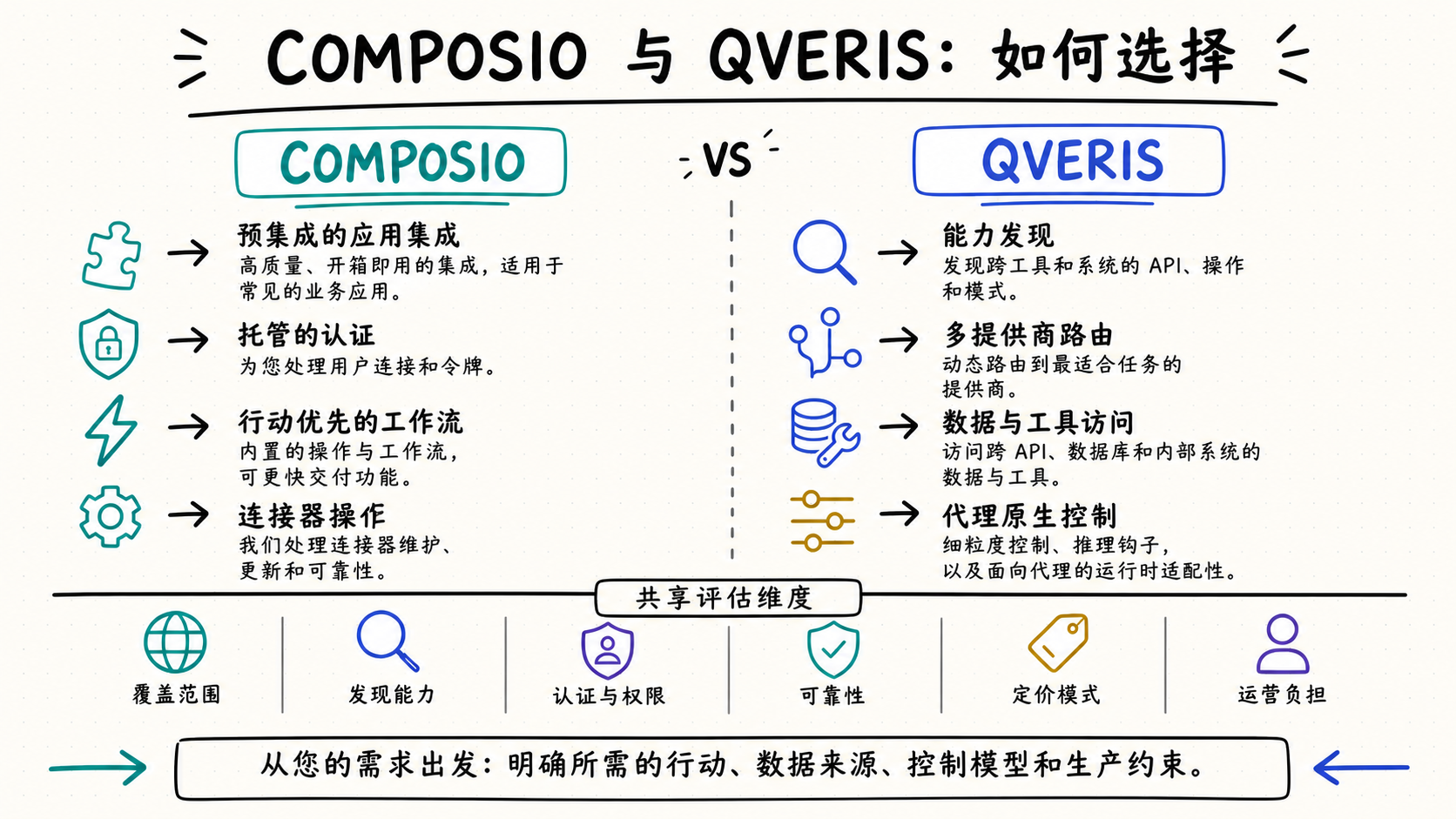
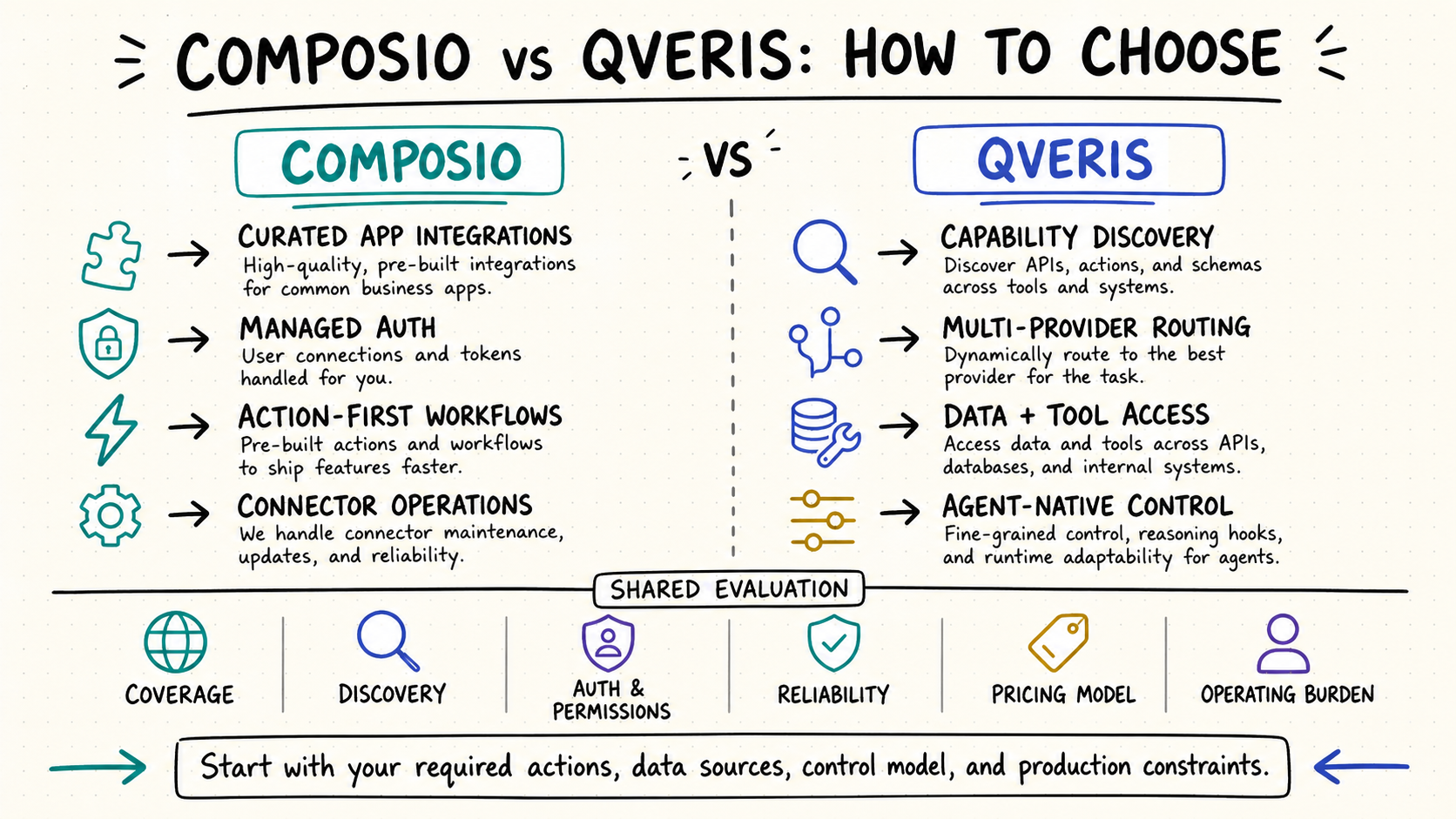
QVeris focuses on discovering, inspecting, and routing capabilities across providers. Composio focuses on connecting applications to user-authorized SaaS actions through Sessions, managed authentication, tool routing, and execution context. Compare the workflow boundary, not just catalog size.
- Your AI Agent needs diverse, evolving tool requirements
- You want free discovery before committing
- Call volumes are variable or burst-heavy
- Latency matters (<50ms avg measured)[1]
- Each user connects their own SaaS accounts
- Managed OAuth and account lifecycle matter
- You need session-scoped tools and permissions
- Triggers or custom actions are central
30-second verdict: Use QVeris for broad capability discovery and provider routing; use Composio for user-scoped application integrations and authenticated actions.
Which is better for AI agent development: Composio or QVeris?
Choose QVeris when the hard problem is discovering and routing across a broad, changing capability set. Choose Composio when the hard problem is giving each user authenticated access to SaaS actions and carrying that identity, connection state, and tool policy through an agent session. The products overlap at tool access, but they optimize different parts of the stack.
What They Are: Core Trade-offs
QVeris is a capability discovery and routing layer: an agent can describe an outcome, inspect possible capabilities, and route a call across a broad provider network. Composio is an agent integration platform whose current architecture centers on Sessions. A Session scopes one user's identity, connected accounts, permitted toolkits, tool availability, and execution state.
That distinction changes the buying decision. QVeris is a stronger fit when provider discovery, cross-source coverage, and routing flexibility are primary. Composio is a stronger fit when the application must connect end users to products such as Gmail, GitHub, Slack, or Salesforce and preserve user-level authorization through the workflow. Neither product should be described as a complete drop-in replacement for the other.
Integration Breadth: Scale & Approach
QVeris publishes 10,000+ callable capabilities across finance, search, weather, maps, blockchain, healthcare, research, and other categories. Composio documents more than 1,000 pre-authenticated toolkits, with multiple actions inside many toolkits. Those figures measure different units, so comparing “capabilities” directly with “toolkits” would be misleading.
Evaluate coverage with a task list instead: identify the exact data sources or SaaS applications, required actions, authentication method, trigger requirements, and tenancy model. A large catalog does not guarantee the endpoint, permission scope, freshness, or regional coverage your production workflow needs.
Discovery: Capability Search vs Session Tool Routing
QVeris Discover starts from the outcome: describe “intraday stock prices with source metadata” or “weather alerts for a city,” then inspect matching capabilities, parameters, and call terms before execution.
Composio is no longer limited to manually browsing a fixed toolkit list. Its Tool Router can expose meta tools that let an agent search for relevant actions at runtime, while the Session constrains that search to the correct user, connected accounts, enabled toolkits, and permissions. Composio also provides Workbench for iterative tool building and testing, plus triggers for event-driven workflows. The practical difference is therefore what the discovery is anchored to: QVeris emphasizes cross-provider capability routing; Composio emphasizes user-scoped application actions and their execution context.
Original Benchmarks: Latency & Token Cost
To provide data beyond public documentation, we conducted original measurements comparing QVeris and Composio across latency and token efficiency. Tests were run from AWS us-east-1 (t3.medium) on May 18–20, 2026.[1]
API Latency Comparison
Response time for a single tool execution call (simple data fetch). Each platform tested 200 times over 24 hours from us-east-1.
| Interface | Avg (ms) | P50 (ms) | P95 (ms) | Error Rate |
|---|---|---|---|---|
| QVeris CLI | 38 | 35 | 62 | 0.0% |
| QVeris MCP | 47 | 43 | 78 | 0.5% |
| QVeris REST | 44 | 41 | 71 | 0.0% |
| Composio MCP | 92 | 85 | 145 | 0.5% |
| Composio REST | 108 | 97 | 178 | 1.0% |
Token Cost Comparison (LLM Context Overhead)
When an AI agent uses MCP tools, each tool's JSON schema is injected into the LLM context window with every prompt. We measured the schema token cost for 5 randomly selected tools on each platform.
| Metric | QVeris CLI | QVeris MCP | Composio MCP |
|---|---|---|---|
| Schema tokens per tool | 0 (CLI) | ~85 | ~120 |
| Tokens for 10 tools | 0 | ~850 | ~1,200 |
| Tokens for 50 tools | 0 | ~4,250 | ~6,000 |
| Annual token cost (50 tools, 10k prompts) | $0 | ~$85 | ~$120 |
Pricing: Subscription vs Pay-Per-Call
The cost models create significantly different economics:
- QVeris: Free discovery and Inspect — explore all capabilities at zero cost. Pay-per-call only in production. No monthly subscription, no auto-renewal.
- Composio: Free tier ($0/mo, 20K calls), Ridiculously Cheap ($29/mo, 200K calls), Serious Business ($229/mo, 2M calls), Enterprise (custom).[3] Verify current pricing as tiers change.
Key divergence points:
- Development phase: QVeris costs $0 (free discovery). Composio's Free tier also costs $0 (20K calls/mo), but paid tiers start from $29/month.
- Variable or low volume: QVeris pay-per-call is significantly cheaper. Pay only for what you use.
- High-volume, consistent workload: At sustained high volume (10,000+ calls/month), Composio's flat subscription may deliver better per-call cost — but QVeris still wins on pay-per-call flexibility.
Integration Methods: MCP, SDK, REST, CLI
QVeris supports CLI, MCP Server, Python SDK, and REST API access. Composio's current developer path centers on Sessions through its TypeScript or Python SDK and API, with MCP support available for compatible clients.
Teams using an older single-toolkit Composio MCP Server or the previous direct-tools flow should review Composio's migration guides before designing new integrations. Sessions are now the recommended abstraction because they combine user identity, connected accounts, tool policy, and runtime execution state. This matters in production: choosing a transport protocol does not remove the need for authorization boundaries, tenant isolation, retries, audit logs, and approval rules.
Try QVeris Discovery — Find Capabilities by Description
Enter what you want your AI Agent to do.
Matching Capabilities Found
QVeris has 10,000+ capabilities.[4] Try specific keywords like "stock", "weather", "crypto", "search", "maps", or "academic" — or open the live demo →
Inspect any capability to see full details, SLA, and per-call cost.
Decision Matrix: Which Fits You
Use this framework to make your decision:
Choose QVeris if:
- Your AI Agent needs diverse, evolving tool requirements (10,000+ capabilities[4])
- You want free discovery and inspection before committing to integration
- Your call volume is variable or burst-heavy (pay-per-call wins)
- Latency is critical — measured at 38–47ms avg across interfaces[1]
- You need CLI integration with Claude Code or OpenClaw (zero token overhead[5])
- You're building a multi-source AI Agent that needs financial data, search, maps, and more
Choose Composio if:
- Your product needs per-user OAuth and connected-account management across SaaS applications
- You want Sessions to scope tools, authentication, and execution state for each user
- You need runtime tool search, event triggers, or Workbench for building and testing custom actions
- The required applications and actions are covered by Composio's current toolkit catalog
Composio tiers: Free ($0, 20K calls), Ridiculously Cheap ($29/mo, 200K calls), Serious Business ($229/mo, 2M calls), Enterprise (custom).[3] QVeris: free discovery + pay-per-call execution at ~$0.002/call avg.
Estimated Monthly Cost
Composio: Free ($0)
QVeris (execution calls only): $10.00
QVeris discovery value: ~$29/month included (what Composio charges during development)
At high volume, Composio's flat subscription can be more cost-efficient. However, QVeris still wins on: free discovery, no subscription lock-in, and pay-per-call flexibility.
Note: QVeris discovery and inspect are always free — you only pay for execution calls. Composio has a Free tier (20K calls) and paid tiers starting at $29/mo. Latency benchmark data available in benchmarks section.[1]
Start Free — Discover 10,000+ AI Agent Capabilities
QVeris free discovery lets you explore capabilities before writing any code. Only pay per call when your AI Agent executes in production.
Try QVeris Free →Quick Start: Switching from Composio to QVeris
Migrating from Composio to QVeris takes three steps:
Sign up without a credit card. Access free Discover to explore 10,000+ capabilities before writing any code.
Use natural language to search for the tools your AI Agent needs. Inspect capability details, SLA, and per-call cost before integrating.
Connect QVeris to your AI Agent via CLI, MCP, Python SDK, or REST. Pay only when your AI Agent executes production calls — zero development cost.
FAQ: Composio vs QVeris
Migrate from Composio in 15 Minutes
Free discovery, no subscription lock-in, and pay-per-call pricing. See if QVeris fits your AI Agent before committing.
Start Free — No Credit Card →Methodology & References
Last updated:
Latency benchmark methodology: Tests conducted
from AWS EC2 us-east-1 (t3.medium, Node.js 22). Each interface was
tested 200 times over a 24-hour window (May 18–20, 2026) with
random jitter between requests to avoid cache biasing. Response
timing via performance.now(). Error rate includes all
non-2xx responses and timeouts above 5s. Composio tests used the
public Composio API at composio.dev with a valid API key.
Token cost methodology: Schema token counts measured by injecting each tool's JSON schema into a Claude Sonnet prompt and counting input tokens via the Anthropic API. Token cost calculated at $0.002/1k input tokens (Anthropic API pricing, May 2026).
Data sources: QVeris capabilities and pricing documented from internal product specifications. Composio positioning, Sessions, toolkit coverage, Tool Router, Workbench, triggers, and migration notes were checked against current Composio documentation on July 29, 2026. Pricing and plan limits should be verified on the vendor's live pricing page before a purchasing decision.
Conflict of interest: QVeris is the publisher's commercial product. This comparison aims for objectivity — we highlight scenarios where each platform is the better choice. Readers should evaluate both platforms against their specific requirements and verify current pricing independently.
Update cadence: Reviewed quarterly. Pricing and feature data refreshed every 90 days. Last full verification: July 29, 2026.
References
- Original measurement data. Latency and token cost benchmarks conducted May 18–20, 2026 from AWS us-east-1 (t3.medium). 200 requests per interface over 24 hours. Full methodology and raw data available on request.
- CCXT GitHub Repository — 34,000+ stars, 340+ contributors. Verified May 2026.
- Composio Official Website — Product specifications, tool count (10,000+), pricing tiers, and managed OAuth features. Pricing specifically at composio.dev/pricing. Verified May 2026.
- QVeris Documentation — Capability catalog (10,000+ capabilities, 138 finance-specific), pricing, and SLA details. Verified May 2026.
- Original measurement data. Token cost benchmarks comparing QVeris CLI vs MCP vs Composio MCP schema overhead. Measured via Anthropic API token counting. Methodology available on request.
- QVeris GitHub Organization — Open-source ecosystem and CLI tool. Verified May 2026.