
The decision in 60 seconds
These products overlap around MCP and tool use, but they solve different primary problems. Start with the system boundary you want a vendor to own.
When you want a managed place to create AI workers, attach tools and knowledge, run schedules, deploy an agent API, and inspect logs or evaluations.
When your agent runtime already exists and the missing layer is natural-language capability discovery, parameter inspection, provider routing, and controlled execution.
When Toolhouse should own worker orchestration while QVeris supplies a broader, inspectable capability layer to that worker through MCP or API.
What this comparison covers
Two different starting points
A useful comparison begins with what your team already has. Buying a second runtime when you need integrations—or buying integrations when you need a runtime—creates avoidable complexity.
- Operations or business teams want repeatable AI workers with a managed interface.
- Developers want agents-as-code, a hosted endpoint, schedules, memory, RAG and logs in one platform.
- The main deliverable is a running worker or agent service.
- You already use your own agent framework, model SDK, workflow engine or MCP client.
- Agents need to find capabilities dynamically instead of hard-coding every provider.
- You need inspectable parameters, price, latency or success signals before execution.
What each platform owns in your stack
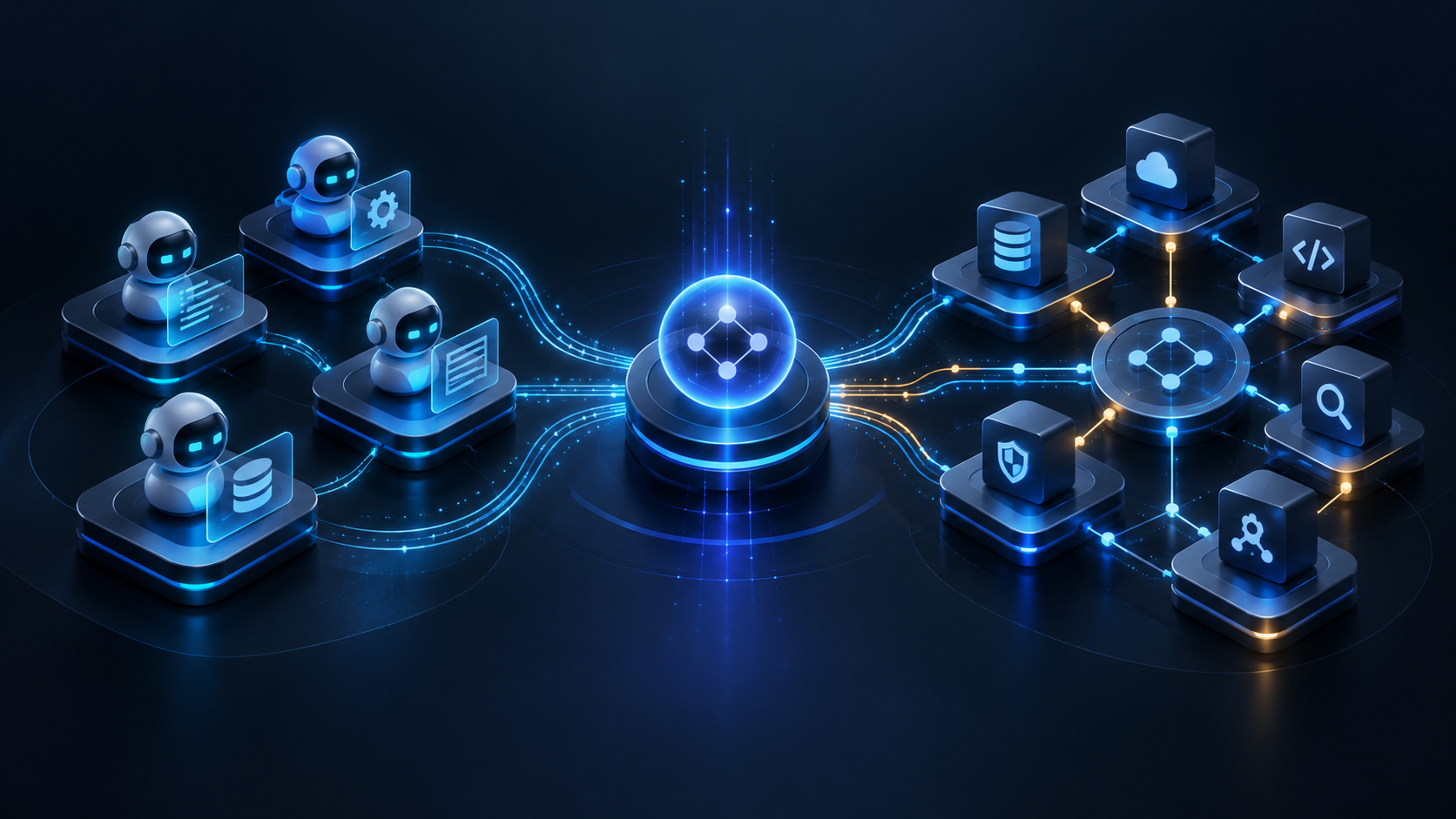
Toolhouse is positioned as an AI worker platform and its technical documentation describes an agentic backend-as-a-service. QVeris is positioned as a capability routing network. That difference changes deployment, observability, and lock-in.
Define the worker → attach MCP, RAG, memory or browser/code tools → run or schedule it → deploy as an API → inspect logs and evaluations.
Describe the capability needed → discover candidates → inspect inputs and execution signals → call the selected capability → retain an auditable result.
Key distinction: Toolhouse can be the place your agent lives. QVeris is more often the capability layer your agent calls. If you already have LangGraph, CrewAI, an internal orchestrator or an MCP host, this distinction matters more than the number of integrations on a landing page.
Toolhouse vs QVeris capability comparison
The table uses current official documentation and avoids unverified performance claims. Product details can change, so verify the linked source before procurement.
| Decision area | Toolhouse | QVeris |
|---|---|---|
| Primary job | Build, run, manage and deploy AI workers or agents. | Discover, inspect, route and call capabilities for an existing agent. |
| Typical owner | Business automation teams, agent builders and developers who want a managed runtime. | Agent platform teams and developers who already control orchestration. |
| Agent runtime | Included: run, schedule, publish as API, maintain continuity and inspect activity. | Not the primary product; connects to your runtime through MCP, SDK, CLI or REST. |
| Capability discovery | Connect curated or custom MCP servers; Studio can suggest MCP connections from a task. | Natural-language discovery is a core operation, followed by inspect and call. |
| MCP | MCP servers become tools available to the worker or agent. | MCP exposes discover, inspect and call to compatible clients. |
| Knowledge and memory | RAG and memory are documented platform features. | Bring your own memory or knowledge layer; QVeris focuses on capabilities. |
| Deployment | CLI deployment and hosted agent endpoints with authentication for private agents. | No new agent deployment required; integrate the routing layer into the runtime you operate. |
| Observability | Action logs, evaluations and optimization features at the worker/runtime layer. | Inspect and execution records at the capability-routing layer; keep end-to-end traces in your runtime. |
| Pricing unit | Subscription plans bundle worker limits and credits. | Discover and Inspect are free; Call consumes credits according to the selected capability. |
| Best fit | A team wants a managed worker lifecycle from creation through operation. | A team wants to expand an existing agent with a flexible capability network. |
Which platform wins in real projects?
A worker gathers sources every morning, summarizes changes, stores context and posts a report. Toolhouse is the more complete starting point because schedules, worker runtime and logs are central.
Your internal agent already handles planning, memory and approval. It needs to find and compare external capabilities at runtime. QVeris adds that layer without replacing the orchestrator.
A nontechnical team wants repeatable workers and visible operations. Toolhouse’s current AI-worker positioning and managed interface align more directly with that ownership model.
An agent should inspect options before committing to a provider and keep integration logic thin. QVeris is designed around discover → inspect → call, which matches this requirement.
The team wants deployment, continuity, RAG, memory, browser use, code execution, logs and evaluations together. Toolhouse covers more of this operational surface.
The worker lifecycle belongs in Toolhouse, but capability selection should remain dynamic and inspectable. Use Toolhouse for orchestration and QVeris as an MCP/API capability layer.
Do not compare the sticker prices directly
The products meter different work. A fair comparison prices the same end-to-end workflow, including the runtime and capability calls you would otherwise source elsewhere.
As checked July 30, 2026, the official page lists Business at $500/month with 25,000 credits and up to 50 workers; Business Max at $1,200/month with 80,000 credits and up to 500 workers; Enterprise is custom. A 14-day trial is listed.
Discover and Inspect are free. Receive 1,000 one-time signup credits after signup verification. Buy 10,000 credits for $19. Credits never expire. No monthly fees or auto-renewal. Execution costs depend on the selected tool; credits are not a fixed number of calls.
TCO checklist: worker/runtime subscription + model tokens + capability/provider charges + retries + schedule frequency + log retention + engineering time + credential operations. Re-run the model with your own workload; published prices may change.
Compare control points, not security adjectives
Map where provider secrets live, who can rotate them, whether they appear in MCP URLs, and which component signs each request. Toolhouse custom MCP documentation explicitly warns about credentials in URLs.
Require allowlists for high-impact actions, explicit approval for writes, budget ceilings, timeouts and bounded retries. Keep discovery separate from execution permission.
Retain the user intent, selected capability, inspected schema, sanitized arguments, provider response, latency, cost and approval decision under one correlation ID.
Use Toolhouse as the worker, QVeris as the capability router
This hybrid pattern is appropriate when you want Toolhouse’s worker lifecycle but do not want every external provider embedded as permanent workflow logic.
Keep the system prompt focused on the business outcome, approval policy and stopping conditions.
Expose discover, inspect and call through MCP, or call the REST/SDK surface from a custom tool.
Select a candidate only after validating its input schema, cost and operational signals against policy.
Pass a correlation ID from the Toolhouse run into capability execution and your own audit store.
{
  "worker": "daily-market-brief",
  "capability_policy": {
    "discover": true,
    "inspect_before_call": true,
    "max_credits_per_run": 80,
    "write_actions_require_approval": true,
    "timeout_ms": 15000,
    "max_retries": 2
  },
  "audit": ["run_id", "capability_id", "cost", "latency", "result_status"]
}Run the same production-shaped test on both
A demo that succeeds once is not a procurement test. Use one representative workflow and record the same evidence for both options.
- Correct result on normal, empty and malformed inputs
- Approval blocks high-impact writes
- Provider or tool failure degrades predictably
- A human can reproduce the decision from logs
- P50/P95 latency measured with your model and data
- Cost per successful outcome, including retries
- Credential rotation and least-privilege test
- Export, rollback and incident ownership documented
Move one boundary at a time
Separate orchestration, model access, memory, tools, credentials, schedules, logging and approvals.
If runtime operations dominate, pilot Toolhouse. If capability integration dominates, pilot QVeris.
Run beside production without write permission and compare result quality, failure rate, latency and cost.
Keep the old route available until retry, timeout, credential and audit requirements pass.
Mistakes that make either choice look worse than it is
A worker subscription and a capability call are not equivalent. Normalize to cost per completed business outcome.
Letting an agent call the first discovered capability without checking schema, cost or permissions creates brittle automation.
Running planning, retries and state in two platforms makes incident ownership ambiguous. Assign one runtime as the system of record.
Latency depends on model, region, provider and workflow. Measure the exact path you plan to ship.
Toolhouse vs QVeris questions
What is the main difference between Toolhouse and QVeris?
Toolhouse is designed to build, run, schedule, deploy and observe AI workers or agents. QVeris is designed to let an existing agent discover, inspect and call external capabilities through one routing layer.
Is QVeris a Toolhouse replacement?
Not as a complete agent runtime. QVeris can replace or simplify the capability integration and routing layer, while Toolhouse also provides agent construction, hosting, schedules, memory, logs and evaluations.
Can Toolhouse and QVeris work together?
Yes. A Toolhouse agent can own the workflow and runtime while QVeris acts as a capability router for discovery, inspection and execution.
Which is better if we already have an agent runtime?
QVeris is usually the more direct fit when the runtime already exists and the missing layer is capability discovery, normalized inspection, routing or pay-as-you-go execution.
How should we compare pricing?
Model the same production workflow. Toolhouse plans package worker runtime and credits, while QVeris meters capability calls by credits. Include model usage, schedules, retries, storage, provider fees and operational labor.
Do both products support MCP?
Yes, but MCP serves different roles. Toolhouse connects MCP servers to workers and agents. QVeris exposes discover, inspect and call as MCP tools so an MCP client can find and execute capabilities.
Verify product details before you buy
This comparison was checked against the following first-party pages on July 30, 2026.
Already have an agent runtime? Test capability routing first.
Use QVeris to discover and inspect capabilities before spending credits on execution. Keep your existing orchestrator, memory and approval flow.