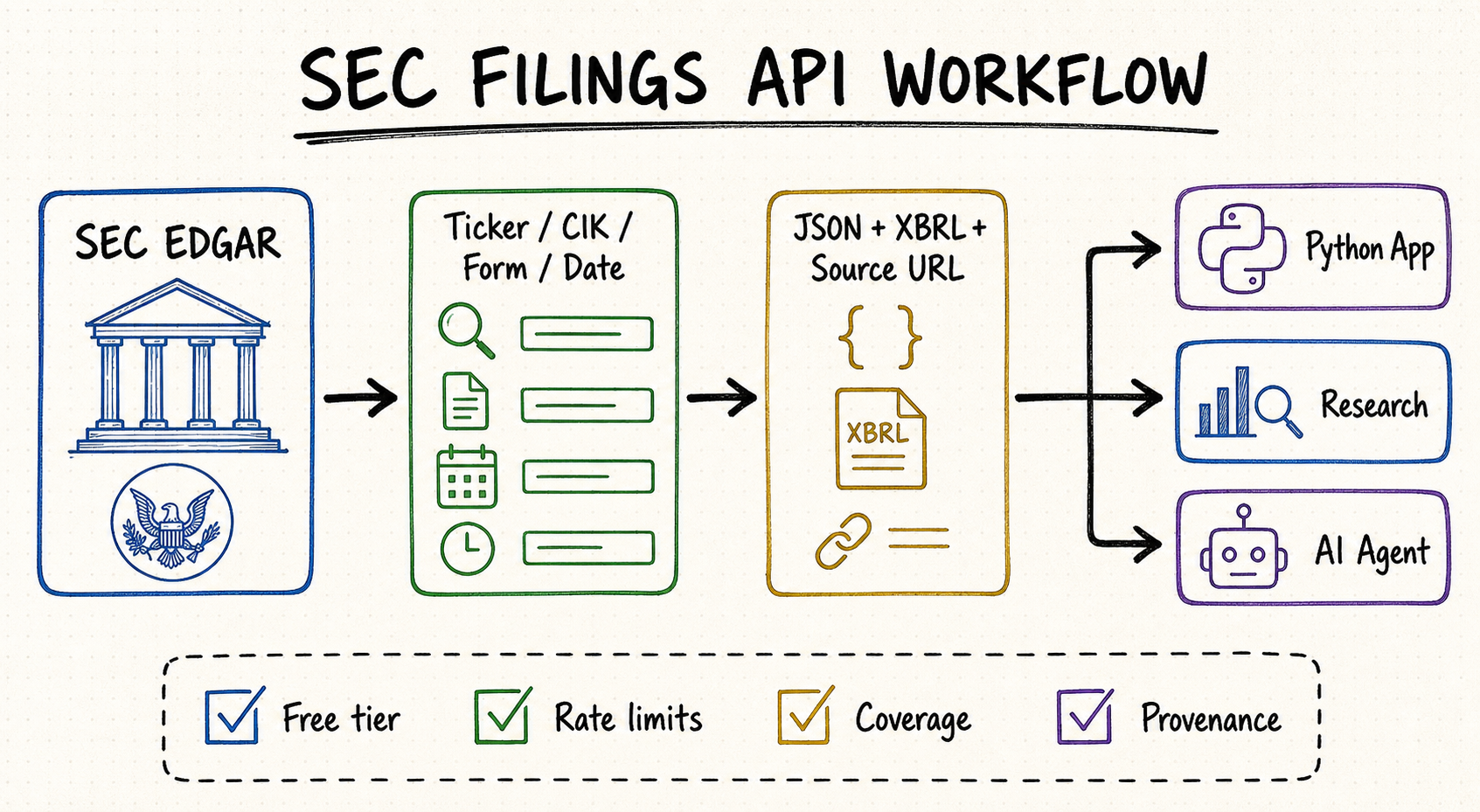
Free SEC filings access: official EDGAR or a third-party API?
The short answer is that the SEC itself offers public, keyless EDGAR data access, while commercial providers may offer a limited free plan around the same source material. The better choice depends less on the word “free” than on whether you need raw authority, normalized fields, searchable text, extracted sections, or production alerts. A developer validating one issuer can use a very different stack from a research product monitoring thousands of issuers.
Before comparing providers, write down one acceptance task: for example, “return every 8-K filed by this CIK after a timestamp, include accession number and primary-document URL, and surface amendments separately.” A concrete task makes historical gaps, ambiguous freshness, and misleading free-tier claims visible in minutes.
Official public data
Use data.sec.gov for submissions history and XBRL company facts without an API key. You still own ticker mapping, document retrieval, caching, parsing, and monitoring.
Normalized API layer
A provider may add ticker lookup, consistent JSON, search, extracted sections, SDKs, or webhooks. Test whether those derived fields link back to the exact filing version.
Free does not mean unlimited
Check daily and monthly quotas, burst limits, historical depth, endpoint exclusions, trial expiry, attribution, redistribution, and commercial-use rights.
Provenance is essential
Keep CIK, accession number, accepted time, filing and report dates, form type, amendment status, and the official SEC document URL.
How the free SEC EDGAR API works
The official SEC EDGAR application programming interfaces expose JSON submissions history and XBRL data at data.sec.gov. They require no API key, but automated access must comply with the SEC privacy and security policy and identify the requesting application.
SEC company filings API by CIK
Resolve the ticker to a ten-digit, zero-padded CIK, then request the company submissions JSON. The response includes recent forms, filing dates, accession numbers, primary documents, and references to older submission files.
SEC XBRL API free endpoints
Companyfacts, companyconcept, and frames endpoints serve machine-readable XBRL facts. They are useful for financial metrics, but they are not a universal substitute for complete 10-K, 10-Q, 8-K, S-1, Form 4, or exhibit text.
Treat every endpoint as a different data contract. Submissions answers “what did this entity file?”, archive documents answer “what was disclosed?”, and XBRL endpoints answer “which tagged facts were reported in a particular context?” Combining them requires explicit joins on CIK, accession number, form, period, unit, and filing version—not a blind merge on company name and fiscal year.
The official route is strongest when source fidelity and control matter. Its engineering cost appears later: resolving historical submission files, downloading exhibits, extracting narrative sections, reconciling amended filings, and operating a respectful incremental crawler. A third-party layer is valuable only if its saved engineering time exceeds the limitations imposed by its quota, schema, latency, or license.
Compare free SEC filing data API options
Check
Official SEC EDGAR
Third-party free tier
Authentication
No API key; descriptive User-Agent required.
Usually an account and API key.
Response
Submissions JSON, raw documents, and as-filed XBRL.
May normalize tickers, sections, facts, and form-specific fields.
Free boundary
Public access subject to fair-access policy.
Monthly quota, endpoint limits, trial, or beta may apply.
Best fit
Authoritative source and custom ingestion.
Faster prototypes needing cleaner schemas or search.
History and amendments
Public filing history is available, but older metadata and documents may require multiple archive paths.
Coverage may start at a vendor-specific date; test Form /A handling and backfill behavior.
Narrative text
Full documents and exhibits are authoritative, but section extraction is your responsibility.
May expose risk factors, MD&A, items, or exhibit search; validate boundaries against source HTML.
Delivery
Build polling, checkpoints, deduplication, and replay yourself.
Webhooks or feeds may reduce work; verify delay, retry policy, ordering, and missed-event recovery.
Verify
Current access policy, caching, throttling, and endpoint semantics.
Quota, history, freshness, source links, license, and export rights.
SEC EDGAR API Python and JSON workflow
Step 1: identify the company and filing form
Map a ticker to CIK, then choose whether you need filing metadata, a complete document, XBRL facts, or a form-specific normalized record. A 10-K API free search and a Form 4 transaction feed are different data tasks.
Use an issuer mapping that can survive ticker changes, multiple share classes, and non-US symbols. Store the resolved CIK with the mapping source and observation date. For form filters, decide whether variants such as 10-K/A and 8-K/A belong in the same result set or a separate amendment stream.
Step 2: make a polite, traceable request
Set a descriptive User-Agent with application and contact information, add a timeout, handle 429 and 5xx responses, cache unchanged data, and use exponential backoff. Do not treat the absence of an API key as permission for unlimited traffic.
Centralize request pacing across workers instead of throttling each process independently. Cache ticker mappings and immutable filing documents, use conditional requests where appropriate, honor Retry-After, and log status code, latency, URL, attempt count, and response size. A “free” integration that repeatedly downloads unchanged archives is neither reliable nor considerate.
Step 3: normalize without losing the source
Store raw JSON and source URLs beside normalized fields. Keep accession numbers as stable filing identifiers, distinguish filing date from report period, and preserve amendments rather than silently overwriting earlier records.
Run a small evaluation set before production: one issuer with decades of history, one recent IPO, one company with multiple share classes, one amended filing, one filing with many exhibits, and one tagged fact reported in different units or contexts. Compare counts and identifiers with EDGAR, inspect source links manually, then test incremental updates and replay after a simulated outage.
Use QVeris to find SEC filings API capabilities
QVeris helps developers and AI agents discover and inspect available data capabilities. In the QVeris tool details, search by job rather than by a single provider name: “latest 8-K metadata,” “10-K risk-factor text,” “company facts by CIK,” or “Form 4 transactions.” Inspect required identifiers, output schema, source links, freshness, and provider requirements before an agent calls a capability. Keep the official EDGAR identifier in downstream records so a normalized result remains independently verifiable. See the QVeris documentation for the capability workflow.
FAQ
Is there a genuinely free API for SEC filings?
Yes. Official EDGAR data access does not require a paid subscription or API key. The tradeoff is that you build more of the issuer mapping, archive retrieval, parsing, caching, and monitoring layer yourself. A commercial “free API” usually limits requests, history, endpoints, or production use.
Should I use official EDGAR or a third-party free tier?
Choose EDGAR when authority, complete source documents, and control matter most. Evaluate a third-party layer when normalized schemas, search, section extraction, SDKs, or alerts save meaningful engineering time. Test both with the same forms, dates, and amendment cases.
Can I query SEC filings by stock ticker?
Official filing records are organized around CIK rather than ticker. Resolve ticker to CIK first, preserve the mapping source and date, and expect ticker changes or multiple share classes. Some third-party APIs perform this step, but the resolved CIK should still be visible.
Are submissions JSON and XBRL company facts the same data?
No. Submissions describe filing history and document metadata. XBRL endpoints expose tagged facts with concepts, units, periods, forms, and filing contexts. Full narrative disclosures and exhibits remain in filing documents.
How should I test a free SEC filings API?
Test recent and old filings, amendments, exhibit-heavy documents, multiple share classes, missing optional fields, and an incremental update after a known filing. Verify accession numbers and source URLs against EDGAR, then measure latency, quota behavior, and recovery after errors.
What must be stored for auditability?
Keep CIK, accession number, form and amendment status, accepted timestamp, filing date, report period, primary document, official URL, retrieval time, provider, and raw-response version. For extracted facts or text, retain the source location and transformation version.
SEC Filings API FreeAccess EDGAR Data Safely | QVeris Guides