
How to Use QVeris MCP Server
Connect compatible AI agent environments — including Claude Code and Cursor — to QVeris capabilities through the Model Context Protocol. Discover, inspect, and call 10,000+ verified tools, APIs, and live data sources from one unified integration point.
Why this guide exists
QVeris offers multiple integration paths. This guide focuses on the MCP Server path for users who want to connect through the Model Context Protocol.
Concept page
The MCP overview explains what the Model Context Protocol is, why it matters for AI agents, and how it fits into the broader ecosystem. Read it first if you are new to MCP.
This integration guide
This page is the practical companion. It covers setup flow, configuration structure, capability discovery, and how to connect your agent to QVeris through MCP — with placeholder examples that show the integration shape.
New to Model Context Protocol? Read the MCP concept overview →
What QVeris MCP Server does
QVeris MCP Server is an integration layer between compatible MCP clients and QVeris's capability routing network — not a static tool directory.
Agent-native discovery
AI agents describe what they need in natural language. QVeris returns ranked capability matches with cost, latency, and success rate — no pre-coded endpoints.
Verified capabilities
10,000+ pre-verified tools across 15+ categories. Every capability has quality signals: success rate, average execution time, and billing rules.
Unified protocol access
One MCP Server gives your agent access to market data, investment research, compliance checks, crypto data, and more — all through the standard Model Context Protocol.
Structured execution
Every call runs in a sandboxed environment with structured JSON responses, unique execution IDs, billing details, and remaining credit balance.
Inspect before committing
Discovery and inspection are always free. Agents review schemas, costs, and quality metrics before committing credits to a call.
Production-ready
99.99% uptime, sub-500ms p95 latency, RBAC access controls, and full audit trails — the same infrastructure across all QVeris integration methods.[1]
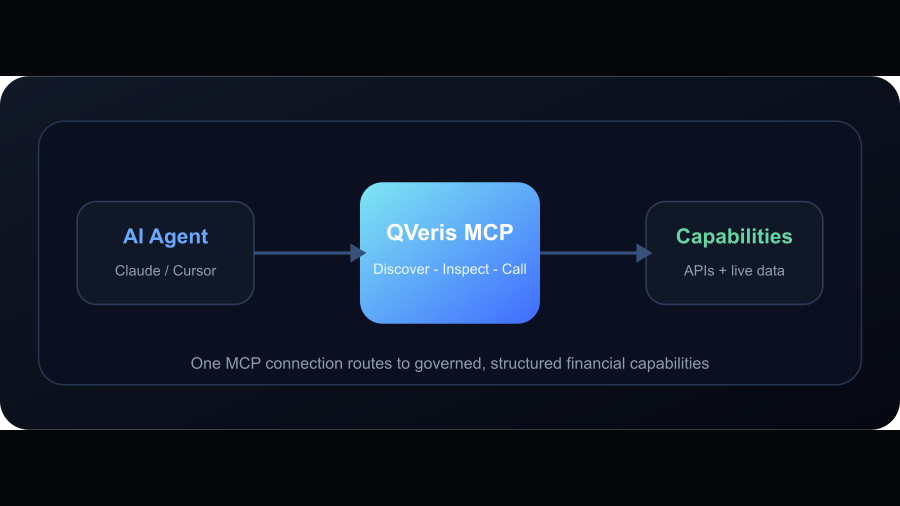
Integration flow
How your AI agent connects to external capabilities through QVeris MCP Server and the capability routing network.
Prerequisites
What you need before configuring the QVeris MCP Server integration.
QVeris access
A QVeris account with valid API credentials. QVeris uses API key authentication with Bearer Token. A valid QVERIS_API_KEY or QVeris credentials are required. Free accounts include 1,000 credits on signup plus 100 daily credits.
Compatible MCP client
An AI agent environment or coding tool that supports the Model Context Protocol. Claude Code and Cursor are confirmed compatible. Other MCP-compatible clients may also work.
Configuration details
The official QVeris MCP Server command and any required arguments. These values should be obtained from your QVeris dashboard or official documentation. See the Example Configuration section below for the expected structure.
Version compatibility
| Component | Minimum Version | Recommended | Notes |
|---|---|---|---|
| Node.js | 18 LTS | 22 LTS | Required for npx execution |
| MCP Protocol | 2024-11-05 | 2024-11-05 | Current stable revision |
| @qverisai/mcp | latest | latest | Always use npm latest tag |
| Claude Code | 0.x | 1.x+ | MCP v1 support in 1.x |
| Cursor | 0.40.x | 0.45.x+ | MCP support added in 0.40 |
Setup guide
A step-by-step walkthrough of the QVeris MCP Server integration process.
Confirm QVeris access
Sign up for a QVeris account at qveris.ai if you have not already. Free accounts include 1,000 credits on signup plus 100 daily credits. Obtain your API key from the QVeris dashboard. A valid QVERIS_API_KEY or QVeris credentials are required.
Add the QVeris MCP Server configuration
Add the QVeris MCP Server entry to your MCP client's configuration. The configuration structure follows the standard MCP servers format. See the Example Configuration section below for the expected JSON structure. Exact command and argument values need confirmation from the official QVeris documentation.
Connect your AI agent or MCP-compatible client
Launch or restart your MCP-compatible AI agent environment (Claude Code, Cursor, or another compatible client). The client should detect the QVeris MCP Server from your configuration. Verify the connection is active — your agent should now see QVeris capabilities as available tools.
Discover available capabilities
Ask your agent to find capabilities using natural language. For example, your agent can query for "market data for US equities" or "KYC verification tools." QVeris returns ranked capability matches with cost estimates, latency, and success rates. Discovery is always free and does not consume credits.
Inspect capability schema and requirements
Before calling a capability, your agent can inspect its full parameter schema, billing rules, example usage, and quality metrics. This step is always free. The agent should verify that the input parameters match the expected schema and that the cost fits within the available credit balance.
Call a capability with structured parameters
Once the agent has selected and inspected a capability, it submits a structured call with the required parameters. QVeris executes the call in a sandboxed environment and returns a structured JSON response containing the result data, a unique execution ID, billing details, and remaining credit balance.
Review response, logs, or execution output
Your agent receives structured JSON output that can be used immediately in downstream workflows. Each call returns an execution_id, search_id, and session_id for full audit trail and debugging.
Example configuration
The expected structure of a QVeris MCP Server configuration entry. Replace placeholder values with your actual QVeris credentials and the official server command.
// ~/.claude/settings.json or Cursor MCP config
	{
	  "mcpServers": {
	    "qveris": {
	      "command": "npx",
	      "args": ["-y", "@qverisai/mcp"],
	      "env": {
	        "QVERIS_API_KEY": "sk-xxx"
	      }
	    }
	  }
}claude mcp add qveris -s user -e QVERIS_API_KEY=sk-xxx -- npx @qverisai/mcpHow agents use QVeris capabilities through MCP
Once connected, your AI agent follows the Discover → Inspect → Call workflow for every capability interaction.
Discover
Agent describes what it needs in natural language ("earnings data for AAPL this quarter"). QVeris returns ranked matches with tool IDs, expected costs, latency estimates, and success rates. Always free — no credits consumed.
Inspect
Agent reviews the full parameter schema, billing rules, and quality metrics for candidate capabilities. Zero-cost decision point — the agent can compare multiple capabilities before committing to a call.
Call
Agent submits structured parameters. QVeris executes in a sandbox, returns structured JSON with the result, a unique execution_id, billing details, and remaining credit balance. Credits are consumed only on successful calls.
// Step 1: Discover — agent queries available capabilities
	{"capabilities": [
	  {"id": "financial-stock-price-realtime",
	   "name": "Real-Time Stock Price",
	   "cost_credits": "5 per call",
	   "avg_latency_ms": "320",
	   "success_rate": "99.2%"}
	]}

	// Step 2: Inspect — review schema and cost before committing
	{"schema": {"properties": {"symbol": {"type": "string", "description": "Ticker symbol (e.g. AAPL)"}},
	                "required": ["symbol"]},
	 "cost_per_call": "5 credits",
	 "avg_execution_ms": "320"}

	// Step 3: Call — execute with parameters
	{"symbol": "AAPL"}

	// Response
	{"result": {"symbol": "AAPL", "price": "189.50", "currency": "USD", "last_updated": "2026-05-28T20:15:30Z"},
	 "execution_id": "exec_abc123",
	 "credits_used": "5",
	 "credits_remaining": "995"}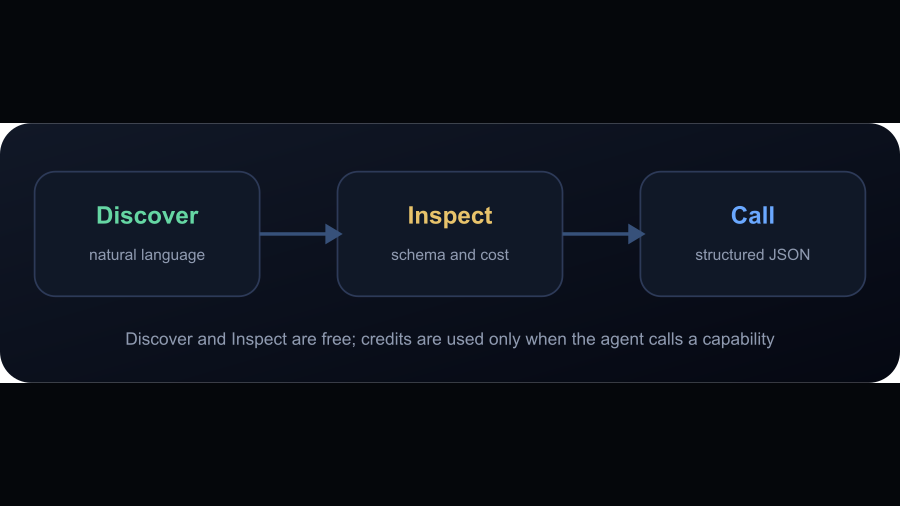
Supported usage scenarios
Common environments and workflows where QVeris MCP Server adds value. Platform support should be verified against official QVeris documentation.
Claude Code
Anthropic's official CLI agent. Confirmed as a compatible MCP client for QVeris MCP Server. Your Claude Code agent can discover and call QVeris capabilities directly within terminal-based coding workflows.
Cursor
AI-first IDE with MCP support. Confirmed as a compatible environment. Connect QVeris MCP Server to give your Cursor agent access to verified tools, APIs, and live data during development sessions.
Finance AI agents
Agents performing investment research, market intelligence, risk assessment, and compliance checks. Access market data, earnings, KYC, sanctions screening, crypto data, and more through MCP.
Investment research workflows
Automate earnings analysis, valuation model data retrieval, and market intelligence gathering. QVeris routes each research query to verified financial data capabilities.
Internal enterprise agents
Connect internal enterprise AI agents to QVeris capabilities through MCP for document processing, data enrichment, compliance checks, and external API access with full audit trails.
Agentic SaaS products
Build SaaS products where AI agents need dynamic access to external tools and data. QVeris MCP Server provides one integration point instead of managing dozens of third-party API integrations.
Compatible MCP clients may include additional platforms beyond those listed. Explore all use cases →
Best practices
Recommendations for integrating QVeris MCP Server effectively and safely into your AI agent workflow.
Start with a small set of capabilities
Begin with a focused set of capabilities relevant to your agent's primary task. Expand gradually as you understand the cost, latency, and reliability characteristics of each capability domain.
Inspect schemas before execution
Always inspect the parameter schema, billing rules, and quality metrics before calling a capability. Inspection is free and prevents costly mismatches between expected and actual parameters.
Keep credentials secure
Store your QVeris API key securely. Use environment variables or a secrets manager. Never hardcode credentials in configuration files that may be committed to version control.
Track execution and outputs
Log execution_id, search_id, and session_id values for every call. These identifiers enable full audit trail reconstruction, cost tracking, and debugging.
Separate test and production workflows
Use separate QVeris sessions or API keys for testing and production. This prevents test calls from consuming production credit budgets and keeps audit trails clean.
Validate outputs before use
For finance, compliance, or other regulated workflows, validate structured outputs before using them in downstream decisions. QVeris provides the data and execution trail — your agent logic should still verify results meet your requirements.
Troubleshooting
Common integration scenarios and resolution paths. Exact error messages and codes should be verified against the official QVeris documentation.
Authentication or access issue
Verify your QVeris API key is valid and has not expired. A valid QVERIS_API_KEY or QVeris credentials are required. Check that your account has available credits. Confirm the API key is being passed correctly in the MCP Server environment configuration.
MCP client cannot find the server
Confirm the QVeris MCP Server command is correct and the server process is running. Verify your MCP client configuration file is in the correct location and has valid JSON syntax. Restart your MCP client after making configuration changes.
Capability not discovered
Try a broader or differently worded natural language query. Discovery matches against capability descriptions and metadata — rephrasing the query may surface relevant capabilities. Ensure your account plan includes access to the capability category you are searching for.
Schema mismatch
Inspect the capability again to confirm the current parameter schema. Capability schemas may be updated by providers. Ensure your agent is passing all required parameters with correct types before calling.
Tool call fails
Check the structured error response for details. Common causes include insufficient credits, rate limiting, invalid parameters, or temporary provider unavailability. Review the execution response for specific error context.
Rate limit or permission issue
Free accounts have a 10 req/min rate limit; Pro accounts have 100 req/min. If you are hitting rate limits, consider upgrading your plan. For permission issues, verify your account tier includes access to the requested capability.
How this guide compares
Understanding the difference between the concept page, this integration guide, and alternative integration approaches.
Concept page vs. Integration guide
| Dimension | MCP Concept Page | This Integration Guide |
|---|---|---|
| Primary question | What is MCP Server? | How do I use QVeris MCP Server? |
| Content type | Concept explainer | Practical integration guide |
| User intent | Informational — learning | Implementation — connecting |
| Setup steps | None or minimal | 7-step walkthrough with configuration structure |
| Code/config | Conceptual examples | Placeholder configuration with clear structure |
| Troubleshooting | Not included | 6 common scenarios with resolution paths |
| Best for | New MCP users | Users ready to connect QVeris via MCP |
QVeris MCP Server vs. Alternative integration approaches
| Dimension | QVeris MCP Server | Manual API Integration | Static MCP Tool Directory | Generic API Marketplace |
|---|---|---|---|---|
| Discovery | ✓ Natural language | ✗ Must pre-code endpoints | ◐ Keyword search only | ◐ Browse by category |
| Cost preview | ✓ Before calling | ✗ No preview | ✗ Pricing page only | ✗ Not available |
| Quality signals | ✓ Success rate, latency | ✗ None | ✗ Provider claims only | ✗ Unverified |
| Protocol | ✓ One unified MCP | ✗ One per API | ✗ Many different APIs | ✗ No unified protocol |
| Audit trail | ✓ execution_id, session tracing | ◐ Provider-dependent | ✗ Limited | ✗ None |
| Execution | ✓ Sandboxed | ◐ Direct call only | ✗ Varies | ✗ None |
| Agent-native | ✓ Built for AI agents | ✗ Built for human devs | ✗ Built for human devs | ✗ Built for human devs |
How this guide was built
This integration guide is a technical document intended for developers and AI-agent engineers integrating QVeris capabilities through the Model Context Protocol. The content is based on publicly available QVeris documentation, the MCP specification, and observed integration patterns.
Research approach
- Analysis of the QVeris capability routing network as documented in official platform materials
- Review of the Model Context Protocol specification (2024-11-05) and its implementation requirements
- Cross-reference with compatible MCP client documentation (Claude Code, Cursor) for integration patterns
- Configuration examples derived from standard MCP server patterns used across the ecosystem
- Metric definitions (uptime, latency, success rate) based on QVeris published service descriptions
Metric definitions
- avg_latency_ms — Mean round-trip execution time in milliseconds, measured from request receipt to response delivery. Source: QVeris capability metadata returned during capability inspection.
- success_rate — Percentage of calls that completed without error over the trailing 30-day window. Source: QVeris capability metadata.
- uptime — Percentage of time the QVeris platform is accessible via API. Claimed as 99.99% in official materials.
- cost_credits — Number of QVeris credits consumed per successful call. Varies by capability complexity and provider pricing.
- req/min — API rate limit. Free accounts: 10 req/min. Pro accounts: 100 req/min. Source: QVeris pricing page.