
Find a GitHub Free Stock API
That You Can Trust
Evaluate the repository, upstream data source, license, rate limits, and maintenance risk before you ship.
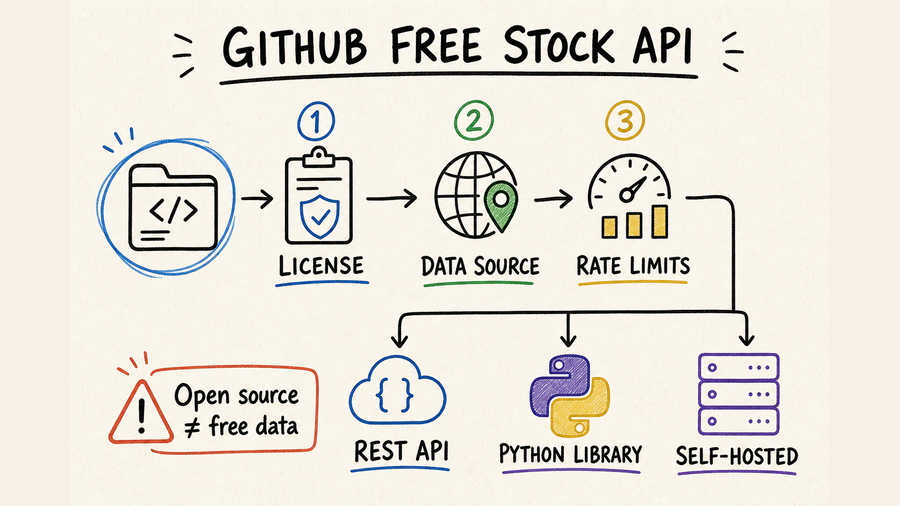
TL;DR
A repository may provide a client library, wrapper, proxy, or server. It does not automatically grant rights to the underlying market data.
Identify whether the project calls an official vendor, scrapes a website, bundles static files, or requires your own brokerage account.
What “GitHub free stock API” actually means
Search results mix several different things: open-source API clients, unofficial wrappers around public websites, self-hosted aggregation services, sample projects, and lists of third-party free tiers. Treat the repository as an integration component, not as proof that the data is free, licensed, real-time, or production-ready.
Usually the safest code path. The repository simplifies authentication and endpoints, while the vendor still controls data entitlements and quotas.
Convenient for prototyping, but it can break when an undocumented endpoint or website changes. Maintenance history matters more than star count alone.
You operate the service and can control caching and schemas, but you still need a lawful, reliable upstream data source.
A clean REST surface can still depend on fragile HTML or undocumented browser calls. Identify selectors, cookies, anti-bot behavior, and the upstream terms before relying on it.
A repository may run offline because it ships a small snapshot. Check the observation date, universe, provenance, and whether an update path actually exists.
Compare GitHub stock API repository types
| Layer | Main job | Best for | Boundary |
|---|---|---|---|
| Official SDK | Calls a documented provider API. | Stable integrations and support. | Requires a provider key and plan. |
| Community wrapper | Normalizes a public or private upstream source. | Fast experiments and scripts. | Breakage and terms risk. |
| Self-hosted service | Exposes your own REST or GraphQL layer. | Caching, schemas, and internal tools. | You own operations and upstream compliance. |
| Static dataset repo | Stores CSV, JSON, or sample history. | Tutorials and reproducible demos. | Usually stale and not a live API. |
A seven-point repository evaluation checklist
Confirm the code license, upstream terms, redistribution rights, commercial-use rules, and attribution requirements.
Trace every quote to its source. Determine whether it is delayed, exchange-limited, adjusted, or available only through a brokerage account.
Review recent releases, open issues, merged pull requests, security policy, dependency updates, and bus factor.
Keys should come from environment variables or a secret store, never examples, query logs, browser bundles, test fixtures, screenshots, or committed configuration.
Look for typed responses, timeouts, pagination, 401 and 429 handling, retries with backoff, and explicit empty or partial results. A happy-path demo is not an API contract.
Tests should cover schema changes, nulls, invalid symbols, throttling, and upstream errors without calling live markets on every run.
Pin a commit or release, maintain your own adapter, and know how to replace the repository or upstream provider without rewriting application logic.
Use QVeris to verify before you integrate
A GitHub README tells you how a project presents itself. Use the QVeris documentation and Playground to inspect callable alternatives, then compare their provider contracts with the repository’s real upstream dependency.
- Discover stock quote, historical price, fundamentals, and market-data capabilities by use case.
- Inspect tool inputs and outputs before writing provider-specific glue code.
- Keep repository evaluation separate from live API verification and data licensing.
FAQ
Not necessarily. The code can be open source while its upstream provider requires a key, paid entitlement, brokerage account, or limits commercial use.
It may work for research or prototypes, but you should evaluate reliability and the applicable terms before using it in production.
Only a weak one. Recent releases, response to breakages, tests, security practices, maintainers, and a documented upstream source matter more.
Only if you can own the upstream integration, security updates, tests, licensing review, and operational support—not merely keep the code compiling.
References and next steps
Alpha Vantage documentation
Alpaca market data documentation
QVeris documentation
QVeris Playground