
Free WebSocket Stock API
for Real-Time Data
Evaluate free streaming stock APIs by feed freshness, exchange coverage, symbol limits, licensing, and connection reliability.
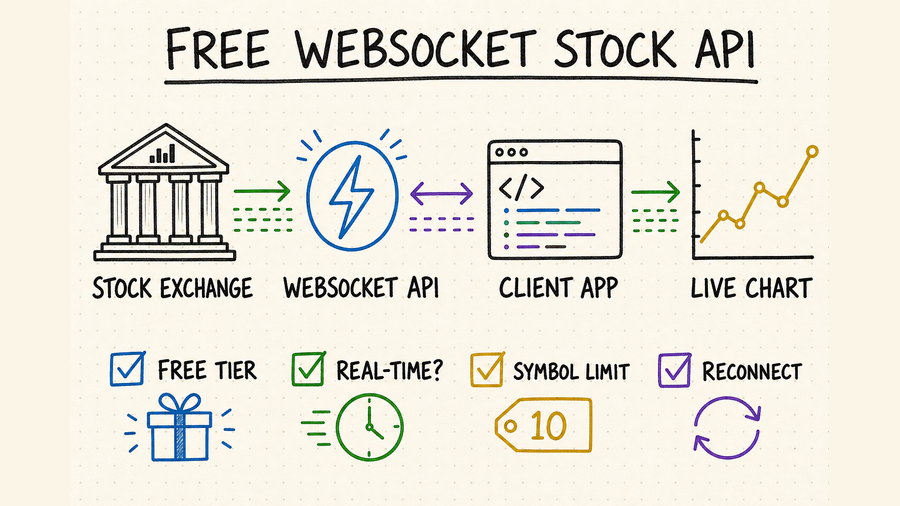
TL;DR
A WebSocket feed is ideal for dashboards, alerts, paper trading, and intraday apps that need server-pushed updates.
Free tiers often cap symbols, connections, messages, exchanges, or usage rights. “Real-time” may still mean a limited feed.
Production clients need heartbeats, reconnects, resubscriptions, sequence checks, and a REST snapshot fallback.
Market-data entitlements can differ for display, redistribution, commercial use, and each exchange.
How a WebSocket stock API streams prices
Unlike repeated REST polling, a WebSocket keeps one bidirectional connection open. After authentication, the client subscribes to symbols or channels, and the provider pushes trades, quotes, or aggregate bars as events arrive.
Send the API key only through the provider’s documented secure handshake or first-message flow. Use wss://, never an unencrypted socket.
Request only the symbols and event types the interface needs. Broad wildcard subscriptions can exhaust a free message or symbol allowance quickly.
Map provider fields into a stable internal model with symbol, event type, price, size, exchange, provider timestamp, and receipt timestamp.
Treat connection, authentication, and subscription as separate states. Do not mark a symbol live until the provider explicitly confirms its channel.
Keep sequence numbers, partition or channel, event ID, correction flag, and both source and receive time. Arrival order alone is not a safe event order.
Free WebSocket stock API selection checklist
| Check | What to verify | Common free-tier catch | Production response |
|---|---|---|---|
| Freshness | Event and receipt timestamps, stated delay. | Real-time for one venue, delayed elsewhere. | Measure lag continuously. |
| Coverage | Exchanges, asset types, trades, quotes, bars. | Limited symbols or consolidated feed. | Document feed provenance. |
| Capacity | Connections, subscriptions, messages, bursts. | Small concurrent symbol allowance. | Share one backend connection. |
| Rights | Display, commercial use, redistribution. | Personal or non-commercial only. | Store entitlement decisions. |
Reliable WebSocket integration pattern
Connect from your backend, then fan out normalized updates to browsers. This protects keys and avoids multiplying provider connections per user.
Use exponential backoff with jitter, cap the delay, and resubscribe only after authentication succeeds. Respect provider retry guidance.
Model disconnected, connecting, authenticating, subscribing, live, stale, recovering, and stopped states. State-specific timeouts prevent a half-open socket from looking healthy.
On a missing sequence, pause stateful consumers, fetch a REST snapshot or bounded replay, then resume from a known event. Log the repaired interval.
Use bounded queues and define whether to drop, coalesce, spill, or disconnect when consumers lag. Silent unbounded buffering turns latency into a memory failure.
Deduplicate by stable event identity and apply corrections deliberately so reconnect replays do not inflate trades, volume, alerts, or bars.
Find stock streaming capabilities with QVeris
There is no verified QVeris result dedicated to every stock WebSocket feed. Use the QVeris documentation to inspect callable market-data capabilities and the Playground for candidate evaluation. Confirm streaming transport, entitlements, and recovery semantics directly with the provider.
- Search for trades, quotes, aggregates, symbol lookup, and market-status capabilities.
- Inspect provider requirements before wiring credentials and schemas into an application.
- Keep a normalized data model so a free prototype can migrate when coverage or limits change.
FAQ
Some providers offer free streaming tiers, but the exchange coverage, symbol count, message volume, and permitted use vary. Verify each term directly.
Use WebSocket for continuous low-latency updates. Use REST for snapshots, history, recovery after gaps, and infrequent requests.
Follow provider guidance, use exponential growth with jitter and a cap, and reset only after a stable live period—not immediately after opening a socket.
Bound the queue, reduce subscriptions, coalesce replaceable updates, scale consumers, or disconnect and recover. Never allow unlimited in-memory growth.
References and next steps
Alpaca Market Data
Finnhub API documentation
Twelve Data API documentation
Free real-time stock data API guide
QVeris Playground