
Free VWAP API
Stock Data Guide
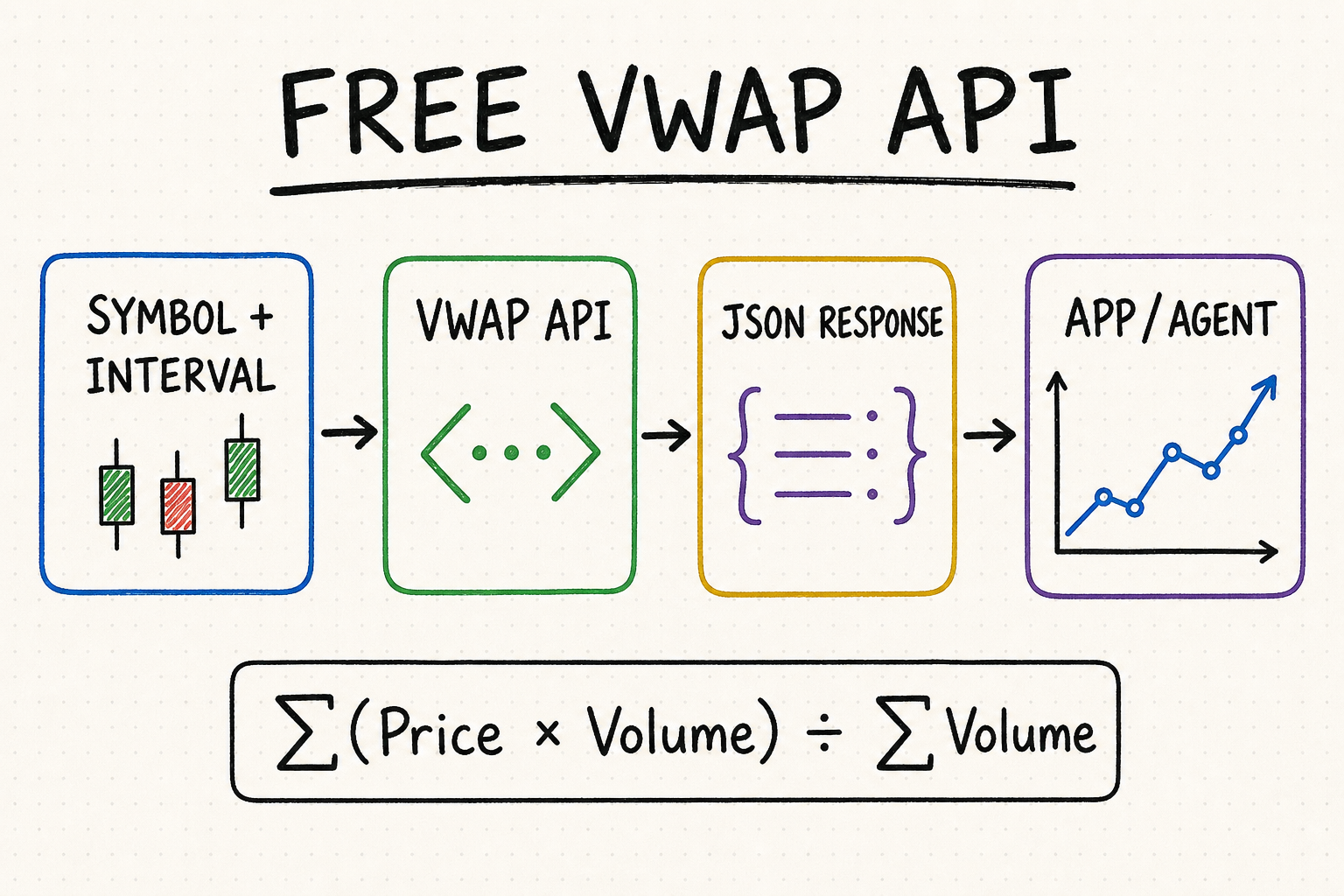
Compare Free VWAP API options, check their limits, and move from a ticker symbol to a usable volume-weighted average price response.
TL;DR
A free VWAP API should return the indicator directly or supply intraday OHLCV bars that let you calculate it correctly.
Check asset coverage, delay, intervals, history, rate limits, licensing, and whether signup or a card is required.
Use a dedicated VWAP endpoint for speed, or calculate cumulative VWAP from consistent price and volume bars for control.
QVeris helps agents and developers discover and inspect relevant financial-data capabilities before making a call.
How to get stock data from a free VWAP API
Start with the job your application must complete: one current intraday value, a historical VWAP series, or raw bars for your own calculation. That distinction changes the endpoint, quota, storage, and validation work.
A VWAP data API may return a ready-made value, while a market-data API may return timestamped open, high, low, close, and volume bars.
Use the provider's ticker format, exchange timezone, regular or extended session rules, and a supported interval such as 1, 5, or 15 minutes.
Confirm whether data is real-time, delayed, or end-of-day and record quotas, pagination, retention, and commercial-use terms.
Check timestamps, missing bars, zero volume, corporate actions, and session resets before using VWAP in a chart, alert, backtest, or agent workflow.
Free VWAP API selection checklist
| Check | Ask the provider | Why it matters | Safe default |
|---|---|---|---|
| Coverage | Stocks, ETFs, crypto, exchanges, and symbol format? | A working endpoint is useless if it omits your instrument. | Test real target symbols first. |
| Freshness | Real-time, delayed, or historical only? | Alerts and live dashboards need explicit timestamps and delay terms. | Display the data timestamp. |
| Method | Direct VWAP or OHLCV-derived; which price basis and reset? | Different session and price rules can produce different values. | Document the formula and session. |
| Free-tier limits | Requests, credits, history, redistribution, signup, and card? | A prototype can fail when a quota or license is overlooked. | Cache, back off, and recheck current terms. |
Define which VWAP you mean. Session VWAP resets at a chosen market open, anchored VWAP starts at a selected event, and rolling VWAP uses a moving window; they answer different questions. Also document whether volume includes premarket and after-hours activity, opening and closing auctions, odd lots, off-exchange trades, or only the venues covered by the feed. Validate a completed session against the same underlying trades or bars. A fast endpoint can be internally consistent yet still disagree with a broker benchmark because its session, venue, price basis, or volume universe is different.
VWAP REST API and Python implementation examples
Direct endpoint request
Use a documented URL pattern such as GET /vwap?symbol=AAPL&interval=5min. Put the API key in a header or environment variable, never in client-side production code.
Python request pattern
Call the endpoint with requests.get(url, params=params, timeout=20), raise on HTTP errors, then validate the response symbol, interval, timezone, timestamps, and numeric VWAP values.
Calculate VWAP from OHLCV
For each bar, choose a documented price basis, often typical price (high + low + close) / 3. Compute cumulative price times volume divided by cumulative volume, resetting at the chosen session boundary.
Production guardrails
Cache stable history, respect Retry-After, use exponential backoff for 429 and transient 5xx responses, and do not silently substitute stale or differently licensed data.
Choose session, anchored, or rolling VWAP deliberately
Session VWAP answers where trading has occurred since a defined market open. Anchored VWAP starts at a selected earnings release, breakout, or other event. Rolling VWAP uses a fixed lookback and does not reset at the session boundary. Store the calculation type, anchor time or window, included sessions, and price basis with every value so a chart, alert, and backtest cannot silently use different indicators with the same label.
Build a reproducible acceptance fixture
Select several completed sessions that include a normal day, a half day, extended-hours activity, a split, a missing bar, and at least one zero-volume interval. Save the raw trades or OHLCV bars, exchange calendar, expected reset point, and independently calculated result. Compare the endpoint at the first bar, midday, and close with an explicit tolerance; investigate differences instead of rounding them away.
Monitor semantic drift after launch
Track last event time, arrival delay, bar count, missing intervals, zero-volume frequency, session reset, source venue coverage, and the difference between provider VWAP and a local reference calculation. Alert when the provider changes adjustment behavior, interval labels, auction coverage, or extended-hours defaults, because a numerically valid response can still become incompatible with historical research.
Recalculate a three-bar VWAP fixture
Assume three completed bars in the same session have documented typical prices of 100, 102, and 101, with volumes of 100, 300, and 100 shares. The calculation must accumulate both price × volume and volume; averaging the three prices would ignore where trading actually occurred.
| Bar | Typical price | Volume | Price × volume | Cumulative VWAP |
|---|---|---|---|---|
| 1 | 100 | 100 | 10,000 | 10,000 ÷ 100 = 100.00 |
| 2 | 102 | 300 | 30,600 | 40,600 ÷ 400 = 101.50 |
| 3 | 101 | 100 | 10,100 | 50,700 ÷ 500 = 101.40 |
The expected session VWAP after the third bar is 101.40. A zero-volume bar contributes neither numerator nor denominator, so it should leave the prior cumulative VWAP unchanged while retaining an explicit zero-volume state. A missing bar is different: do not invent a zero-volume observation, because trades may be absent from the feed. Mark the interval missing, attempt a permitted repair, and withhold a validated result when completeness is unknown.
Reset and source rule: the first included bar of the next session starts a new session VWAP. Decide in advance whether premarket, regular hours, after-hours, and auctions belong to that session. A trade-level benchmark weights actual eligible trades; an OHLCV-derived value weights a representative bar price. Both can be internally correct and still differ, so the response must state the source method rather than hiding the difference inside a tolerance.
How QVeris helps with VWAP data API discovery
QVeris is a capability routing network, not a promise that every market-data source is free or real-time. It helps an agent discover relevant capabilities, inspect their inputs and outputs, and call a suitable provider through a consistent workflow.
- Start in the QVeris tool details when you need a financial-data capability rather than a provider name.
- Inspect parameter requirements, response shape, provider terms, and freshness before using a capability in production.
- Use the QVeris documentation to connect agent workflows to discoverable and auditable external tools.
FAQ
Yes, some providers expose a VWAP endpoint or include enough free intraday OHLCV data to calculate it. Free-tier coverage and terms vary, so verify the current provider documentation.
Send a supported symbol and interval to a dedicated VWAP endpoint, or request intraday price and volume bars and compute cumulative price-volume divided by cumulative volume.
Any documented REST endpoint returning JSON or CSV can work with Python. Prioritize stable schemas, explicit timezones, numeric fields, predictable errors, and clear rate limits.
Not necessarily. A free plan may be delayed or historical only. Treat timestamps and entitlement labels as part of the result, not as optional metadata.
Yes. Use a documented price basis and cumulative volume, but keep exchange sessions, missing bars, zero volume, and daily resets consistent with your intended benchmark.
Check instruments, exchanges, intervals, history, delay, quota, authentication, licensing, corporate-action treatment, pagination, errors, and support for your deployment region.