
Choose a Free Valuation Data API
with Confidence
Choose a free valuation data API by field definitions, fiscal periods, price timing, estimate provenance, historical revisions, and usage rights—not by a long list of ratios.
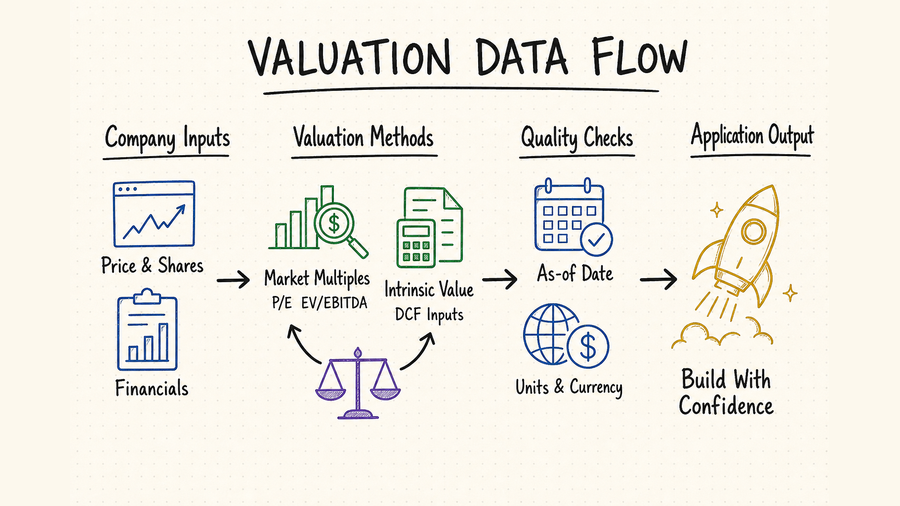
TL;DR
A screener, comparable-company model, DCF, and historical factor test require different fields. Start with the decision and output, then choose the smallest dataset that supplies compatible inputs.
Market value, enterprise value, TTM ratios, forward estimates, and reported fundamentals can refer to different dates and calculation policies. Preserve every relevant timestamp and denominator.
Free access is useful for schema review, prototypes, personal research, and a limited acceptance test. Production fit still depends on coverage, quota, stability, history, support, and redistribution rights.
What valuation data should the API cover?
Start from the decision, not the endpoint
A stock screener may need current market capitalization and comparable-company multiples. A research notebook may need standardized financial statements, diluted shares, net debt, estimate horizons, and historical ratios. A DCF model needs revenue drivers, margins, taxes, capital expenditure, working capital, discount-rate assumptions, and terminal-value inputs. No single “valuation” field can serve all these jobs, and a provider-calculated fair value cannot replace a transparent model when the assumptions matter.
Separate reported inputs, calculated metrics, and estimates
Reported facts come from company filings; standardized fundamentals reflect a provider's mapping and normalization; market capitalization and enterprise value combine market and balance-sheet inputs; ratios apply an additional formula; analyst estimates introduce a forecast horizon and contributor set. Store the data class, provider, fiscal period, filing or publication date, revision status, and calculation timestamp. Without those fields, two values with the same label may not be comparable.
Keep price, price time, basic and diluted shares, market cap, debt, cash, preferred equity, minority interest, and enterprise value. State whether each value is reported, normalized, or provider-calculated.
Retain fiscal period, filing date, currency, accounting standard, restatement status, original reported value, and normalized value when both exist. Do not mix annual, quarterly, and TTM periods.
Store numerator, denominator, period, and formula beside P/E, P/S, P/B, EV/Sales, EV/EBITDA, free-cash-flow yield, and return metrics. A ratio without lineage is difficult to validate.
For estimates, preserve the forecast period, as-of date, contributor count when available, mean or median convention, and revision history. For DCF assumptions, identify which values came from the API and which were chosen by the analyst.
Preserve identity, currency, and time
Resolve symbol plus exchange to a stable security and issuer identifier before joining prices, statements, and estimates. Record the listing currency, statement currency, conversion rate and conversion date when they differ. Keep the price timestamp separate from the shares-effective date and the financial-period end. For historical research, also preserve when the filing, estimate, or normalized record first became available; period end is not the same as information availability.
Match API fields to the valuation method
Choose one method and define its inputs before evaluating providers. The same API can be suitable for a current comparable-company screen and unsuitable for a historical factor test. The table below identifies the minimum data contract and the failure that deserves the most attention.
| Method | Required fields | Key caveat |
|---|---|---|
| Comparable multiples | Price, shares, enterprise value, sales, EBITDA, earnings, book value, and estimates. | Peers, fiscal periods, and adjusted metrics must be consistent. |
| Discounted cash flow | Cash flow drivers, debt, cash, share count, discount rate, and terminal assumptions. | The API supplies inputs; your assumptions still determine the result. |
| Asset-based value | Assets, liabilities, off-balance-sheet items, and asset-specific adjustments. | Reported book values may differ greatly from realizable values. |
| Historical factor | Point-in-time prices, shares, statements, estimates, publication dates, and universe history. | Later revisions and survivor-only universes create look-ahead bias. |
Rebuild key metrics from their components
For a representative sample, independently calculate market cap, net debt, enterprise value, and several ratios from the returned components. Reconciliation should align the security, as-of time, currency, share class, split basis, fiscal period, and adjusted-versus-reported convention. Set absolute and percentage tolerances appropriate to the application, then route exceptions for review instead of automatically accepting the newest or largest value. The related free market cap API guide covers price and share-count alignment in more detail.
Validate historical and operational fit
- Test representative companies: include a financial institution, a loss-making company, a recent IPO, a multi-class issuer, a foreign listing, and a company with a recent restatement or major capital-structure change.
- Check missing-value semantics: distinguish zero, unavailable, not meaningful, and not covered. A negative denominator can make a ratio economically meaningless without making the source value invalid.
- Inspect period labels: confirm annual, quarterly, latest-quarter, TTM, and forward values are not silently mixed in one comparison.
- Exercise failures: test invalid symbols, authentication failure, rate limits, timeouts, partial payloads, schema changes, and provider maintenance.
- Measure freshness: monitor the age of market inputs, filing inputs, and estimates separately. A successful HTTP response can still contain stale valuation data.
- Review data rights: check whether caching, derived calculations, display, exports, and redistribution are permitted for the intended product.
For backtests, require point-in-time fundamentals and the date each record became available. Do not combine historical prices with today's restated fundamentals or current share count. Keep the historical universe, delistings, identifier changes, and estimate revisions. See the separate stock data API for backtesting guide for a fuller treatment of availability dates and survivorship controls.
Inspect a valuation-metrics capability with QVeris
The exact QVeris Key Metrics Tool is a strong match for company valuation screening. Its record describes annual or quarterly metrics including market cap, enterprise value, EV/Sales, EV/EBITDA, earnings yield, free-cash-flow yield, working capital, and per-share measures.
Inspect before calling
Review the required symbol, period, and limit parameters; inspect the returned schema; and confirm the provider identity on the Financial Modeling Prep Provider Profile. Start with one representative company and save the tool ID, request parameters, raw response, retrieval time, and validation result before expanding coverage.
Keep the product boundary explicit
The Key Metrics capability supplies standardized metrics; it does not make a complete valuation decision. A DCF still needs explicit operating forecasts, discount rates, terminal assumptions, and scenario controls. A historical strategy still needs point-in-time availability and revision history. QVeris helps discover, inspect, and call the capability, but provider documentation, licensing, and your acceptance tests remain authoritative for production use.
FAQ
It can be useful, but reliability depends on source filings, normalization, price timing, corporate actions, estimate revisions, and calculation definitions. Verify representative records and reconcile important metrics from components.
Not automatically. Free access and commercial use or redistribution are separate rights. Review the provider's current terms for caching, display, attribution, derived values, exports, and redistribution.
Only when the data is point-in-time and preserves publication or availability dates, revisions, historical identifiers, and the investable universe. Historical prices combined with current fundamentals create look-ahead bias.
No. It can supply statements, market values, ratios, and some assumptions, but the analyst still controls forecasts, discount rates, terminal value, scenarios, and the interpretation of uncertainty.
References and next steps
FMP Key Metrics documentation
FMP Financial Ratios documentation
FMP Stable API documentation