
Free Top Losers API
Python Guide
Compare free top losers API options, validate the price behind each decline, separate real drawdowns from market-state anomalies, and build an explainable Python risk workflow.
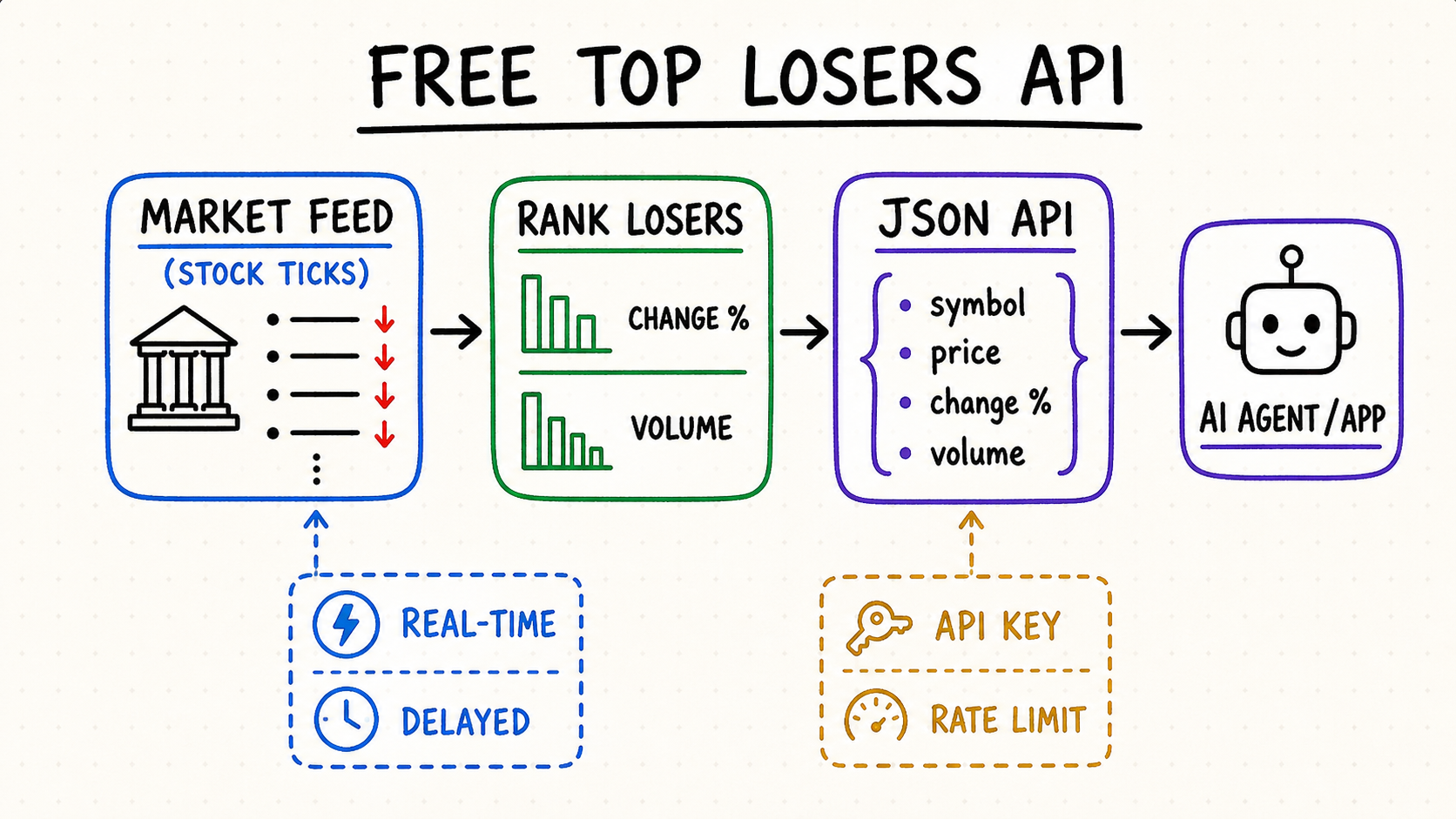
What a free top losers API should accomplish
This page targets downside-risk monitoring. A useful losers feed helps a risk desk or agent distinguish a genuine drawdown from a bad print, reverse split, stale prior close, temporary halt, or illiquid microcap. The result should be joined to negative catalysts, portfolio exposure, short-sale constraints, and halt status before it triggers escalation. It is not simply the gainers page with the sort direction reversed.
The default leaderboard should state whether it ranks last trade, midpoint, bid, or an official session close against an adjusted prior close. That choice matters most during fast selloffs: the last trade may precede a halt, the bid can reprice before another trade occurs, and an after-hours print may be far outside the regular-session market. Risk systems should therefore keep the raw market ranking separate from their own exposure-weighted escalation queue.
Risk interpretation: preserve bid/ask, last trade, prior close, halt code, corporate actions, session, and quote condition. A displayed last price can be stale while the best bid has collapsed, or can be one erroneous trade outside the current market.
What a stock market top losers API should return
Validate the negative move against the market
Require prior close, current last, bid, ask, percentage change, session, and quote condition. Compare the last trade with the current spread before declaring a live drawdown.
Screen corporate-action distortions
Reverse splits, distributions, rights, spin-offs, and symbol changes can create extreme unadjusted losses. Join the effective corporate-action calendar before ranking.
Preserve halt, resume, and price-band states
A halted security may remain near the top while its displayed quote is stale. Store halt reason, halt time, resume time, auction state, and any regulatory price band.
Prioritize portfolio and liquidity impact
Join position size, borrow availability, spread, depth, volume, market cap, and negative event type. A smaller liquid decline can matter more than a spectacular move in an unowned microcap.
Distinguish price loss from total-return effects
A cash distribution or other ex-date event can reduce the quoted price without creating an equivalent economic loss. Preserve adjustment type, ex-date, distribution amount, and both raw and adjusted returns before labeling the move as a drawdown.
Handle delistings and terminal price states
Bankruptcy, delisting, symbol deletion, OTC migration, and a long trading suspension require explicit status fields. Do not keep carrying an old quote as though it were a live, continuously tradable price, and do not invent a zero when no closing transaction exists.
Free stock market losers API sources to evaluate
Treat the provider table as a verification checklist, not an endorsement; availability and terms can change. Evaluate every candidate with the same fixed incident set: an ordinary decline, earnings gap, reverse split, distribution ex-date, intraday halt, resumed auction, delisting event, and thin after-hours trade. Record which rows each source includes, how it timestamps them, and whether the displayed loss can be rebuilt from underlying prices.
| Source | Useful signal | Verify before use |
|---|---|---|
| Alpha Vantage | Official documentation lists TOP_GAINERS_LOSERS, returning 20 U.S. gainers, losers, and most-active tickers. | Free-key quota, default data freshness, exchange entitlements, and production terms. |
| Massive | Its Top Market Movers endpoint documents the top 20 U.S. gainers or losers and a minimum-volume filter. | Current plan access, snapshot timing, market delay, and redistribution rights. |
| Financial Modeling Prep | Its Market Top Losers page exposes a losers endpoint and fields such as symbol, name, price, and change. | Current endpoint path, free-plan availability, quota, freshness, and security types included. |
| Webull | Official docs support gainers/losers ranking by period, category, sort field, and ascending direction. | App credentials, sandbox versus production, supported market, signature flow, and access approval. |
Top losers API Python example and validation
Build an executable-market list from normalized rows and route excluded anomalies to review. This example requires an active, valid quote; recalculates the decline from an adjusted prior close; and refuses to turn a missing or terminal price into zero.
from decimal import Decimal, InvalidOperation


def build_tradable_losers(
    rows: list[dict],
    minimum_dollar_volume: Decimal = Decimal("1000000"),
    limit: int = 20,
) -> tuple[list[dict], list[dict]]:
    eligible, review = [], []
    for row in rows:
        reasons = []
        if row.get("session") != "regular":
            reasons.append("outside_regular_session")
        if row.get("halt_status") != "trading":
            reasons.append("halted_or_terminal")
        if row.get("quote_status") != "valid":
            reasons.append("stale_or_invalid_quote")
        if row.get("prior_close_adjusted") is not True:
            reasons.append("unverified_baseline")
        if row.get("corporate_action_status") not in {None, "resolved"}:
            reasons.append("unresolved_corporate_action")
        try:
            current = Decimal(str(row["current_price"]))
            prior_close = Decimal(str(row["prior_regular_close"]))
            bid = Decimal(str(row["bid"]))
            ask = Decimal(str(row["ask"]))
            volume = Decimal(str(row["volume"]))
        except (KeyError, InvalidOperation):
            review.append({"symbol": row.get("symbol"), "reasons": ["invalid_numeric_fields"]})
            continue
        if min(current, prior_close, bid, ask) <= 0 or volume < 0:
            reasons.append("non_positive_price_or_volume")
        if bid > ask:
            reasons.append("crossed_market")
        change_pct = ((current / prior_close) - Decimal("1")) * Decimal("100") if prior_close > 0 else Decimal("0")
        if change_pct <= Decimal("-100") or change_pct >= 0:
            reasons.append("not_a_valid_decline")
        if current * volume < minimum_dollar_volume:
            reasons.append("insufficient_dollar_volume")
        if reasons:
            review.append({"symbol": row.get("symbol"), "reasons": reasons})
            continue
        eligible.append({
            "symbol": row["symbol"], "exchange": row["exchange"],
            "current_price": current, "prior_regular_close": prior_close,
            "change_pct": change_pct, "bid": bid, "ask": ask,
            "source_timestamp": row["source_timestamp"],
            "rule_version": "tradable-losers-v1",
        })
    eligible.sort(key=lambda item: (item["change_pct"], item["symbol"]))
    for rank, item in enumerate(eligible[:limit], start=1):
        item["rank"] = rank
    return eligible[:limit], review
Review rows are evidence, not waste. A halted issuer, unresolved reverse split, or terminal listing can be more important to a risk team than a valid ranked quote. Keep those records with explicit reasons in a separate queue; excluding them from an executable leaderboard must not erase the underlying event.
1. Validate the decline with bid, ask, and quote condition
Normalize percentage change, then compare last trade with current bid and ask. Quarantine crossed markets, out-of-sequence trades, stale quotes, and values outside the security’s valid price regime.
2. Join halt and corporate-action state
Before escalating, check regulatory halt codes, resume auctions, reverse splits, distributions, rights, spin-offs, and symbol changes. Preserve the state that explains why the move may not be directly tradable.
3. Rank by risk impact, not percentage alone
Combine decline with portfolio exposure, liquidity, spread, borrow status, options activity, market cap, and event severity. Keep raw market rank separate from the firm-specific escalation score.
4. Record evidence for each alert
Attach source timestamps, quote snapshot, corporate-action check, halt status, triggering news or filing, and validation outcome. A risk alert must remain explainable after the market recovers.
5. Build an event timeline, not a single snapshot
Store first appearance, worst rank, lowest validated bid or trade, halt and resume transitions, recovery from the low, and exit from the list. The path distinguishes a continuing impairment from a temporary liquidity vacuum or erroneous print.
6. Define escalation and suppression separately
Escalate on validated loss, owned exposure, liquidity deterioration, or a material filing. Suppress or route for review when the baseline is missing, a corporate action is unresolved, the quote is stale, or trading is halted without a current executable market.
How QVeris helps connect market movers APIs
QVeris does not publish stock rankings, grant exchange licenses, or guarantee a provider’s feed. It helps developers and agents discover available financial-data capabilities, inspect interfaces, and connect a selected external tool through a consistent workflow.
- Open the Alpha Vantage Top Gainers & Losers tool details to inspect the exact market-movers capability.
- Inspect inputs, outputs, authentication, supported markets, provider documentation, quote conditions, timestamps, and adjustment conventions before connecting.
- Follow the QVeris REST API reference or Python SDK guide to discover, inspect, and call the selected capability.
- Use the QVeris Capability Map to explore adjacent data tools; connectivity and downside rankings are not investment advice.
Free top losers API FAQ
Is there a free API for top losing stocks?
Yes. Some providers offer a free key or trial. Verify market coverage, data delay, quota, fields, licensing, and whether the endpoint remains in the current plan.
Which API returns top gainers and losers?
Alpha Vantage, Massive, FMP, and Webull document market movers or ranking endpoints. Their authentication and access terms differ.
Can I get real-time top losers data for free?
Sometimes, but free responses may be delayed or end-of-day. Read the result timestamp and provider entitlement notes.
How do I call a top losers API in Python?
Send a documented GET request, raise for HTTP errors, parse JSON, normalize percentage change, and verify the most negative valid values sort first.
What fields should a stock losers API return?
Look for symbol, name, price, change, percentage change, volume, market, timestamp, and explicit error or status fields.
Should a halted stock remain on the losers list?
It may remain visible, but it must be labeled halted with the halt time and last valid market state. A stale displayed price should not be presented as an executable quote or used for repeated automated alerts.
Can a dividend make a stock look like a top loser?
Yes. On the ex-date, the quoted price can drop by roughly the distribution amount. Compare raw and adjusted returns and preserve the distribution record before interpreting the move as economic loss.
Why do the bid and last price show different losses?
The last trade records a completed transaction, while the bid reflects current displayed buying interest. During a fast decline or thin session they may update at different times; preserve both with timestamps and quote conditions.