
Free Stock Split API
for Historical & Upcoming DataStock Split API
History & Calendar
Compare split dates, ratios, revisions, and limits before adjusting prices, shares, volume, and positions.
Free stock split API: what developers need
A stock split API should identify when a listed security changes its shares-per-unit relationship without treating that mechanical change as an investment gain or loss. For each event, require a stable security ID, original and current ticker where relevant, announcement and effective dates, forward or reverse type, numerator and denominator, a documented factor orientation, status, source timestamp, and revision history.
The ratio must be interpreted before it is applied. A “4-for-1” split can be represented as 4:1, 1:4, or a factor of 4 depending on the provider and target field. Define whether the factor means new shares divided by old shares, new price divided by old price, or the inverse. Store the original terms and derive separate price, share, and volume factors so the same event is never applied in the wrong direction.
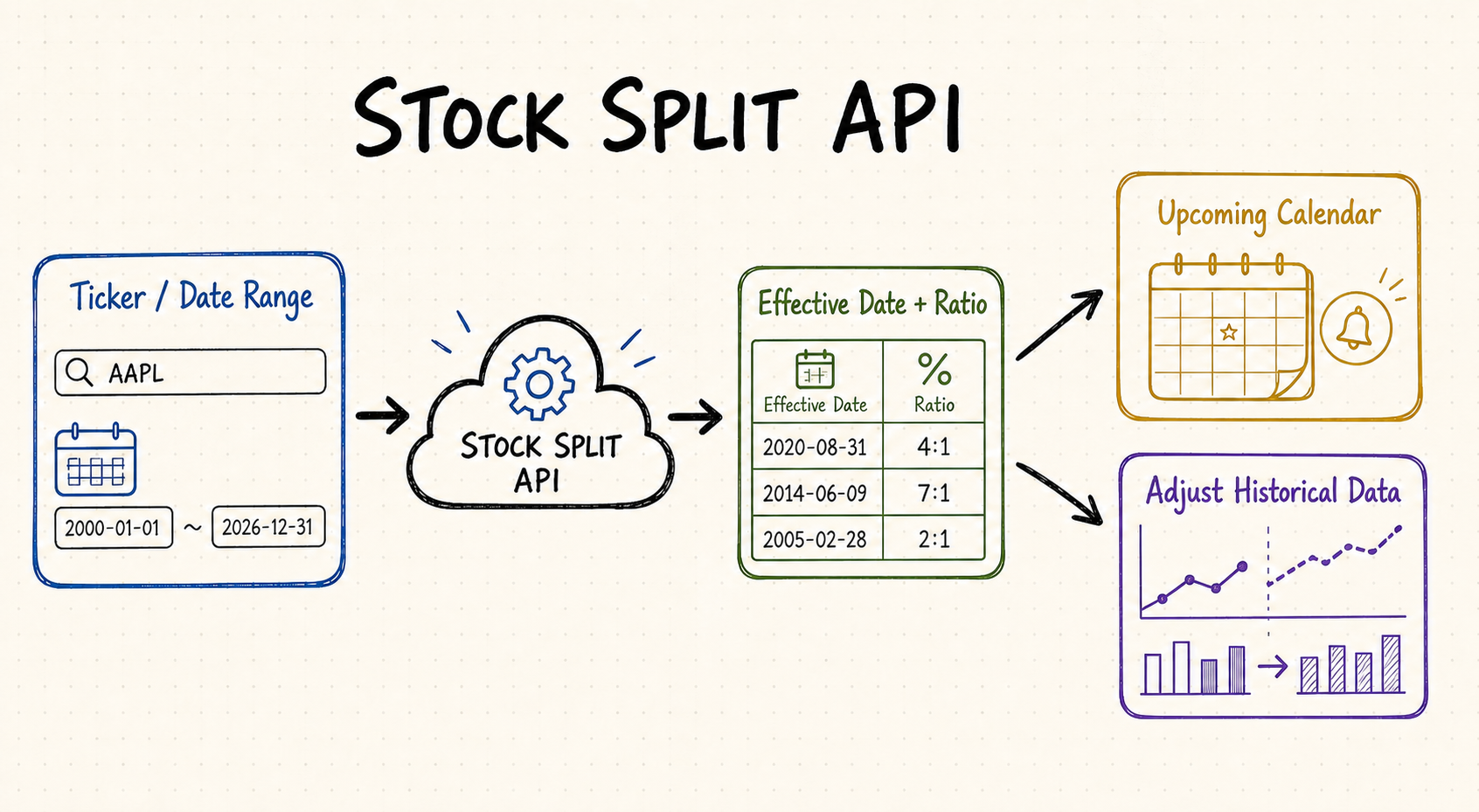
Query historical or upcoming stock splits by ticker or date range and receive machine-readable dates and ratios.
Stable ID, announcement and effective dates, numerator, denominator, ratio orientation, status, and forward or reverse type.
Maintain a stock split calendar, normalize time series, and prevent a split from looking like a sudden price collapse.
Check request quotas, history depth, exchange coverage, delayed data, attribution, and commercial-use terms.
Historical stock split data and upcoming calendars
There are two distinct retrieval jobs: a ticker-level history for rebuilding one security and a market-wide calendar for monitoring a date window. A provider may expose both, but the endpoints, date filters, update cadence, and free-tier limits can differ. Historical data should include completed and corrected events; an upcoming calendar should expose announced, confirmed, amended, postponed, and cancelled states where available.
Stock split history API by ticker
Use this pattern when importing a symbol, rebuilding an adjusted series, recalculating shares outstanding, or checking whether a price gap was mechanical. History must survive ticker changes and delistings, so prefer a permanent security identifier with symbol effective dates. Preserve the raw event and the provider’s adjustment convention before deriving research-ready fields.
Upcoming and reverse stock split API
Calendar requests usually filter by start date, end date, exchange, or split type. Include reverse splits in testing: a 1-for-10 consolidation needs a factor below one when represented as new shares divided by old shares.
What a split changes—and what it does not
A split changes per-share price, share count, per-share fundamentals, and often reported volume units, while leaving the investor’s economic ownership approximately unchanged before market movement and implementation frictions. Historical adjustment should therefore transform linked fields coherently. Adjusting close without open, high, low, volume, shares, options deliverables, or per-share metrics can create internally inconsistent research data.
Stock split dates, fractional shares, and adjustment math
A provider may expose several dates for one event. Preserve each date under its own meaning instead of choosing whichever field is populated. The announcement date is when terms become public; the record date can identify holders for administrative purposes; the effective or ex-date is when the new share relationship and trading basis apply; the distribution or payable date describes delivery. Exact mechanics vary by market and event, so the source notice—not a generic date label—should control the interpretation.
Store announced terms, source document, first-known time, event ID, and status. A future event may later be amended, postponed, or cancelled.
Use the confirmed effective or ex-date for price-series boundaries. Do not shift the factor to the announcement date merely because that date appeared first.
A reverse split can create fractional entitlements. Preserve whether fractions are rounded, aggregated and sold for cash in lieu, or handled under another issuer rule.
Keep the permanent security ID, old and new ticker, exchange, and effective ranges. A symbol change beside a split must not break or duplicate the history.
For a 4-for-1 forward split, each old share becomes four new shares: the share factor is 4 and the price factor is 1/4. A pre-split close of $120 becomes $30 on a comparable adjusted basis, while 1,000 pre-split shares become 4,000; the approximate position value remains $120,000 before market movement. For a 1-for-10 reverse split, the share factor is 0.1 and the price factor is 10. An account with 103 shares may become 10.3 shares before the issuer's fractional-share rule is applied. These assertions catch reversed ratios and silent rounding.
How to use a free stock split API
Start from the task. A per-ticker endpoint answers company history; a calendar endpoint supports daily monitoring and batch ingestion.
Store the API key outside source code. Use an exact ticker or bounded date range, then implement pagination and retry rules from the provider documentation.
Map provider fields into a stable internal schema. Validate that numerator divided by denominator matches the split factor and type.
Do not adjust an already adjusted price series. Record the source event, factor, ingestion time, and transformation version.
Poll upcoming events by update time, then re-fetch recently effective splits. Keep amended, postponed, and cancelled versions under one event lineage rather than creating silent duplicates.
On the effective boundary, test price continuity, inverse share-factor behavior, volume convention, market-cap continuity, and downstream per-share metrics. Quarantine unexplained jumps instead of guessing a factor.
GET /splits?ticker=AAPL&start_date=2020-01-01
Authorization: Bearer YOUR_API_KEY

{
  "ticker": "AAPL",
  "effective_date": "2020-08-31",
  "ratio": "4:1",
  "split_factor": 4
}
This is a provider-neutral schema example, not a live QVeris endpoint. Match parameter names and authentication to the selected provider's documentation.
Compare free stock split data API options
| Criterion | Questions to verify | Why it matters |
|---|---|---|
| Free access | Is it a permanent free plan, a trial, or delayed sample data? Is commercial use allowed? | “Free” can describe materially different rights and limits. |
| Coverage | Which exchanges, assets, historical years, upcoming events, and reverse splits are included? | Missing events can corrupt downstream adjustments. |
| Fields | Are effective date, ratio, numerator, denominator, factor, type, status, and exchange available? | Explicit fields reduce ambiguous parsing. |
| Factor semantics | Does the factor apply to shares or prices? Is it new divided by old, or old divided by new? | A correct event applied backward corrupts the entire history. |
| Identity and lineage | Are permanent security ID, provider event ID, old and new ticker, source time, and revision time returned? | Supports deduplication, ticker changes, and point-in-time research. |
| Adjustment scope | Which price, volume, shares, and per-share fields are already adjusted, and when are factors restated? | Prevents double adjustment and cross-dataset inconsistency. |
| Operations | What are the rate limit, pagination, update schedule, error format, and service terms? | A prototype endpoint still needs reliable ingestion behavior. |
Find and inspect stock split API capabilities with QVeris
QVeris helps developers and agents discover available capabilities, inspect schemas, and connect to real-world tools. Use the Alpha Vantage Stock Splits tool details to evaluate split history and calendar data. Before calling it, inspect identifier and date inputs, ratio fields, status and revision metadata, pagination, coverage, pricing, and provider terms. QVeris can route the capability; your pipeline must still validate factor direction and adjustment state.
- Search by the job: stock split history, corporate actions, or split calendar.
- Inspect input and output fields before writing integration code.
- Keep provider limitations visible in your agent or data-pipeline policy.
Free stock split API FAQ
Is there a free stock split API?
Yes, some providers offer free plans or trials. Compare history depth, request limits, exchange coverage, data delay, attribution, and commercial-use rights.
How do I get historical stock split data by ticker?
Call a ticker-history endpoint with an API key, then store the effective date, ratio, numerator, denominator, and split factor returned for each event.
Can an API return upcoming and reverse stock splits?
Many calendar endpoints do, usually with date-range and split-type filters. Confirm announcement status and update timing with the provider.
How do I adjust historical prices after a stock split?
Apply the documented factor to pre-event prices and share counts, preserve raw values, and make sure the source series was not already adjusted.
What is the difference between a forward and reverse split?
A forward split increases shares and reduces the per-share price proportionally; a reverse split consolidates shares and raises the per-share price proportionally. The event itself does not create equivalent economic value.
How do I avoid applying a split factor backward?
Store numerator and denominator separately, document whether each factor targets price or shares, test a known forward and reverse split, and assert the expected inverse relationship.
Authoritative references
Provider documentation is the source of truth for endpoint behavior. For the corporate-action concept and investor impact, see the U.S. Securities and Exchange Commission's investor bulletin.