
Free Stock Recommendations API
Signals You Can Verify
Evaluate recommendation endpoints by their evidence, timestamps, methodology, and limits—not by a buy or sell label alone.
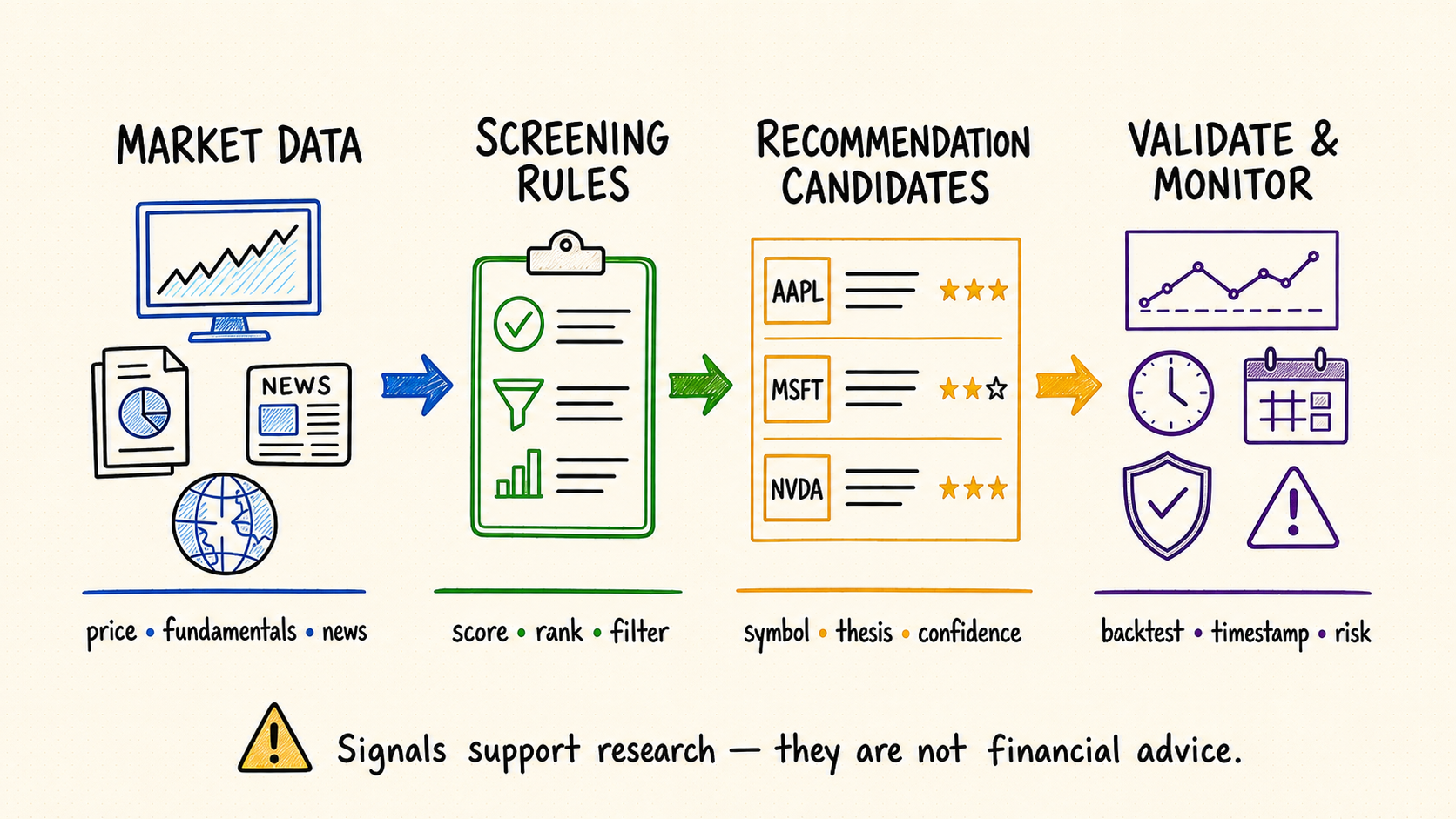
TL;DR
An endpoint may rank symbols, but it should not place trades or replace suitability checks.
Useful results expose factors, observation time, methodology, and universe—not only a label.
Check request caps, data delay, coverage, and commercial-use terms before integration.
Backtest with point-in-time inputs and monitor drift before using a signal.
What a free stock recommendations API should return
A recommendation API converts market observations into ranked research output, often combining price behavior, fundamentals, estimates, news, or technical indicators. Without an input window, scoring rule, and effective time, a symbol list cannot be reproduced or evaluated.
State whether the screen covers common stocks, ETFs, one exchange, or another universe, including delisting rules.
Give each candidate an as-of time and reason. Separate source observation time from recommendation generation time.
Document the score scale, holding horizon, invalidation condition, and refresh time.
For broker research, preserve firm, analyst when licensed, action, previous rating, new rating, announcement time, source ID, and whether the event is initiated, reiterated, upgraded, or downgraded.
State the lookback window, included firms, rating-to-score mapping, duplicate policy, stale-report expiry, and weighting. A consensus without its denominator is not comparable.
If target prices are included, store the currency, horizon, publication time, previous target, new target, and the stock price observed at that time. Never aggregate targets across currencies or mix a newly issued rating with an old target that happened to remain in the source.
Response fields that make a signal testable
| Field | Meaning | Why it matters | Check |
|---|---|---|---|
| symbol | Stable exchange-qualified identifier. | Joining prices and fundamentals. | Ticker reuse across venues. |
| as_of | UTC time when inputs were valid. | Point-in-time testing. | Not the same as delivery time. |
| score / rank | Documented ordering value. | Comparing candidates consistently. | Requires scale and direction. |
| reasons | Factors that contributed to output. | Review and debugging. | Avoid generated explanations without evidence. |
How to evaluate a free recommendation endpoint
Confirm the universe, schedule, sources, corporate-action handling, and whether observations are delayed or real time.
Use only information available at each as-of time. Include fees, slippage, delistings, and empty periods.
Track score changes and timestamp progress. Stale data should return an explicit status, not silently repeat a recommendation.
Record quotas, attribution, commercial rights, retention limits, support, and upgrade pricing.
The same broker action may arrive through multiple wires or summaries. Deduplicate by source event ID and a stable event fingerprint before counting analysts.
A higher consensus can result from bearish analysts dropping out of the window. Track analyst count, additions, removals, and rating changes alongside the average.
Use QVeris to find and inspect market data capabilities
There is no verified QVeris result dedicated to every recommendation methodology. Use the QVeris documentation to understand capability calls and the Playground to inspect candidate market or fundamental inputs. Keep the recommendation logic, evidence, and timestamps in your own auditable layer.
- Search by required data capability, not by a promised outcome.
- Inspect authentication, schema, examples, and terms before use.
- Keep the logic testable and retain every source timestamp.
FAQ
No. Suitability, risk tolerance, portfolio context, and execution remain outside its response.
Only after checking its scale and calibration on unseen periods.
Not always. Compare observation, generation, and delivery times separately.
Keep the request, response, timestamps, method version, universe, and source identifiers.
Keep the original label, then map it through a versioned provider-specific table. Do not assume every “outperform” or five-point scale has the same meaning.
Yes. Reports can age out, coverage can start or stop, duplicates can be corrected, and the eligible analyst set can change.
References and next steps
Financial Modeling Prep documentation
Alpha Vantage documentation
QVeris documentation
QVeris Playground