
How to Choose a Free Stock Options API
Evaluate option chains, Greeks, implied volatility, coverage, delays, and rate limits before a free tier becomes production infrastructure.
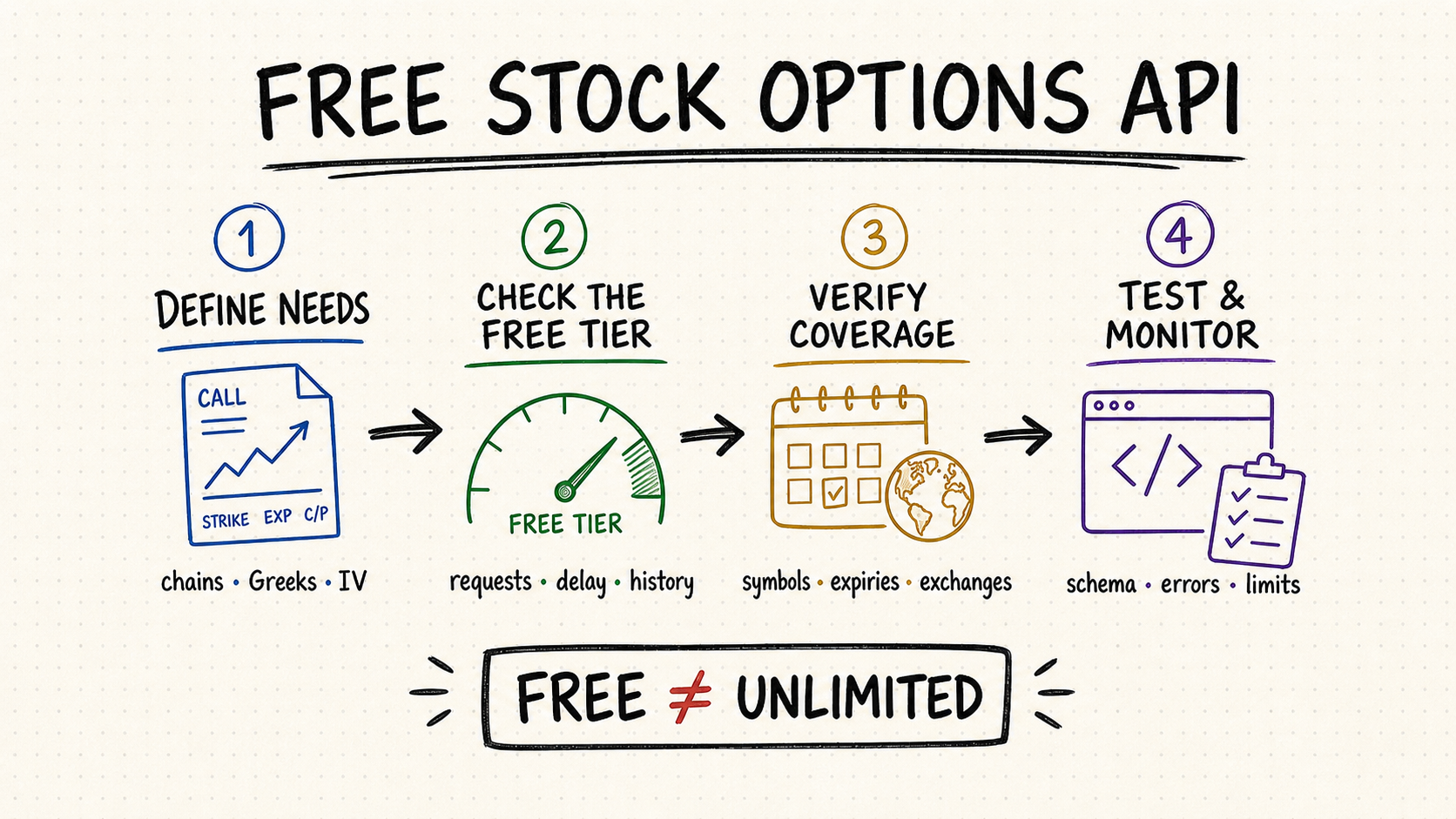
Free stock options API: the short answer
A free tier normally limits requests, symbols, history, real-time access, or commercial use. It is a testing allowance, not unlimited market data.
Confirm whether the API returns complete option chains, strikes, expirations, bid/ask, volume, open interest, Greeks, and implied volatility.
Options data is exchange-licensed. A technically free API may still provide delayed, partial, or non-redistributable data.
Write one representative query, test several liquid and illiquid symbols, then measure completeness, latency, and error behavior.
What an options data API should return
The endpoint shape matters less than whether the data is complete, timestamped, and licensed for your use. For a selected underlying and expiration, you should be able to connect every contract to its market fields and derived analytics.
Use stable identifiers plus underlying symbol, call or put, strike, expiration, exercise style, multiplier, and exchange. Do not infer identity from a display label.
Look for bid, ask, last, quote time, trade time, volume, open interest, and the data delay. A price without a timestamp is hard to trust.
Delta, gamma, theta, vega, rho, and implied volatility are useful only when the provider explains calculation inputs and update cadence.
Preserve the requested underlying, expiration set, strike range, pagination state, and returned contract count. A successful response can still be a partial chain.
Corporate actions can change deliverables, multipliers, strikes, and symbols. Standard 100-share assumptions are unsafe when a contract is adjusted.
Match API features to your use case
| Use case | Data needed | Recommended access | Key limitation |
|---|---|---|---|
| Learning project | Current chain, basic quotes, simple JSON. | Small free allowance and delayed data. | Do not assume production rights. |
| Options screener | Full chains, Greeks, IV, volume, open interest. | Batch endpoints and predictable quotas. | Partial chains create false signals. |
| Backtesting | Point-in-time chains, historical quotes, expired contracts. | Bulk downloads or stable pagination. | Free tiers rarely include deep history. |
| Live trading | Licensed real-time quotes, low latency, SLA. | Paid professional data agreement. | A free API is usually unsuitable. |
Use underlying identity, expiration, call or put, strike with fixed precision, and adjustment identifier. Treat the provider symbol as an attribute, not the only key.
Bid and ask describe current liquidity, last describes a historical trade, and volume or open interest use different update clocks. Never collapse them into one “price freshness” timestamp.
Record spot price, option price side, rate, dividend assumption, model, valuation time, and time-to-expiry convention. Missing inputs should produce null analytics, not plausible zeros.
Verify inclusive strike bounds, weekly and monthly expirations, zero-bid contracts, adjusted series, pagination, and contracts expiring on the query date.
QVeris
Use the QVeris Options Chain tool for a directly relevant chain query, then inspect inputs and outputs in the Playground. Verify provider freshness, exchange rights, chain completeness, and analytics methodology before production use.
- Search for option-chain, quote, or financial-data capabilities by intent.
- Inspect inputs and outputs before writing a provider-specific adapter.
- Keep licensing, freshness, and quota checks in your production acceptance process.
FAQ
Usually not for unrestricted professional use. Exchange-licensed real-time options data commonly requires agreements or fees; free tiers are often delayed, limited, or intended for evaluation.
Some do, but coverage and calculation methods vary. Verify whether values are provider-calculated, how often they update, and what happens when inputs are missing.
The last trade may be old, corrected, or from a different market state. Compare quote time, trade time, venue scope, and condition codes before flagging it.
Check requested versus returned expirations and strikes, pagination tokens, contract counts, and known liquid contracts. HTTP success alone is insufficient.
References and next steps
Alpha Vantage options documentation
Massive options documentation
QVeris Options Chain Tool
QVeris Playground