
Free Stock OHLCV API
for Reliable Candle Data
Choose, validate, and integrate free historical candle data without overlooking intervals, adjustments, rate limits, or usage rights.
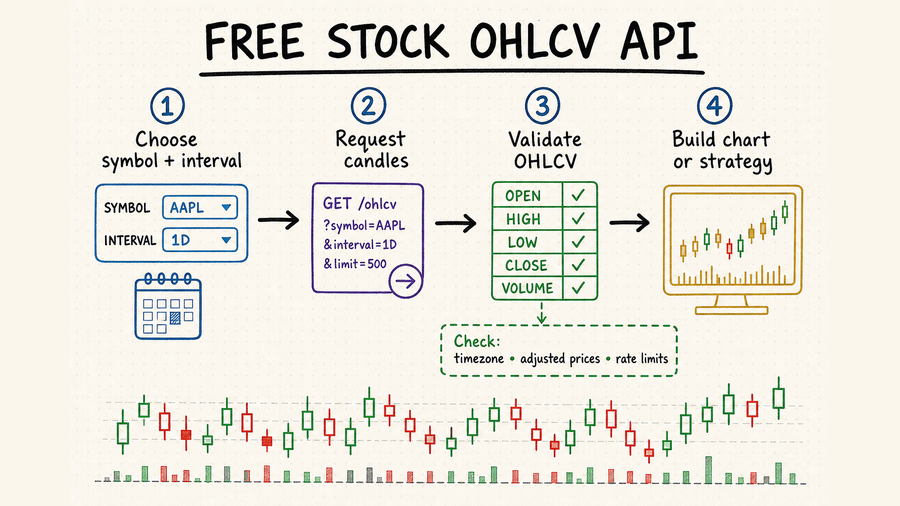
Free stock OHLCV API: quick summary
Time-series candles containing a timestamp plus open, high, low, close, and volume values for a symbol and interval.
Usually a limited quota, delayed coverage, shorter history, or non-commercial terms—not unlimited market data.
Exchange coverage, intervals, historical depth, time zone, split and dividend adjustments, missing bars, and rate limits.
Prototypes, education, research notebooks, charting demos, and low-frequency strategies with explicit data validation.
What OHLCV data means
Each candle aggregates trading activity over an interval. Open is the first eligible trade, high and low are the interval extremes, close is the final eligible trade, and volume is the traded quantity. Provider rules can differ, so identical symbols and intervals may still produce different bars.
Confirm whether timestamps mark the candle open or close, which time zone applies, and whether sessions include pre-market or after-hours trades.
Adjusted history may rewrite past prices after splits or dividends. Never mix raw and adjusted bars in one backtest.
Volume can represent shares, contracts, or another venue-specific unit. Some feeds omit or estimate it.
Expect holidays and halts, but investigate unexplained gaps, duplicate timestamps, zero-volume bars, and impossible high-low ranges.
Confirm whether intervals are left- or right-labeled, whether the ending timestamp is inclusive, and how partial current bars are marked. Boundary differences can duplicate or drop trades.
Bars from one venue, a consolidated feed, and adjusted vendor aggregates need not match. Condition codes determine which trades can set open, high, low, or close.
Compare free OHLCV API options
| Layer | Main job | Best for | Boundary |
|---|---|---|---|
| End-of-day feed | Daily candles after the session closes. | Research, screening, and long-horizon models. | Not suitable for intraday decisions. |
| Intraday REST API | Minute or hourly bars requested on demand. | Charts, alerts, prototypes, and backfills. | Free quotas may be easy to exhaust. |
| Bulk CSV download | Large historical extracts in files. | Notebooks, archives, and reproducible research. | Updates may be delayed or manual. |
| Streaming feed | Live trades or aggregates over a persistent connection. | Live dashboards and event-driven systems. | Real-time exchange rights are rarely fully free. |
Request explicit non-overlapping windows, then verify the first and last timestamp of every page. Cursor and inclusive-date semantics often create duplicate boundary bars.
Aggregate a sample of smaller bars into hourly or daily candles and compare OHLCV. Differences reveal session boundaries, excluded trades, rounding, or missing input bars.
A provider may emit an empty interval with carried-forward prices, omit it entirely, or return nulls. Choose one internal policy and never interpret synthetic bars as trades.
Late trades and corrections can revise bars after the interval closes. Re-fetch a bounded overlap and version material changes rather than assuming old candles are immutable.
Use QVeris to find OHLCV capabilities
There is no single verified QVeris result dedicated to every stock OHLCV interval and market. Use the QVeris documentation to understand the capability layer and the Playground to inspect candidates before validating candle semantics with the provider.
- Search by capability instead of hardcoding a provider before requirements are clear.
- Inspect parameters and response schemas before wiring data into a chart or strategy.
- Keep provider attribution and request context attached to downstream results.
FAQ
Several providers offer free tiers, but they usually limit requests, history, exchanges, intervals, or commercial rights. Treat “free” as a plan constraint, not a data-quality guarantee.
Yes for learning and prototypes if you check survivorship bias, delisted symbols, corporate actions, missing bars, time zones, and whether the history is point-in-time correct.
They may use different venues, eligible-trade rules, interval boundaries, sessions, corrections, or adjustment methods. Compare metadata before choosing a winner.
Only with an explicit provisional flag. Replace them after the interval closes and retain event or retrieval timestamps so downstream code knows which version it used.
References and next steps
Alpha Vantage API documentation
Alpaca market data documentation
Twelve Data API documentation
QVeris documentation
QVeris Playground