
Free Stock Market Data Feed
Compare free feeds for quotes, WebSocket streams, OHLCV, and CSV, then verify latency, coverage, limits, adjustments, and usage rights.
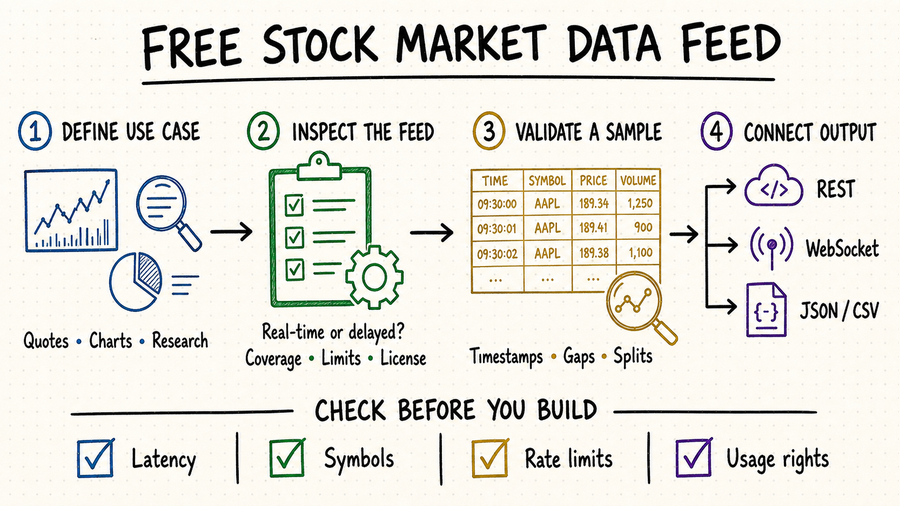
Quick Summary
Most free stock data APIs start with symbol search, delayed quotes, daily OHLCV bars, and limited company metadata.
Compare requests per minute and per day, symbols per call, history depth, exchange coverage, and allowed concurrency.
Verify venues, listing types, premarket and after-hours sessions, halts, auctions, condition codes, and corporate-action reference data.
Monitor universe completeness, feed age, sequence gaps, open and close events, and post-session corrections—not only whether the socket is connected.
Define your requirements before comparing data feeds
Start with the application contract, not a provider name.
The phrase free stock data covers several products that behave very differently. A quote endpoint may return only the latest traded price, while an end-of-day dataset can provide years of bars but no intraday updates. Fundamental feeds often follow company reporting cycles, and regulatory filings may arrive as documents rather than tidy rows.
For research, price fields alone are rarely enough.
Last price, change, bid/ask, session status, and timestamp. Confirm whether values are real-time, delayed, indicative, or end-of-day.
Open, high, low, close, and volume by interval. For return calculations, verify splits, dividends, and adjusted-close methodology.
A national best bid and offer, consolidated last sale, and one venue’s quote are different products. Preserve venue and scope so the application does not compare unlike values.
Maintain active symbols, listing venue, security type, currency, status, symbol changes, and effective dates. A stream cannot repair an incomplete subscription universe.
Handle premarket, core, after-hours, halts, auctions, and early closes explicitly. Silence can mean a closed market, a halted symbol, or a broken feed.
How free stock market data feed options compare
REST APIs are the easiest place to start because they work with ordinary HTTPS clients and return predictable JSON. WebSocket feeds support streaming updates but usually have stricter entitlements. Broker APIs add account and execution context, while bulk-download endpoints are efficient for backfills and repeatable research. A useful free plan should match both your data need and your update pattern.
| Source | What it offers | Best for | Watch for |
|---|---|---|---|
| REST API | Quotes, candles, profiles, and fundamentals over HTTPS. | Apps, agents, prototypes, and scheduled jobs. | Rate limits, pagination, and delayed prices. |
| WebSocket API | Push-based trades, quotes, or aggregate updates. | Live dashboards and event-driven systems. | Connection limits and market entitlements. |
| Broker API | Account-linked data plus portfolio context. | Personal monitoring and execution workflows. | An eligible funded account may be required. |
| Bulk or CSV API | Large historical files for download and archival. | Backfills, notebooks, and backtests. | Less current and more expensive to refresh. |
Compare sources with the same small test set rather than relying on feature lists. Request a liquid stock, a thinly traded security, a symbol that changed, and a date containing a split or dividend. Compare timestamps, missing records, precision, adjustment behavior, and error messages.
Before the open, compare expected and acknowledged subscriptions by venue and security type. Alert on missing groups rather than discovering gaps after users ask for a symbol.
Use event time, receive time, and session state. Highly liquid and thinly traded symbols need different silence thresholds.
Verify official open and close conditions, late prints, corrected trades, and final bar updates. Do not assume the first or last received trade is official.
Use QVeris to find stock data capabilities
There is no single verified QVeris result for every whole-market feed. Use the QVeris documentation to understand callable capabilities and the Playground to inspect candidates before validating market-wide coverage directly with the provider.
FAQ
Yes, several services offer free keys, but quotas, exchanges, history, delays, and permitted uses vary. Compare the full plan contract, not only the price.
Some do for selected venues, while others provide delayed or end-of-day values. Check the exchange entitlement and response timestamp.
No. It can be current for that venue while missing trades and quotes elsewhere. Label venue scope and avoid presenting it as consolidated coverage.
Compare the provider’s active universe with an independent symbol master, then test each venue, session, security type, halt, and corporate-action transition.
References and next steps
Alpaca Market Data
Finnhub API documentation
Twelve Data API documentation
QVeris documentation
QVeris Playground