
Free Stock Fundamental
Data API Guide
Choose free fundamentals by field coverage, filing dates, point-in-time history, request limits, and licensing—not by endpoint count alone.
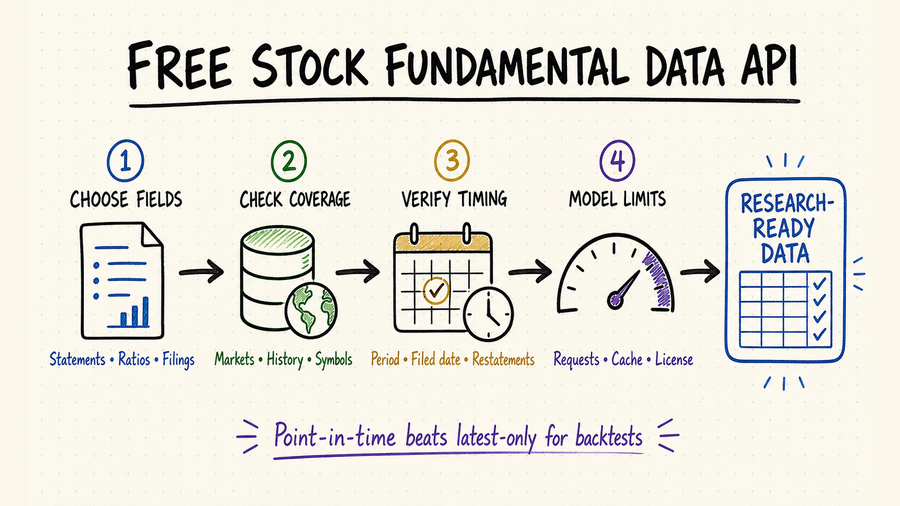
TL;DR
SEC EDGAR provides US filings and company facts, but developers must normalize the records.
Commercial APIs simplify statements and ratios, while free plans restrict quotas or history.
Use filing dates and point-in-time records to avoid look-ahead bias.
Cache filings, retain raw responses, and verify display or redistribution rights.
What a stock fundamental API should include
An API should return income statements, balance sheets, cash-flow statements, currency, fiscal period, and filing dates. Screeners may need shares, enterprise value, margins, growth, and valuation ratios.
Identical labels may hide different methods: reported values, standardized values, trailing-twelve-month calculations, or restatement policies. Test unusual fiscal years and amended filings before adopting a schema.
Preserve statement type, fiscal year, fiscal quarter, period start and end, filing form, consolidated scope, segment, currency, unit, and scale. One numeric value without these dimensions is ambiguous.
Distinguish period-end shares from weighted-average basic and diluted shares. EPS, market capitalization, and per-share ratios cannot safely share one denominator.
Keep provider ratios separate from reported facts. Record formula, numerator, denominator, period alignment, and treatment of negative or missing values.
Why filing dates and point-in-time history matter
The period end says when activity occurred; the filed timestamp says when the market could know it. A December report filed in February cannot enter a January backtest. Store both dates, amendments, source, units, and version.
A screener may accept nightly updates, while an event study needs reliable timestamps. Cache slow-changing history and reserve requests for new filings.
Store at least three clocks: fiscal period end, original filing acceptance time, and the retrieval or provider-availability time. When an amendment arrives, append a new version rather than overwriting the record that a historical strategy would have seen. TTM values should be rebuilt from the four quarters available at the target date, not copied from today’s endpoint into the past.
Free fundamental data sources compared
| Source | Strength | Free access | Watch for |
|---|---|---|---|
| SEC EDGAR | Authoritative US filings and XBRL company facts | Public JSON endpoints | Normalization, request pacing, US focus |
| Alpha Vantage | Statements, overview, earnings, and market data | API key with limited quota | Endpoint limits and normalized methodology |
| Financial Modeling Prep | Developer-friendly statements, ratios, and profiles | Limited free endpoints or plan | Confirm current coverage and commercial rights |
| Provider marketplace | One discovery layer for multiple capabilities | Varies by provider | Inspect freshness, quotas, and license per tool |
A reliable implementation checklist
- Resolve identities: map ticker, exchange, CIK, or another permanent identifier.
- Keep raw data: archive each response before transforming it.
- Normalize carefully: retain currency, scale, period, units, taxonomy, and provenance.
- Respect limits: use caching, conditional refreshes, backoff, and an identifiable user agent.
- Test history: reproduce screens with only information available on the target date.
- Check rights: free access may not permit display, redistribution, or model training.
Add automated reconciliation before publishing a normalized statement. Check that assets approximately equal liabilities plus equity, cash-flow subtotals reconcile within a documented tolerance, units do not change silently, and annual values are not mixed with quarterly values. Compare a small sample back to the filing whenever the provider changes a schema or restates history.
Use QVeris to find the right fundamental capability
For normalized company metrics, open the Financial Modeling Prep Key Metrics tool and inspect the provider profile. Verify period, units, calculation method, freshness, and access terms before using any value in screening or backtests.
FAQ
SEC EDGAR provides public US filings. Commercial free plans usually restrict quotas, history, or endpoints.
Start with statements, shares, period, filing date, currency, and provenance.
Yes, when it includes point-in-time availability and amendments.
Cache by document ID, batch when supported, and retry with backoff.
References and next steps
Alpha Vantage documentation
Financial Modeling Prep documentation
QVeris Key Metrics Tool
Financial Modeling Prep provider profile