
Choose a Free Stock Data Feed
That Fits Your Build
Compare REST APIs, CSV downloads, and WebSocket streams—then verify delay, coverage, limits, and licensing before you integrate.
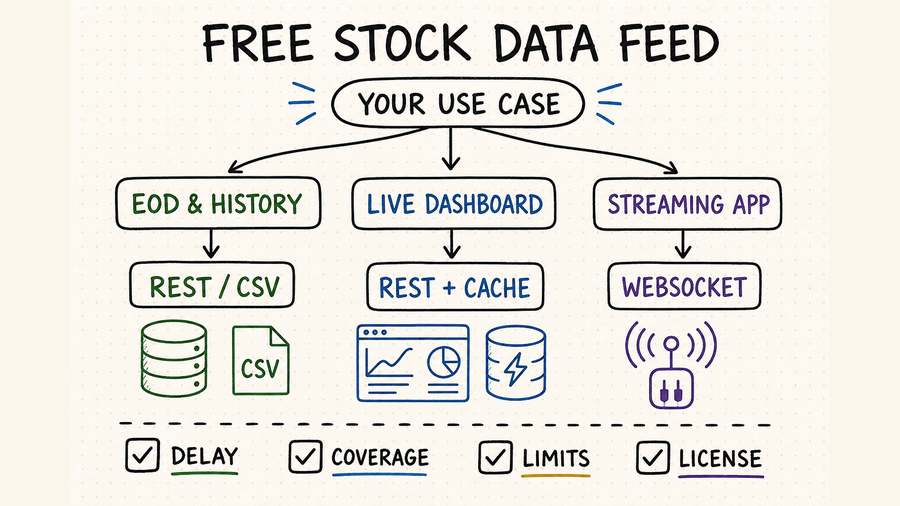
Quick Summary
Free tiers commonly expose delayed quotes, daily OHLCV history, company profiles, and selected fundamentals.
Check exchange coverage, timestamps, adjustment rules, request limits, redistribution rights, and commercial-use terms.
Use REST for snapshots and history, WebSocket for continuous events, and bulk files for large backfills or reproducible archives.
A dependable feed needs sequence checks, reconnect logic, stale-data alerts, and a snapshot path to repair missed events.
Which free stock data feed do you actually need?
Start with the decision or product you are building.
The phrase free stock market data covers several products that behave very differently. A quote endpoint may return only the latest traded price, while an end-of-day dataset can provide years of bars but no intraday updates. Fundamental feeds often follow company reporting cycles, and regulatory filings may arrive as documents rather than tidy rows. Define the market, asset class, frequency, history depth, and acceptable delay before comparing providers.
For research, price fields alone are rarely enough. You may also need trading calendars, symbol changes, delistings, currency, exchange identifiers, and corporate actions. These reference fields prevent survivorship bias and make it possible to join prices with fundamentals correctly.
Last price, change, bid/ask, session status, and timestamp. Confirm whether values are real-time, delayed, indicative, or end-of-day.
Open, high, low, close, and volume by interval. For return calculations, verify splits, dividends, and adjusted-close methodology.
Events may arrive out of order, repeat after reconnect, or cover only one venue. Preserve event time, receive time, sequence, venue, and condition codes.
A stream tells you what changed; a snapshot tells you the current state. Use both when a disconnect can leave your order book or watchlist incomplete.
How free stock data feed options compare
No single source is best for every workflow. Exchanges and regulators are closest to primary records, but their files may require more cleaning.
| Source | What it offers | Best for | Watch for |
|---|---|---|---|
| Exchange or regulator | Authoritative listings, notices, and filings. | Verification and primary-source research. | May be fragmented or not API-friendly. |
| Free market-data API | Normalized quotes, history, and fundamentals. | Apps, agents, prototypes, and repeatable research. | Rate limits, delays, and license restrictions. |
| Broker data | Account-linked quotes and trading context. | Personal portfolio and execution workflows. | Access may require an eligible account. |
| CSV or bulk dataset | Portable files for analysis and archival. | Spreadsheets, notebooks, and backtests. | Often less current than a live API. |
Compare sources with the same small test set rather than relying on feature lists. Request a liquid stock, a thinly traded security, a symbol that changed, and a date containing a split or dividend. Compare timestamps, missing records, precision, adjustment behavior, and error messages.
Record requested and acknowledged symbols separately. After reconnect, resubscribe from a clean state and verify that every expected channel is active.
Compare event time and receive time against market-session expectations. A connected socket with no fresh events is not a healthy feed.
Use provider sequence IDs or a composite event key to tolerate duplicates. Do not let a replay inflate volume, counts, or derived bars.
On a sequence gap, pause downstream state updates, fetch a current snapshot or bounded REST window, then resume from a known point.
Use QVeris to find stock data capabilities
There is no single verified QVeris result that represents every stock data feed. Use the QVeris documentation to understand callable capabilities and the Playground to inspect candidates before committing to a transport and provider.
FAQ
Start with exchanges and regulators for primary records, then compare free API or broker tiers for normalized quotes, history, and fundamentals.
Sometimes, but often it is delayed or limited to specific venues. Always read the timestamp, entitlement, and exchange-coverage notes.
Poll REST when occasional snapshots are enough. Use WebSocket when event latency matters and you can operate reconnect, ordering, and recovery logic.
Set thresholds by session and symbol, compare source and receive timestamps, monitor heartbeats, and verify silence against a snapshot endpoint.
References and next steps
Alpaca Market Data
Finnhub API documentation
Twelve Data API documentation
QVeris documentation
QVeris Playground