
Free Stock Data Download
Sources, CSV & APIs
Download free historical stock prices in CSV or JSON—then verify symbols, adjustments, timestamps, missing rows, and licensing before analysis.
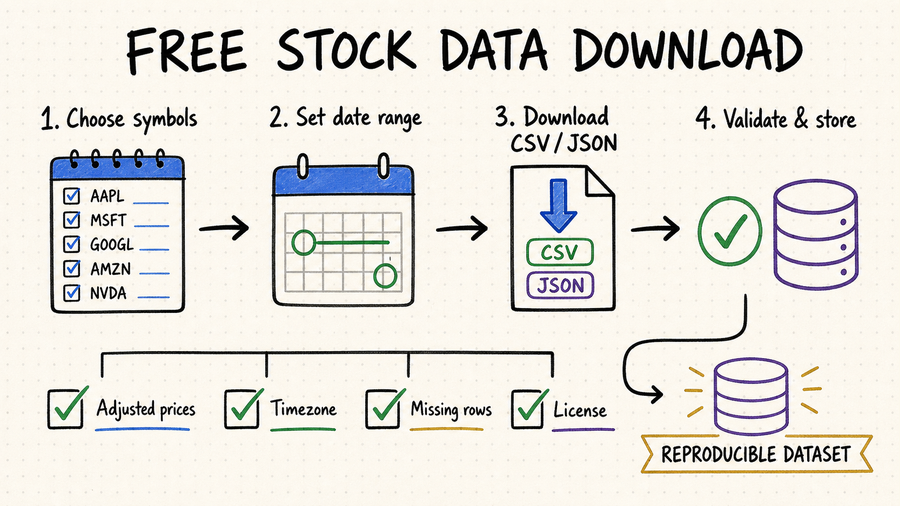
Quick Summary
Free sources may provide daily or intraday OHLCV bars, adjusted close prices, dividends, splits, and symbol metadata.
Check exchange coverage, timestamps, adjustment rules, request limits, redistribution rights, and commercial-use terms.
Use a manual file for one-off work, a parameterized export for recurring research, and bulk archives for large historical universes.
Store the source, request, retrieval time, license note, schema version, and checksum next to every downloaded dataset.
Which stock market data should you download for free?
Start with the decision or product you are building. A watchlist may need recent quotes, a backtest needs long and survivorship-aware history, and a spreadsheet may only need daily OHLCV data. An agent or application also needs stable schemas and source metadata.
Free downloadable stock data products differ in update frequency, historical depth, exchange coverage, and adjustment policy.
For research, price fields alone are rarely enough. You may also need trading calendars, symbol changes, delistings, currency, exchange identifiers, and corporate actions. These reference fields prevent survivorship bias and make it possible to join prices with fundamentals correctly.
Last price, change, bid/ask, session status, and timestamp. Confirm whether values are real-time, delayed, indicative, or end-of-day.
Open, high, low, close, adjusted close, and volume by day or minute. Check session boundaries, missing bars, and adjustment rules.
Splits, dividends, symbol changes, exchange, currency, and delisting status explain discontinuities that price-only downloads cannot resolve.
Financial statements need filing and availability dates, not only fiscal periods. Without them, a historical download can introduce look-ahead bias.
How free stock market data sources compare
No single source is best for every workflow.
| Source | What it offers | Best for | Watch for |
|---|---|---|---|
| Exchange or regulator | Official listings, filings, notices, and selected market files. | Verification and primary-source research. | Mixed formats, limited bulk history, and usage terms. |
| Free market-data API | Normalized quotes, history, and fundamentals. | Apps, agents, prototypes, and repeatable research. | Rate limits, delays, and license restrictions. |
| Community dataset | Prebuilt historical stock files shared for research. | Learning, notebooks, and quick experiments. | Unclear lineage, stale files, and licensing gaps. |
| CSV or bulk dataset | Portable files for analysis and archival. | Spreadsheets, notebooks, and backtests. | Often less current than a live API. |
Compare sources with the same small test set rather than relying on feature lists. Request a liquid stock, a thinly traded security, a symbol that changed, and a date containing a split or dividend. Compare timestamps, missing records, precision, adjustment behavior, and error messages.
List every symbol, interval, date partition, expected file name, and source URL before starting. Mark each object pending, complete, or failed so interrupted jobs can resume safely.
Check status, content type, file size, checksum, header row, and minimum row count. A 200 response can still contain an HTML error page or a truncated archive.
Write downloads to a temporary version, validate cross-file uniqueness and date coverage, then publish the completed snapshot atomically.
Keep the original provider files immutable. Build cleaned CSV or Parquet outputs separately so parsing changes never destroy the evidence needed to reproduce them.
Use QVeris to find stock data capabilities
There is no one verified QVeris result for every stock-data download. Use the QVeris documentation to understand repeatable calls and the Playground to inspect candidate capabilities when manual downloads no longer scale.
FAQ
Start with exchanges, regulators, and reputable market-data providers, then compare free APIs and bulk files for coverage, history, adjustments, and licensing.
It may be live, delayed, or end-of-day depending on the exchange and license. Always check timestamps, session coverage, and entitlements.
Use a manifest and write each file atomically. On restart, verify completed checksums and retry only missing or invalid partitions.
Only if the provider and applicable exchange terms allow it. Free access, personal analysis, derived display, and redistribution are separate rights.
References and next steps
Stooq data download
Alpha Vantage API documentation
Twelve Data API documentation
QVeris documentation
QVeris Playground