
Free Social Sentiment API
Compare source coverage, sentiment fields, freshness, history, free limits, and integration paths.
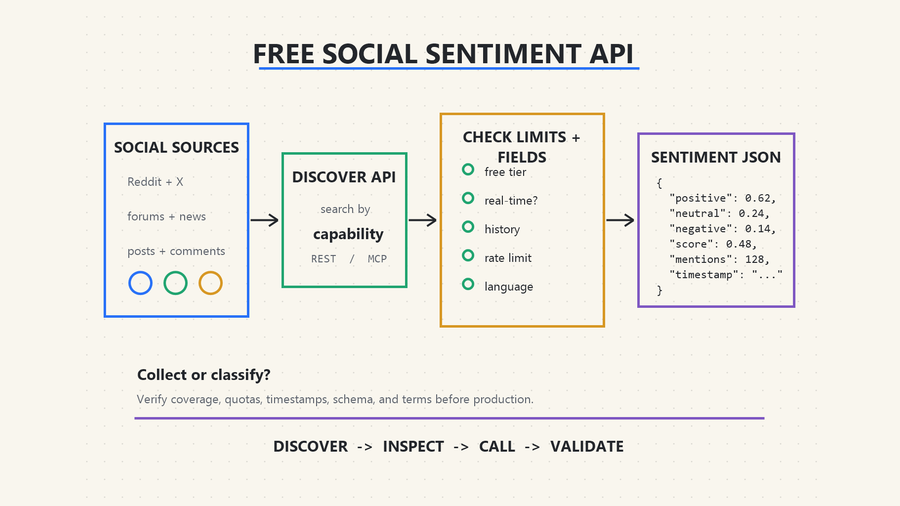
Two ways to build social media sentiment analysis
Use a social listening API with sentiment included
Send a keyword, topic, account, ticker, or URL and receive mentions plus sentiment fields. This is the shortest path, but source coverage, history, and classification details may be provider-specific.
Combine a social media data API with a text sentiment API
Collect permitted public content first, then classify each text item. This gives more control over language models and storage, but you must handle deduplication, rate limits, privacy, and platform terms.
Choose a finance-specific social sentiment API only when needed
Stock and crypto endpoints often return ticker-level mention volume and sentiment trends. They fit trading prototypes but should not replace a general brand or topic monitoring API.
Choose item-level evidence or aggregates
Item-level posts support audit, reclassification, entity correction, and custom weighting, but may carry stricter storage and deletion obligations. Pre-aggregated scores reduce privacy exposure and data volume but can hide sample composition, bot filtering, and model errors. Require counts and methodology even when raw content is unavailable.
Plan deletion and retention before collection
Document permitted fields, retention period, user deletion propagation, hashing, access controls, and whether text can be embedded or sent to another model. A public post can later be deleted or made private; the collection pipeline needs a policy for removing evidence and recomputing affected aggregates.
Evaluate each language and domain separately
Do not infer Chinese, Spanish, finance, gaming, or product-review accuracy from a generic English benchmark. Build labeled samples with slang, sarcasm, negation, emojis, code switching, ticker aliases, and mixed sentiment, then report results by language, source, and topic.
What users expect from a free social sentiment API
Start by separating three different products: an API that collects permitted social posts, a classifier that scores text you already hold, and an aggregate feed that returns topic- or ticker-level indicators. They require different inputs, permissions, evidence, and validation. An endpoint that performs one job should not be assumed to perform the other two.
A free tier, trial, demo, or sample dataset is not the same as unlimited production use. Record quotas and commercial terms.
A social data API may return posts without sentiment. A sentiment API may classify text but collect nothing from social networks.
Check timestamps, cache policy, polling interval, sampling, and history. Never infer real-time coverage from marketing language.
How to compare social sentiment API free tiers
Separate opinion from amplification. Mention volume and engagement can be dominated by bots, coordinated campaigns, reposts, giveaways, or a few high-reach accounts. Record whether the provider deduplicates reposts, scores unique authors, exposes bot or spam filters, and weights posts by engagement or influence. For finance queries, resolve a ticker to the intended company or token contract before aggregation; a shared symbol or ordinary word can create a persuasive but false sentiment signal.
Worked example: aggregate authors, not repeated amplification
Assume a 15-minute window contains four matched posts: Author A scores +0.8 with confidence 0.9, Author B scores −0.4 with confidence 0.8, Author A reposts the first message, and Author C scores +0.2 with confidence 0.5. Keep raw mention volume at four, but remove the repost from the opinion aggregate. A confidence-weighted mean over the three independent items is (0.8×0.9 − 0.4×0.8 + 0.2×0.5) ÷ (0.9+0.8+0.5) = 0.23. Return that score with raw mentions 4, eligible items 3, unique authors 3, source mix, exclusion counts, and the exact window boundary.
Use availability time in alerts and backtests. Preserve published_at, ingested_at, edited_at, and scored_at separately. A post published at 10:02 but first ingested at 10:08 was not available to a 10:05 decision, even though its publication timestamp falls inside the earlier window. If text is edited or deleted, keep the permitted version history or mark the affected aggregate; never silently replace the evidence that an earlier decision actually saw.
Free social sentiment API Python request pattern
Send a narrow query first
Start with one topic, language, source, and time window. Put the API key in an environment variable and set a finite timeout.
Validate sentiment JSON fields
Require source, timestamp, text or content ID, label, score, and confidence where available. Preserve the raw response for debugging within the permitted retention period.
Handle quotas and partial coverage
Respect 429 and Retry-After, paginate deliberately, and mark gaps instead of silently treating missing posts as neutral sentiment.
Keep item and aggregate contracts separate
Normalize content ID, author or anonymized author key, source, timestamps, language, entity match, label, score, confidence, model version, and deletion status before aggregation. Store window boundaries, weighting, unique-author count, source mix, and missing-data state with every aggregate.
Run a manipulation-aware benchmark
Include organic discussion, coordinated reposts, bots, spam, giveaways, sarcasm, ambiguous entities, deleted posts, and sudden volume spikes. Measure entity precision, label agreement, duplicate suppression, bot-filter behavior, source concentration, and aggregate stability—not only average sentiment accuracy.
Monitor drift and evidence loss
Track source coverage, language mix, sample count, unique authors, score distribution, neutral share, bot-filter rate, freshness, deleted-content volume, quota use, and model changes. Recompute or mark affected windows when evidence is removed.
import os, requests

response = requests.get(
    "https://provider.example/v1/social/sentiment",
    headers={"Authorization": f"Bearer {os.environ['API_KEY']}"},
    params={"query": "product launch", "language": "en", "limit": 25},
    timeout=20,
)
response.raise_for_status()
items = response.json().get("results", [])

for item in items:
    required = {"source", "timestamp", "sentiment", "score"}
    if not required.issubset(item):
        raise ValueError("Unexpected sentiment response schema")
The hostname is intentionally illustrative. Replace it with the endpoint and field names from the provider you select.
How QVeris helps discover social sentiment capabilities
QVeris is a capability routing network. It does not promise that every social data provider is free, real-time, or permitted for every use. It helps agents discover relevant capabilities, inspect inputs and outputs, and route calls through a consistent workflow.
- Open the Alpha Vantage News Sentiment tool details when the workflow concerns finance news or ticker sentiment.
- Review authentication, parameters, response fields, and provider terms before production use.
- Follow the QVeris REST API reference to connect discoverable tools to an agent workflow.
FAQ
Yes. Some providers offer a free tier or trial for social listening or text sentiment endpoints. Limits, platforms, retention, and commercial-use terms vary and should be checked in current provider documentation.
Common responses include positive, neutral, or negative labels; a score or confidence; mention counts; timestamps; source identifiers; and sometimes topics, language, or engagement fields.
Some unified providers cover multiple public sources, while others require separate collection APIs plus a sentiment classifier. Confirm supported platforms and lawful data access before implementation.
Send an authenticated HTTP request with a query or text payload, check the status code, validate the response schema, and store timestamps, source, label, score, and model or endpoint version.
Not always. Free access may be delayed, sampled, cached, limited to a short history, or restricted to a small quota. Verify freshness and timestamps rather than assuming real-time coverage.
Compare source coverage, whether sentiment is included, languages, history, latency, limits, authentication, pagination, licensing, privacy, error handling, and export fields.