
Free Shareholder Data API
Compare ownership definitions, source filings, identity resolution, refresh cycles, confidence, and free limits.
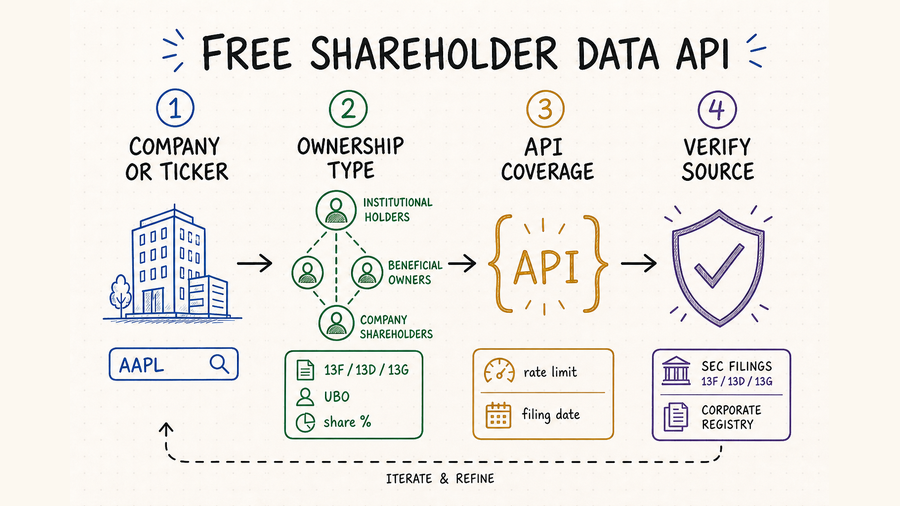
Define the ownership question before choosing a shareholder API
Developers usually want a usable endpoint rather than a definition: query a company or security, identify disclosed owners, retrieve ownership amounts or percentages, and trace each result to a filing or registry record. The first decision is the dataset, not the vendor. A public-company investor page, an institutional-holdings screen, a KYB ownership graph, and a private-company cap table require different sources and legal definitions.
No public API should be assumed to provide a complete, live list of every ultimate human owner. Securities may be held through nominees, custodians, funds, trusts, or layered companies; disclosures can be threshold-based, periodic, jurisdiction-specific, private, or legally restricted. A high-quality API exposes source scope, effective dates, ownership path, confidence or unresolved links, and the reason a person or entity appears in the result.
Start with the ownership question
“Who owns this company?” can mean a registered shareholder, an institutional holder, an insider, a 5% beneficial owner, or a UBO. These are not interchangeable.
Free is a plan condition
Record the request quota, reset period, market restrictions, history depth, attribution, redistribution, and production-use rules.
Source dates matter
Ownership data is point-in-time. Keep the reporting period, filing date, retrieval time, and source document so users can understand staleness.
Free shareholder data API coverage and ownership types
A shareholder endpoint may offer ticker or company lookup, institutional holders, beneficial owners, registered members, ownership percentages, historical filings, or corporate ownership chains. These labels do not establish equivalence. Record the governing source, disclosure threshold, included owner types, security or share class, geographic coverage, observation date, and whether the dataset represents reported, registered, inferred, or calculated ownership.
Institutional ownership API for 13F holdings
Use this for U.S. investment-manager positions. Check filer and issuer identifiers, shares, value, reporting quarter, filing date, amendments, historical quarters, and accession numbers.
Beneficial ownership API for 13D and 13G filings
Use this to research disclosed holders crossing reporting thresholds. Keep filing type, reporting person, ownership percentage, event date, and amendments.
Company shareholder and UBO API coverage
Corporate registries and KYB providers may return registered shareholders, ownership percentages, control statements, and ownership chains. Jurisdiction, legal definitions, privacy rules, and update cycles vary.
Registered shareholder lists and public-company disclosures
A transfer-agent or issuer register can differ from public “top holders” disclosures. Nominee and omnibus accounts may appear instead of underlying investors, and full registers may not be public or API-accessible.
Insider and control data are separate evidence
Officer, director, or significant-owner filings can describe transactions, roles, or threshold ownership, but they do not automatically produce a complete current ownership graph. Preserve filing type and legal capacity.
Reconcile ownership percentages, sources, and unknown states
Worked indirect-ownership example
Assume Company A owns 60% of Company B, and Company B owns 40% of Company C. Along that path, A's derived economic interest in C is 60% × 40% = 24%. If A also directly owns 5% of the same share class in C, a simple model may report 29%—but only when both records use compatible effective dates, denominators, ownership definitions, and share classes.
Do not automatically add parallel paths. They may represent voting rights versus economic rights, joint control, nominee holdings, duplicate registry records, or the same interest disclosed by several sources. Preserve each edge, path formula, source, effective period, and confidence before publishing a consolidated percentage. Circular ownership also requires a declared calculation method rather than repeated multiplication until an arbitrary cutoff.
Different disclosures can describe different owner populations
| Source | Population represented | Why the list may differ |
|---|---|---|
| 13F | Reportable positions of qualifying institutional investment managers | Quarterly timing, reportable-security scope, manager aggregation, and no complete look-through to beneficial humans |
| 13D / 13G | Beneficial owners meeting applicable disclosure conditions | Threshold and event-driven disclosure, group reporting, amendments, and beneficial-ownership rules |
| Proxy or issuer disclosure | Selected major holders, directors, officers, and ownership known for the stated disclosure | Different measurement date, inclusion rules, share classes, and reported persons |
| Register or transfer-agent record | Registered names for the covered legal register | Nominees and omnibus accounts can hide underlying beneficial owners; access may be restricted |
A mismatch among these sources is therefore a reconciliation task, not immediate proof that one provider is wrong. Compare issuer, security class, denominator, effective date, filing date, legal ownership concept, and amendment status before choosing a preferred record.
For authoritative definitions and source records, consult the Investor.gov guide to Schedules 13D and 13G, the SEC EDGAR API documentation, and the UK Companies House API when the jurisdiction applies.
Represent unknown ownership states explicitly
The source explicitly reports zero or confirms that a prior position ended. Keep the source, date, and scope.
No qualifying disclosure is present. This does not prove zero ownership.
The query, identifier mapping, name match, pagination, or parser did not produce a reliable record.
The register or personal data exists but cannot be returned under current access, privacy, or license conditions.
How to compare free shareholder data API options
| Check | Questions to ask | Evidence to keep |
|---|---|---|
| Ownership type | 13F, 13D/13G, insider, registered shareholder, or UBO? | Dataset definition |
| Coverage | Which exchanges, registries, countries, entities, and history? | Coverage list and test IDs |
| Free limits | Calls, credits, sandbox-only data, delay, and commercial-use rules? | Pricing page and terms date |
| Freshness | Does the response expose period, filed date, updated date, and amendments? | Source and retrieval timestamps |
| Identity | Can names be resolved to CIK, LEI, company number, ISIN, or ticker? | Stable IDs and mapping rules |
| Verification | Can each row link back to a filing or registry record? | Accession or registry URL |
| Percentage semantics | Voting or economic ownership? Direct or indirect? Which share class, denominator, and date? | Numerator, denominator and calculation version |
| Ownership path | Are intermediate entities, control basis, path percentages, loops, and unresolved links exposed? | Path-level source and confidence |
| Privacy and permitted use | May personal data be stored, displayed, enriched, or redistributed for this purpose? | Terms, lawful basis and retention policy |
Free shareholder data API integration steps
1. Query one known company or ticker
Start with a stable company, security, or filing identifier and one reporting period. Avoid broad name searches until identifier matching is tested.
2. Validate the shareholder JSON response
Require stable owner and issuer identifiers, position or percentage, units, reporting period, filed date, source type, and a source record reference. Treat derived labels as provider-specific.
3. Handle pagination, amendments and rate limits
Follow cursors or pages, respect 429 and Retry-After, retain amendments, and avoid overwriting a historical record with a later filing.
4. Preserve evidence and uncertainty
Store the raw response, source record, retrieval time, provider mapping version, and any confidence or unresolved status. Do not convert “not disclosed” or “not found” into zero ownership.
5. Version the ownership graph
Key relationships by owner, owned entity or security, ownership type, effective period, and source version. Recalculate indirect percentages only when every path component uses compatible dates and definitions.
6. Publish limitations with the answer
Return source jurisdiction, as-of date, disclosure scope, possible nominee coverage, and whether the percentage is reported or derived. A concise limitation label prevents a partial disclosure from being read as a complete cap table.
import os, requests

response = requests.get(
    "https://provider.example/v1/shareholders",
    headers={"Authorization": f"Bearer {os.environ['API_KEY']}"},
    params={"company_id": "KNOWN_ID", "period": "2026-Q1"},
    timeout=20,
)
response.raise_for_status()
for row in response.json().get("results", []):
    required = {"owner_id", "company_id", "reported_at", "source_id"}
    if not required.issubset(row):
        raise ValueError("Unexpected shareholder schema")
The hostname and identifiers are illustrative. Replace them with the provider’s documented endpoint and identifier scheme.
How QVeris helps discover shareholder data capabilities
QVeris is a capability routing network, not a claim that every discoverable shareholder dataset is free, complete, current, or licensed for every use. Search by the ownership question—13F holdings, beneficial ownership, company registry, UBO, or insider evidence—then inspect entity inputs, jurisdiction, source type, effective dates, relationship fields, confidence, pagination, and provider terms. Keep source verification and privacy controls around every result.
- Open the Twelve Data Institutional Holders tool details for a precise ownership-data capability.
- Inspect authentication, identifiers, response fields, limits, and provider terms before use.
- Use the QVeris REST API reference to connect a verified capability to an app or agent.
Frequently asked questions
Is there a free shareholder data API?
Some providers, filings, and registries offer free access, trials, sandboxes, or limited tiers. Coverage, calls, history, personal-data handling, redistribution, and production use may be restricted.
Can an API return a complete list of a company’s shareholders?
Usually not from public disclosure alone. Thresholds, nominees, custodians, private registers, reporting delays, and jurisdiction rules can hide or aggregate underlying owners. Check exactly what the source claims to represent.
What data does a shareholder API return?
Depending on the source, it may return owner and company IDs, ownership type, shares or percentage, direct or indirect path, filing or registry dates, source record, and confidence or status.
Is shareholder data the same as beneficial ownership data?
No. Institutional holdings, registered members, insiders, significant beneficial owners, and UBOs are different legal or reporting concepts. Choose the dataset for the task and jurisdiction.
How should an ownership percentage be verified?
Confirm voting versus economic ownership, direct versus indirect interest, share class, numerator, dated denominator, path calculation, and whether the value was reported or derived.
How do I verify shareholder API data?
Keep the filing or registry ID, effective and filing dates, entity and security IDs, retrieval time, mapping version, and source link. Compare material records with the authoritative source.
How can QVeris help?
QVeris can help agents discover capabilities and inspect inputs and outputs. Provider coverage, identity mapping, pricing, licensing, privacy, and accuracy still require source-level review.