
Free Sector Data API for Stock Market Research
Compare classifications, constituents, performance, history, and provenance before choosing a sector-data source.
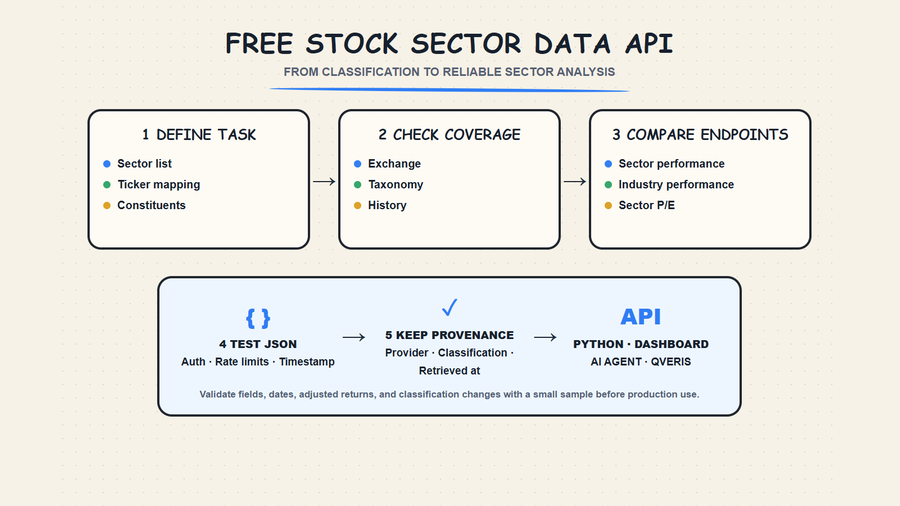
What users need from a stock sector data API
Sector data supports screeners, research notebooks, dashboards, portfolio views, and AI agents. The required output may be a valid sector label, ticker classification, constituent list, or performance series for a chosen period. Historical work also needs membership dates so a backtest does not apply today’s constituents to the past.
“Sector” is not one universal field. GICS, ICB, exchange classifications, and provider-owned taxonomies can assign different labels or hierarchy levels to the same issuer. Keep the original taxonomy code and parent-child path rather than normalizing everything into a loose text label.
Fields and capabilities that matter
Capture sector, industry, ticker, exchange, country, company ID, and the provider’s taxonomy name.
Prefer endpoints with additions, removals, weights, and effective dates; current members alone are unsafe for historical analysis.
Check weighting, price versus total return, corporate-action adjustments, aggregation method, and observation date.
Authentication, pagination, time zones, nulls, response limits, caching, and licensing determine production suitability.
Record the classification source, version, effective-from and effective-to dates. A company can move sectors after a business transformation, merger, or methodology review.
For valuation, growth, breadth, or margin metrics, document weighting, negative-value treatment, missing observations, currency conversion, and the eligible universe.
Test spin-offs, mergers, ticker changes, dual listings, and diversified companies. Decide whether the workflow follows the legal issuer, the listed security, or the provider's primary classification.
Preserve the source taxonomy when creating a cross-provider map
A canonical label is useful for navigation, but it must not erase the provider's meaning. One source may classify a software issuer as Information Technology → Software → Application Software, another as Technology → Software & Computer Services, and a third as a broad Technology category. Mapping all three to “Technology” is acceptable for a coarse dashboard only if the original code, hierarchy, taxonomy version, mapping rule, and validity dates remain available.
| Field | Example | Why retain it |
|---|---|---|
source_taxonomy | GICS 2025 | Identifies the owner and version of the classification |
source_path | 45 → 4510 → 451030 | Preserves the exact hierarchy instead of a loose label |
canonical_sector | Technology | Supports a product-owned broad grouping |
valid_from / valid_to | 2025-03-24 / null | Prevents a later reclassification from rewriting history |
mapping_confidence | manual-reviewed | Distinguishes reviewed mappings from text matching |
Free sector data API: quick answer
Separate company classification, sector constituents, index levels, and calculated aggregates. A label lookup cannot safely replace a point-in-time sector performance or breadth dataset.
Confirm the taxonomy owner and version, hierarchy, market coverage, effective dates, unclassified securities, and how reclassifications are represented.
Compare free sector data API sources
Providers solve different tasks. Financial Modeling Prep documents classification, screening, performance history, and valuation endpoints; Webull returns stocks and statistics for a selected sector; Barchart focuses on multi-period sector returns; Roic AI supplies classification reference lists. Verify current free-plan access and terms.
Benchmark candidates with the same small portfolio and date range. Compare unresolved symbols, taxonomy depth, effective-date support, constituent count, aggregate formulas, response latency, and whether a historical request reproduces the provider's own published sector result. Do not compare labels alone: two feeds can both say “Technology” while using different universes and methodology.
| Source | Best fit | Key / format | Important caveat |
|---|---|---|---|
| Financial Modeling Prep | Mapping, screening, history, valuation. | Key; JSON. | Confirm free endpoints and limits. |
| Webull | Stocks and statistics by sector. | Credentials; JSON. | Specific market and access rules. |
| Barchart | Multi-period sector returns. | Key; JSON/CSV. | Check delay and redistribution terms. |
| Roic AI | Classification reference lists. | Auth; JSON. | Not a full performance feed. |
How to use a free sector data API in Python
A reliable workflow for classification and performance data
For capability discovery, inspection, and execution requests, follow the QVeris REST API reference.
Specify exchange, taxonomy level, symbols, constituent fields, performance window, valuation date, and history.
Fetch supported exchanges, sectors, industries, and provider IDs. Preserve original labels and codes.
Check JSON types, pagination, nulls, currency, timezone, timestamp meaning, ordering, and one documented example.
Add timeouts, bounded retries, caching, and validation. Store endpoint, parameters, taxonomy, effective date, retrieval time, and formulas.
Store every mapping with valid-from and valid-to dates. Never overwrite yesterday's sector with today's label if the output supports research or backtesting.
For a sample date, rebuild return, breadth, or valuation from constituents and compare it with the API result. Investigate universe, weight, currency, and null-handling differences.
Use known mergers, spin-offs, ticker changes, and methodology review dates. Confirm that the old and new states are available at the correct effective time.
Recalculate one sector result from constituents
Suppose a sector contains three eligible stocks at the start of the day. A has a $600 million float-adjusted market value and returns +2%; B has $300 million and returns −1%; C has $100 million and returns +4%. A market-value-weighted return is (600×2% + 300×−1% + 100×4%) ÷ 1,000 = 1.3%. The equal-weighted return is (2% − 1% + 4%) ÷ 3 = 1.67%, while breadth is two advancers out of three, or 66.7%. All three figures are correct, but they answer different questions.
Now remove B because its price is missing. Renormalizing A and C produces a 2.29% weighted return; keeping B in the denominator with an assumed zero return produces 1.6%; marking the sector result incomplete produces no number. The API contract must specify which rule it uses. Store expected constituents, included constituents, excluded weights, return type, weight date, currency treatment, and corporate-action policy next to every aggregate.
Reclassification acceptance case: choose a company with a known sector move. Query the day before and the effective day. The old mapping must remain valid through the prior date, the new mapping must begin on the documented effective date, and sector membership and weights must change under the same timing rule. A current-only label pasted across both dates fails the test.
How QVeris helps discover sector data APIs
QVeris does not create classifications or alter market data. It helps developers and agents find relevant capabilities and inspect documented inputs and outputs. Use the Financial Modeling Prep provider details in QVeris, then verify the provider’s coverage, entitlement, taxonomy, timestamps, and limits.
- Search separately for company classification, sector constituents, sector index history, and sector aggregate capabilities.
- Inspect whether the contract exposes taxonomy name, version, hierarchy, effective date, formula, history, and revision state.
- Preserve provider codes, entity IDs, timestamps, formulas, and license constraints in the downstream evidence record.
Review QVeris REST API reference.
FAQ
There is no universal winner. Choose by required exchange, taxonomy, ticker mapping, constituents, performance history, valuation fields, free-tier limits, and licensing.
Yes. Company profile, screener, or classification endpoints commonly return sector and industry fields. Preserve the provider’s taxonomy because labels can differ between sources.
Use a documented historical sector endpoint, request one sector and short date range first, verify weighting and timestamps, then add pagination, caching, retries, and provenance.
Some reference datasets may be public, but many sector endpoints require credentials even when a free tier exists. Recheck current access rules and request limits before deployment.
They may use different taxonomies, versions, hierarchy levels, effective dates, or judgment for diversified companies. Keep the source code and methodology instead of treating the label as universal truth.
Not safely. Doing so introduces classification and membership look-ahead. Use point-in-time mappings with effective dates and retain prior classifications after a company moves sectors.
Document whether the metric is weighted by market value or equally weighted, how negative and missing values are treated, which securities are eligible, and which date and currency the inputs use.