
Issuer identity
CIK is the stable key; ticker and company name can change.
Track every filing version from the first S-1 through amendments, effectiveness, pricing, and outcome evidence.
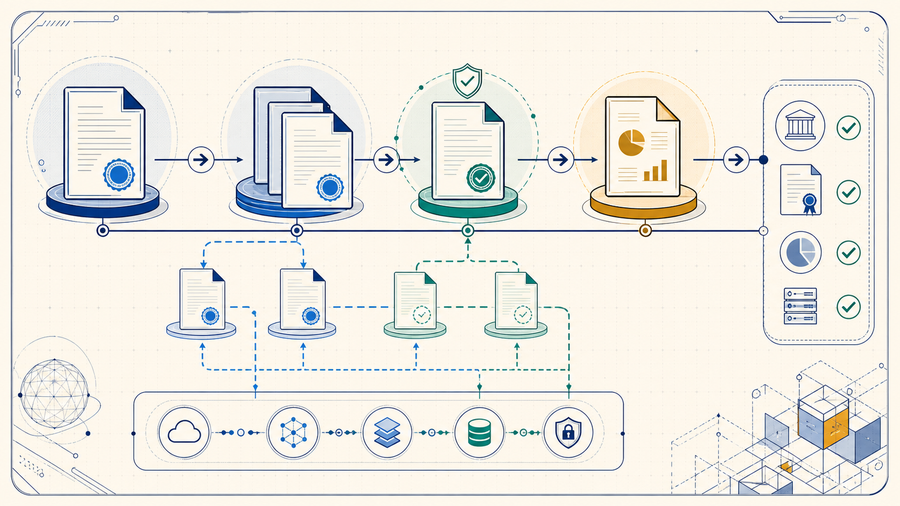
Assemble the original registration statement and amendments into one evolving offering record before an issuer has a stable ticker.
Track price range, offered shares, selling shareholders, proceeds, dilution, underwriters, risk factors, and each value’s filing version.
An S-1 shows registration intent; it does not prove that the deal will launch, price inside the range, list, or avoid withdrawal.
QVeris helps agents discover and call relevant financial-data capabilities; provider terms and quotas still govern each API.
Registration statement with the first public disclosure set.
S-1/A filings revise risk factors, financials, terms, and exhibits.
Rule 424 filings may contain pricing and final offer details.
An EFFECT filing marks effectiveness, not necessarily completed trading.
Withdrawal, delay, pricing, listing, or another path must be determined from evidence.
No single document proves every stage of an IPO. Build an offering-level timeline keyed by issuer CIK and registration identity, then attach each filing and market event with its own accepted time and evidence. A public API also cannot reveal a confidential draft while it remains nonpublic; absence from EDGAR before public filing is not proof that an issuer has done no preparation.
| Evidence | What it establishes | Important fields | Do not infer |
|---|---|---|---|
| S-1 | A public registration statement was filed. | CIK, accession, securities, initial disclosures, accepted time. | Final price, completion, listing date, or first trade. |
| S-1/A | A specific version amended the registration. | Changed range, shares, financial periods, risks, exhibits. | That the newest disclosed range became the final price. |
| EFFECT | The registration statement became effective. | Effective date and time, related registration identity. | That securities priced, were sold, or began trading. |
| 424B4 | A final prospectus commonly provides final offering terms. | Offering price, final shares, underwriting terms, proceeds, dilution. | That every allocated share traded or that the deal met forecasts. |
| RW | A request was made to withdraw the registration statement. | Filing time, related registration, stated reason when provided. | That the issuer can never return with another registration. |
| Market evidence | Listing and first trade can be observed separately. | Exchange, ticker, listing date, first-trade timestamp and price. | That filing acceptance time equals market launch time. |
An initial S-1 may omit price and final share count. An S-1/A can later disclose 12 million shares at $18–$20, another amendment can change that to 10 million shares at $20–$22, EFFECT can mark registration effectiveness, and a 424B4 can state 10 million shares priced at $21. A “latest value” table loses how expected gross proceeds moved from an implied $216–$240 million range to $200–$220 million and finally $210 million. Store each value with its accession, accepted time, units, scenario and source location.
CIK is the stable key; ticker and company name can change.
Use it as the immutable filing version identifier.
Keep the exact HTML or text document selected from the filing index.
Store exhibit type, filename, and relationship to the filing.
Keep S-1, S-1/A, 424B, EFFECT, and RW distinct.
Preserve SEC URL, retrieval time, and parser version.
| Field group | Examples | Version rule |
|---|---|---|
| Issuer | CIK, legal name, jurisdiction | Use filing-time identity |
| Offering | Securities, amount, price range | Never backfill from a later amendment |
| Financials | Periods, statements, auditor | Keep units and filing context |
| Risk | Risk factors and changes | Compare by accession number |
| Use of proceeds | Categories and amounts | Mark narrative versus quantified |
| Evidence | Source URL, page/section, retrieval time | Attach to every extracted claim |
| Layer | Main job | Best for | Boundary |
|---|---|---|---|
| Form type | S-1 or S-1/A. | Separating originals from amendments. | Do not infer IPO completion. |
| CIK / ticker | Issuer lookup key. | Company-specific S-1 search. | Ticker may be absent or change. |
| Accession / URL | Unique filing reference and source document. | Deduplication and audit trails. | Document parsing may be separate. |
| Extracted IPO fields | Offering, underwriter, proceeds, shareholders, or risk data. | Structured IPO research. | Coverage varies by provider and plan. |
| Offering version | Price range, primary and secondary shares, options, proceeds, and valuation assumptions per accession. | Explaining how deal terms evolve. | Blank early-stage fields are not zero and must not be forward-filled silently. |
| Capitalization / dilution | Share classes, conversions, options, warrants, pro forma equity, and dilution assumptions. | Ownership and per-share impact analysis. | Calculations depend on the stated scenario and offering version. |
| Narrative diff | Added, removed, or changed risks, use of proceeds, business claims, and related-party disclosures. | Reviewing substantive changes across S-1/A versions. | Layout and pagination changes create noisy text diffs; section-aware comparison is required. |
Map name or ticker to CIK and verify identity.
List the full form family in chronological order.
Download the filing index, primary document, and required exhibits.
Return section, source URL, and accession with every field.
Diff amendments without mixing later facts into earlier versions.
Use EFFECT, 424, RW, exchange, and issuer evidence together.
An S-1 API supports IPO and registration-statement due diligence. Start with CIK because a first-time filer may not have a ticker, assemble the original S-1 and every S-1/A in filing order, then extract how the offering changes: proposed price range, share counts, dilution, use of proceeds, selling shareholders, underwriters, risk factors, capitalization, and financial statements. Filing an S-1 does not prove that an IPO will price or complete.
Treat the registration as a versioned dossier, not a row in an IPO calendar. Early filings may omit a price range or final share count; later amendments can add financial periods, change underwriters, revise risk language, update selling shareholders, or alter the primary-versus-secondary mix. The economically important answer is often the difference between versions and the evidence behind it.
Order S-1 and S-1/A filings by acceptance time and accession. Compare versions rather than treating every amendment as a separate IPO candidate.
Track primary versus secondary shares, proposed price range, total proceeds, selling shareholders, option allocations, underwriters, and exchange plans when disclosed.
Preserve pre- and post-offering shares, equity classes, conversion assumptions, option pools, and pro forma capitalization. Headline proceeds alone do not explain ownership impact.
Compare risk factors, use of proceeds, business description, related-party transactions, and financial statements across amendments. A newly added or expanded passage can matter more than a changed cover-page number.
Track the same offering through prospectus filings and effectiveness or withdrawal events when available. Keep form type and accession for each stage; do not infer pricing, first trade, or completion from an S-1/A alone.
The filing package can include underwriting forms, charter documents, material contracts, legal opinions, consents, and financial exhibits. Save exhibit type, sequence, filename, description, URL, and version relationship rather than indexing only the main prospectus.
Store one registration dossier with a version list rather than emitting every amendment as a new IPO. The placeholders below show how filing evidence and extracted offering terms remain connected.
{
  "registration_id": "ISSUER_CIK:REGISTRATION_FILE_NUMBER",
  "issuer": {"cik": "ISSUER_CIK", "name": "ISSUER_NAME", "ticker": null},
  "state": "amended",
  "versions": [
    {
      "accession_number": "INITIAL_S1_ACCESSION",
      "form": "S-1",
      "accepted_at": "YYYY-MM-DDThh:mm:ss-04:00",
      "source_url": "SEC_S1_URL",
      "offering": {"shares": null, "price_low": null, "price_high": null}
    },
    {
      "accession_number": "AMENDMENT_ACCESSION",
      "form": "S-1/A",
      "accepted_at": "YYYY-MM-DDThh:mm:ss-04:00",
      "source_url": "SEC_S1A_URL",
      "offering": {
        "shares": "12000000",
        "price_low": "18.00",
        "price_high": "20.00",
        "currency": "USD",
        "source_location": "prospectus-cover"
      }
    }
  ],
  "outcome_evidence": {"effect_accession": null, "final_prospectus_accession": null}
}
State must follow evidence. An S-1/A can justify amended, but not effective, priced, or completed. Update those later states only from the appropriate EFFECT, final prospectus, withdrawal, exchange, or market evidence, and retain the accession that caused each transition.
Use CIK because a pre-IPO issuer may have no ticker. Retrieve S-1 and S-1/A, sort by accepted timestamp, follow older-submission references where needed, and preserve every accession as a distinct version in one registration timeline.
Store the filing index, primary registration statement, exhibits, accepted time, filing date, and official URLs. Hash immutable source files before parsing. A valid source package is the prerequisite for reliable field extraction and later replay.
For price range, shares, proceeds, underwriters, shareholders, dilution, and financial periods, store value, unit, accession, source section, extraction method, and confidence. Preserve blanks and ranges; never convert missing early terms to zero.
Normalize headings and trivial formatting while retaining tables and substantive text. Compare Risk Factors, Use of Proceeds, Dilution, Capitalization, Business, MD&A, related parties, and financial statements. Surface additions, removals, and changed numbers with source anchors.
Keep registration filed, amended, effective, priced, completed, postponed, and withdrawn as separate states backed by appropriate filings or market evidence. An S-1 record alone proves only that a registration statement was filed publicly.
Use a concrete SEC capability for issuer lookup and filing discovery, then keep the SEC source URL in every result. Continue with SEC submissions tool, then confirm the calling contract in the QVeris REST API reference.
SEC EDGAR exposes public submission metadata and archived registration statements without an API key. Query the issuer by CIK, filter S-1 and S-1/A, follow current access guidance, and retrieve the filing package for prospectus analysis.
Yes. CIK is the durable SEC issuer identifier and is more reliable than ticker for pre-IPO research. Preserve issuer names and observed ticker mappings separately because names and proposed symbols can change.
S-1 is an initial public registration statement; each S-1/A is a separate amendment version. Amendments may add or change offering terms, financial periods, risk language, shareholders, underwriters, exhibits, or other disclosures.
No. It establishes a public registration record, not a guaranteed launch, price, listing, or completion. Track later amendments and appropriate effectiveness, prospectus, withdrawal, and market events before assigning an outcome.
Store lower and upper price, primary and secondary shares, option assumptions, units, currency, accession, and source location for each version. Keep missing values null; do not overwrite history with the latest terms.
Align sections first, normalize only superficial formatting, then diff text, tables, and extracted fields. Prioritize Risk Factors, Use of Proceeds, Dilution, Capitalization, shareholders, underwriting, and financial statements, with links to both source versions.