
Free Live Stock Quotes API
Compare latency, timestamps, exchange coverage, REST and WebSocket delivery, rate limits, and usage rights before you build.
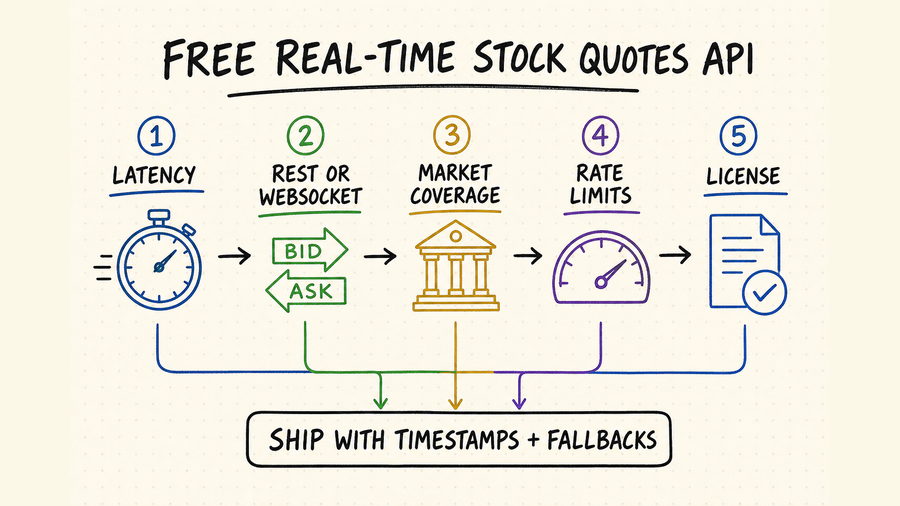
TL;DR
A free stock quotes API is usually enough for demos, personal dashboards, coursework, and low-traffic research tools.
“Real time” is not universal. Verify exchange, quote timestamp, session, and whether the response is delayed.
Latest trade, midpoint, bid, ask, and previous close are different values. Choose one explicitly for each product surface.
Cache repeated requests, batch symbols when allowed, and keep a provider adapter so you can switch later.
Fields a real-time stock quote should include
A symbol and a number are not enough. Reliable applications need enough context to interpret the price correctly and avoid mixing incompatible values.
| Data | Fields to expect | Use | Common trap |
|---|---|---|---|
| Latest quote | Price, timestamp, currency, exchange, session | Watchlists and snapshots | Treating delayed data as live |
| Bid and ask | Bid, ask, sizes, quote timestamp | Spread and liquidity views | Confusing a stale quote with a trade |
| Session context | Market status, previous close, change, change % | Correct daily movement | Mixing regular and extended hours |
| Symbol metadata | Canonical symbol, name, type, market, status | Search and validation | Ticker collisions across exchanges |
Do not collapse a quote into one price
Store bid, ask, sizes, quote time, latest trade, trade time, previous close, and session separately. A midpoint is derived and a last trade may be stale. If an endpoint returns only one field named price, require documentation that identifies whether it is a trade, quote-side value, official close, or provider mark.
Know whether the quote is consolidated or venue-specific
A quote can be real time for one venue without representing the full market. Preserve the exchange or feed identifier and do not label venue-specific bid, ask, or volume as consolidated. For pre-market and after-hours data, store the session explicitly and use a session-matched previous close for change calculations.
What “free” and “real time” actually mean
Convert the advertised quota into your own workload: symbols × refreshes × users. A generous daily allowance can still fail if the provider enforces a tight per-minute burst limit.
Free feeds may be delayed, end-of-day only, or limited outside regular sessions. Label the timestamp and delay in the UI instead of implying live execution quality.
Check maximum symbols, URL length, per-symbol credit cost, ordering, partial failures, duplicate symbols, and whether one bad ticker invalidates the whole batch.
Test primary listings, share classes, ETFs, ADRs, OTC securities, and inactive symbols. Key instruments by market and stable ID rather than ticker alone.
A quote shown to one account, cached on a server, calculated into a signal, exposed to a team, or redistributed publicly can require different permissions.
A resilient real-time quotes integration
Map provider-specific responses into your own Quote, Bar, and Instrument models. Keep raw payloads for debugging, but do not spread vendor field names through product code.
Cache end-of-day history much longer than an active quote. Use explicit freshness rules and coalesce identical requests to protect the free quota.
Reject impossible timestamps, negative prices, inconsistent currencies, duplicate bars, and unexpected timezone shifts. Record the provider and retrieval time.
A batch received at one moment can contain symbols last updated at different times. Calculate age from each source timestamp and retain the receipt time separately.
Return a status per symbol, retry only transient failures, and keep the last valid quote with its age. Never replace unavailable prices with zero or publish a partial watchlist as current.
Merge identical requests across users, stagger large watchlists, respect burst and daily limits, and poll no faster than the source or product actually updates.
Verify pre-market open, regular open, halts, regular close, and after-hours behavior. Ensure change and percent-change fields reset against the intended reference session.
Find real-time quote capabilities with QVeris
No exact QVeris real-time stock-quote tool and matching provider profile were verified for this page. Use the QVeris Docs and QVeris Playground to probe the exact fields and feed semantics before integration.
- Ask for bid, ask, sizes, trade, source timestamps, currency, exchange or feed, session, and batch support.
- Reject generic price results that do not identify the price type or delay.
- Save the discovery query, inspected capability, parameters, raw response, retrieval time, and validation result.
FAQ
Sometimes, but coverage, exchanges, entitlements, and delays vary. Verify the timestamp and license instead of relying on a “real-time” label.
Some APIs support batch symbols, while others allow only one symbol per request. Check both the batch size and how each symbol counts against the free quota.
No. It is a completed transaction at its own timestamp. A current quote needs bid, ask, sizes, and a quote timestamp.
Return a per-symbol error and preserve the last valid value with its age. Never silently drop the symbol or substitute zero.
References and next steps
Alpha Vantage quote documentation
Finnhub quote API
Twelve Data documentation
Alpaca market data