
Free Real-Time Stock API
Verify quote freshness, exchange feeds, entitlements, streaming support, limits, and fallback behavior before you ship.
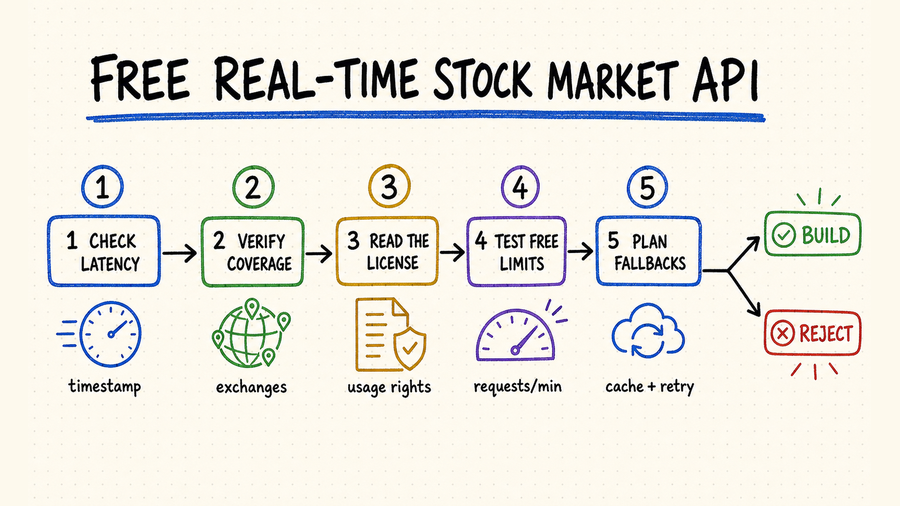
TL;DR
A free real-time stock market API can support demos, watchlists, paper trading, and low-traffic research tools when its feed and license match your use case.
“Real time” is not universal. Verify exchange, venue, quote timestamp, session, and whether the response is delayed.
“Real-time” is not a measurable promise without an exchange timestamp, retrieval time, timezone, and documented session policy.
Cache repeated requests, batch symbols when allowed, and keep a provider adapter so you can switch later.
How to verify real-time stock data
A “real-time” label is not enough. Measure freshness from the exchange timestamp, identify the underlying feed, and confirm what the license permits.
| Data | Fields to expect | Use | Common trap |
|---|---|---|---|
| Latest quote | Price, timestamp, currency, exchange, session | Watchlists and snapshots | Treating delayed data as live |
| Freshness | Exchange time, received time, timezone, delay | Measure end-to-end latency | Comparing server time to local time |
| Market feed | Exchange, venue, feed type, session | Understand quote scope | Assuming one feed represents the full market |
| Delivery | REST cadence, WebSocket events, reconnect rules | Snapshots or streaming | Polling faster than the source updates |
Distinguish trades, quotes, and bars
A latest trade records one completed transaction; a quote records available buying and selling interest; a bar aggregates eligible events over an interval. None can substitute for the others. Keep trade and quote conditions, bid and ask sizes, bar interval boundaries, volume, source venue or feed, and independent source timestamps.
Consolidated and single-venue feeds answer different questions
A single-venue feed can be genuinely live while representing only activity on that venue. A consolidated feed offers broader market context but may carry different entitlement and display terms. Label the feed in storage and the interface; never present venue-specific activity as total market volume or a universal best quote.
What “free” means for real-time stock data
Convert the advertised quota into your own workload: symbols × refreshes × users. A generous daily allowance can still fail if the provider enforces a tight per-minute burst limit.
Free feeds may be delayed, end-of-day only, or limited outside regular sessions. Label the timestamp and delay in the UI instead of implying live execution quality.
A free US equities feed may cover one venue, exclude OTC or international listings, or use separate subscriptions for pre-market and after-hours events. Test the actual universe.
A personal dashboard, server-side signal, team product, public widget, stored history, and redistributed stream can require different permissions even when they use the same endpoint.
A resilient real-time stock data integration
Map provider-specific responses into your own Quote, Bar, and Instrument models. Keep raw payloads for debugging, but do not spread vendor field names through product code.
Cache end-of-day history much longer than an active quote. Use explicit freshness rules and coalesce identical requests to protect the free quota.
Track sequence or ordering keys, subscription acknowledgements, heartbeats, disconnect time, and reconnect attempts. After a gap, request a fresh snapshot before applying new events.
Append immutable quote, trade, and bar events, then derive the latest state by symbol. Corrections and cancels should create traceable versions instead of silent overwrites.
When the stream stalls, keep the last valid state with its source time, mark it stale, stop execution-dependent actions, and fall back only to a source whose scope and delay are labeled.
Measure latency, gaps, duplicate events, CPU, memory, and outbound fan-out during the open, close, halts, and unusually active symbols—not only midday.
Find real-time stock data capabilities with QVeris
No exact QVeris real-time stock-market tool and matching provider profile were verified for this page. Use the QVeris Docs and QVeris Playground to probe a narrowly stated capability before integration.
- Ask for exchange-time-stamped trades or quotes, named feed coverage, session policy, and streaming or snapshot delivery.
- Reject generic “stock price” results that do not expose source time, venue or feed, currency, and delay.
- Save the discovery query, inspected capability, parameters, response, retrieval time, and validation result.
FAQ
Sometimes, but coverage, exchanges, entitlements, and delays vary. Verify the timestamp and license instead of relying on a “real-time” label.
Use time-series OHLCV bars with a documented interval, timezone, session policy, and adjusted-price option.
Yes for long-term performance and most backtests. Raw close can create false jumps after splits and can omit dividend effects.
No. It can be real time for that venue while missing activity elsewhere. Label the feed and do not infer consolidated volume or best quotes.
Detect the gap, fetch a fresh snapshot, reconcile sequence state, then resume events. Do not assume the first new message repairs missed updates.
References and next steps
Alpaca market data
Polygon stocks API
Twelve Data documentation
Alpha Vantage documentation