
Free Price Target API
Data, Limits & Use Cases
Find analyst targets without paying first, then verify coverage, timestamps, source records, and usage rights before building on the data.
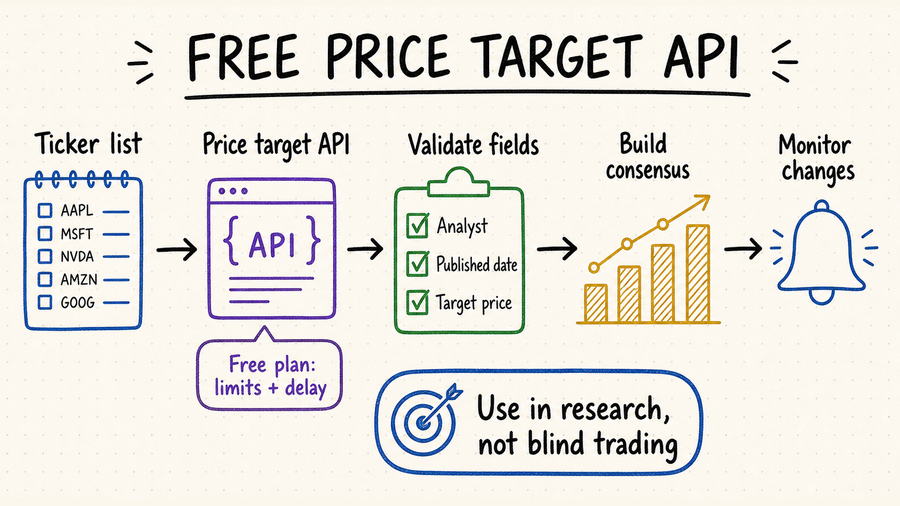
TL;DR
Expect request caps, delayed updates, limited history, reduced exchange coverage, or personal-use restrictions.
Check the analyst record behind every aggregate, plus timestamp meaning, currency, symbol mapping, and adjustment policy.
Mean, median, high, and low are meaningless without the contributing analysts, lookback window, duplicate policy, and observation count.
A price target is a dated analyst estimate with assumptions and a horizon, not a market quote or guaranteed future price.
Fields a useful price target API should expose
A consensus number is easy to display but hard to audit. Prefer endpoints with individual observations so you can reconstruct the aggregate and remove stale or duplicate entries. Each record should identify the symbol, target, rating action, analyst or firm, publication date, and currency.
A new target means something different when it was raised from $90, cut from $150, initiated for the first time, or merely reiterated.
Distinguish when the analyst published the note from when the provider collected it. The gap determines practical data freshness.
Keep a stable analyst or firm identifier, display name, brokerage, and source-record ID. Names alone create duplicates after spelling or employer changes.
Preserve the stated horizon where available, quote currency, exchange, share class, listing, and provider symbol. Never compare targets across currencies or ADR ratios without conversion.
Return observation count, mean, median, high, low, dispersion, calculation time, lookback start, and inclusion rule—not only one average.
How to evaluate a free price target API
| Test | Question | Failure signal |
|---|---|---|
| Coverage | Which exchanges, security types, and analysts are included? | Only popular US large caps return records. |
| Freshness | How soon does a published revision appear? | No published timestamp or delay disclosure. |
| Consistency | Can you recompute consensus from raw records? | Aggregate changes without underlying records. |
| Terms | Are caching, redistribution, and commercial use allowed? | “Free” pricing with unclear usage rights. |
Query the same watchlist daily for two weeks. Log status codes, latency, missing fields, duplicate IDs, and revision times. This acceptance test reveals more than a feature checklist.
Build a defensible price target workflow
Keep the original response, provider timestamp, query parameters, and a normalized copy. Raw evidence lets you investigate later changes.
Map symbols, currencies, analyst identities, and action labels. Flag splits and corporate actions before comparing old and new targets.
Document the lookback window, whether each analyst contributes one latest target, and whether you use mean, median, or trimmed mean.
Do not overwrite a prior target. Link each raise, cut, reiteration, initiation, suspension, or withdrawal to the previous observation and source record.
Store both reported and adjusted values. Splits, reverse splits, spinoffs, currency changes, ADR ratio changes, and symbol migrations require an explicit transformation record.
A changed average may come from one revision, a stale target aging out, a new analyst entering, or a withdrawn record. Attribute the change before treating it as a signal.
Use QVeris to find and compare data capabilities
No exact QVeris price-target tool and matching provider profile were verified for this page, so the safe next steps are the QVeris Docs and QVeris Playground. Describe the capability narrowly—individual analyst targets with firm, publication date, prior target, action, currency, and source ID—then inspect the returned schema before integration.
- Reject generic market-data results that return only a consensus number without source observations.
- Save the discovery query, inspected capability, parameters, response, retrieval time, and validation decision.
- Keep provider selection separate from consensus calculation and corporate-action adjustment logic.
FAQ
Some providers offer a free plan, but coverage, history, request volume, freshness, or usage rights are usually limited.
Use one recent observation per analyst, disclose the lookback window, and compare the median with the mean and dispersion.
It can support research, but delayed or incomplete records should not be treated as execution-grade signals.
Use the analyst's stated horizon when available. Otherwise apply a disclosed freshness window and remove withdrawn or superseded observations.
Preserve the reported value and add a separate adjusted value with the action, factor, effective date, and transformation source.
References and next steps
FMP price targets API
FMP plans
Benzinga analyst ratings API