
Find a Free Options Greeks API
and Verify the Numbers
Compare delta, gamma, theta, vega, and rho coverage—then verify model inputs, timestamps, limits, licensing, and reproducibility.
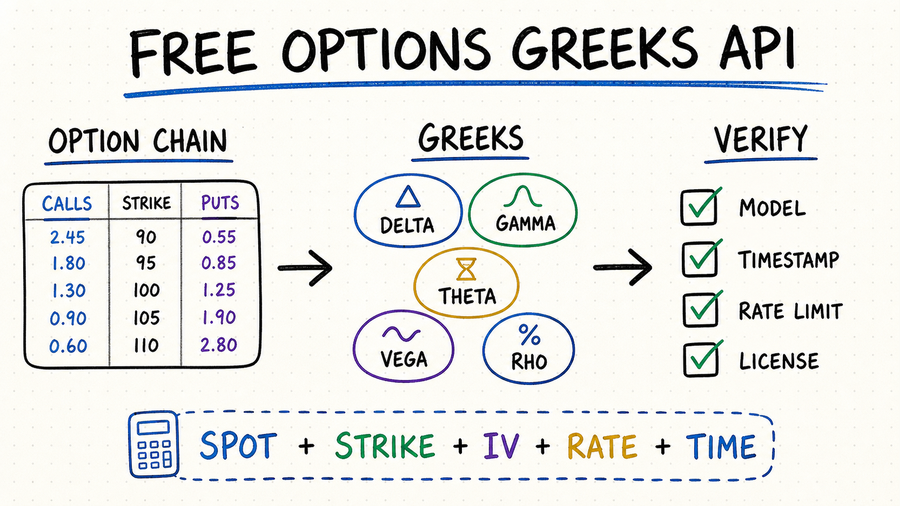
Quick Summary
Typical entry plans expose option chains, contract quotes, expirations, strikes, volume, open interest, and sometimes Greeks or implied volatility.
Check quote delay, venue coverage, request limits, contract history, Greeks methodology, redistribution rights, and commercial-use terms.
Identical contracts can have different Greeks when providers use different prices, rates, dividends, clocks, or numerical methods.
Compare one liquid contract across two timestamps and recompute a small tolerance check from the same underlying and option prices.
Which Greeks should a free options API return?
Start with the sensitivity the application actually uses. A hedge monitor may need delta and gamma, a decay screen may focus on theta, and a volatility book may need vega plus implied volatility. Rho is often smaller for short-dated equity options but still belongs in a complete schema. Every value needs contract identity, units, sign convention, calculation time, and model lineage.
Approximate first-order option-price sensitivity to the underlying. Verify call and put sign conventions, premium adjustment, and whether the value is spot or forward delta.
Measures how delta changes as the underlying moves. Confirm the underlying-price unit and calculation scale before comparing contracts.
Measures time-decay sensitivity. Providers may report per day, per calendar day, per trading day, or annualized values; the unit must be explicit.
Vega depends on whether volatility changes are measured per one percentage point or a full decimal unit; rho has a similar basis-point versus unit-rate ambiguity.
Keep option price, synchronized underlying price, strike, time to expiration, rate, dividend or borrow assumption, exercise style, model name, and calculation timestamp.
Verify an options Greeks API before using it
1. Lock one contract and one valuation clock
Choose a liquid near-the-money contract and record the exact option quote, underlying quote, timestamps, expiration, strike, side, multiplier, and market status. If the API accepts a contract identifier, use it; do not rely on a strike-only lookup.
2. Discover units and conventions empirically
Change one input at a time or compare adjacent responses. A vega near 0.12 may mean a 0.12 price change for one volatility point, while another API can scale the same sensitivity by 100. Check theta time basis, delta sign, rho rate unit, and IV decimal versus percent.
3. Recompute a tolerance check
Use the provider's documented inputs where available and calculate the same contract with a known model. Exact equality is not required, but large unexplained differences should block mixing values. Test deep in-the-money, far out-of-the-money, near-expiry, and longer-dated contracts because numerical behavior changes at the edges.
4. Preserve lineage with every value
- Store provider, endpoint, contract ID, request parameters, response ID, and retrieval time.
- Keep model name, version, option-price input, underlying input, rate, dividends, and valuation time.
- Separate provider Greeks from locally calculated Greeks in different columns or tables.
- Version corrections instead of silently overwriting a historical calculation.
- Fail visibly when a required Greek disappears or changes unit.
How free options Greeks APIs compare
No single source fits every options workflow. Exchange-backed resources are useful for authoritative contract and market-structure checks; vendor APIs normalize chains and analytics; broker APIs may expose entitled quotes for an account; downloadable datasets are convenient for repeatable research.
| Source | What it offers | Best for | Watch for |
|---|---|---|---|
| Exchange-backed source | Contract directories, delayed quotes, specifications, and market notices. | Verification and primary-source research. | Data may be fragmented or subject to display terms. |
| Free options-data API | Normalized chains, quotes, Greeks, IV, and selected history. | Apps, agents, prototypes, and research pipelines. | Rate limits, delays, history gaps, and license restrictions. |
| Broker API | Account-entitled quotes, positions, orders, and trading context. | Personal monitoring and execution workflows. | Requires an eligible account; redistribution is usually restricted. |
| Historical bulk dataset | Portable files containing expired contracts, quotes, trades, or analytics. | Notebooks, model research, and backtests. | Free samples may cover only short periods or limited underlyings. |
Compare sources with the same test set: one liquid near-the-money contract, one far expiration, one thinly traded strike, and one adjusted contract. Compare symbology, timestamps, bid/ask freshness, open interest date, Greeks methodology, missing contracts, and error messages. Identical field names do not guarantee identical calculations.
Use QVeris to find options data capabilities
The exact QVeris Realtime Options Tool is a strong match because its public record exposes an optional Greeks parameter. Review the Alpha Vantage Provider profile, then test one contract before assuming units, model inputs, history, or entitlement.
FAQ
Yes. Many providers offer free tiers for chains, Greeks, or historical contracts, usually with request limits, delayed data, or restricted exchange coverage.
Sometimes, but often they are delayed or limited to specific venues. Always inspect timestamps, entitlements, and exchange-coverage notes.
They can use different option prices, underlying clocks, rates, dividends, models, smoothing, and numerical conventions.
Yes, but keep the model, inputs, units, valuation time, and version. A local result is not directly comparable without aligned assumptions.
References and next steps
Alpha Vantage options documentation
Polygon options API
Cboe delayed quotes