
Free Options Data
with Python
Fetch option chains into pandas, compare free sources, and validate expiries, strikes, Greeks, timestamps, limits, and licenses.
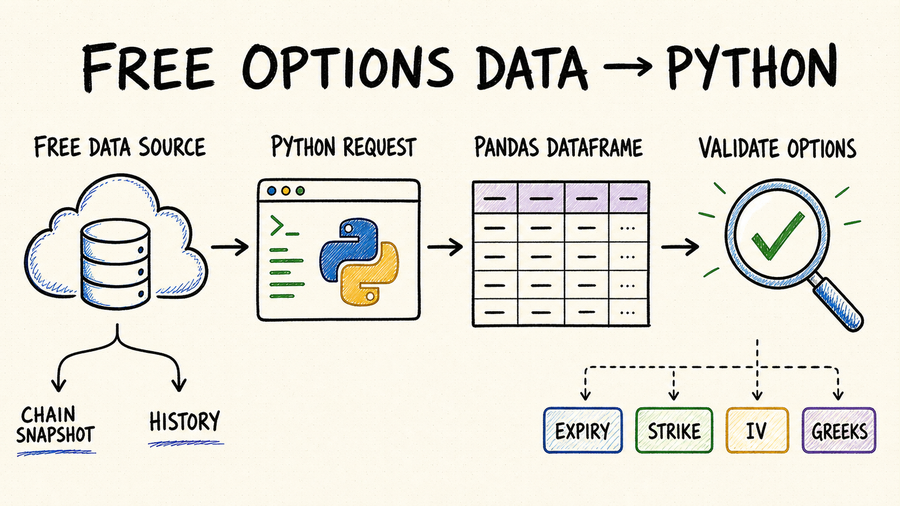
TL;DR
Use a documented API or provider SDK, load JSON into pandas, and save a raw copy before transforming it.
Expect delayed chains, snapshot-only access, request caps, limited expiries, or non-commercial terms.
Start with one underlying and one expiry. Confirm contract fields, timestamps, missing values, and quote quality before requesting a wider chain.
A current free chain can support learning and screening, but it is not automatically a point-in-time historical dataset suitable for backtesting.
The practical answer is to begin with one narrow, repeatable request: one underlying, one expiry, and a documented set of fields. Save the response before transforming it, normalize the contract identity and quote timestamp, then reject rows that fail basic market-data checks. Only after that workflow is stable should you add more expiries, symbols, or scheduled collection.
This guide is for developers building research notebooks, option screeners, teaching examples, or data-ingestion prototypes. It is not a recommendation to trade an option, and it does not treat a free quote as complete evidence for execution or historical performance.
Choose a free options data source for Python
Start with the dataset—not the library. A current chain screener needs bid, ask, volume, open interest, IV, strike, expiry, and contract side. Backtesting also needs historical chain snapshots, which are much harder to find on a free plan.
Define the job before comparing sources. A notebook that ranks contracts by spread needs current bid and ask sizes; an implied-volatility study needs the option price, synchronized underlying price, valuation time, rate, dividend assumption, and calculation method. If you only need to learn DataFrame operations, a documented sample file may be more stable than an undocumented public endpoint.
Best for screeners and notebooks. Confirm whether quotes are live or delayed and whether IV and Greeks are supplied or must be calculated.
Useful for prototypes, but wrapped endpoints can change. Pin versions, test returned columns, and never assume every expiry is available.
Useful when the same application may later place orders. Check whether market-data permissions depend on the account, exchange agreements, region, or session.
Useful for repeatable tutorials and schema exploration. Verify the observation date, adjustment status, license, and whether the file contains quotes, trades, or derived analytics.
Treat “free” as an access condition, not a quality grade. Record the source, retrieval time, advertised delay, request parameters, terms of use, and the fields actually returned. That small provenance record lets you explain why two runs produced different chains.
| Source type | Best use | Check before using |
|---|---|---|
| Documented REST API | Repeatable scripts, scheduled snapshots, and explicit request parameters. | Authentication, pagination, rate limits, quote delay, fields, and redistribution terms. |
| Provider SDK | Faster integration when the SDK exposes the full API contract. | Supported Python versions, release cadence, error behavior, and access to raw responses. |
| Convenience library | Exploration and short-lived prototypes where convenience matters most. | Upstream source, maintenance status, schema drift, licensing, and caching behavior. |
| Downloadable sample | Tutorials, unit tests, schema design, and offline demonstrations. | Observation date, completeness, survivorship, contract adjustments, and reuse rights. |
Keep adjacent search intents separate. If the main decision is which endpoint or provider model to use, continue with the free options data API selection guide. For a file-first workflow, use the free options data CSV guide to define columns, encoding, and import checks before writing Python transformations.
Quote fields also need market context. Option chains present buying and selling interest through bid and ask values, and the spread matters alongside either price. That is why a source returning only a last price is inadequate for many screening and execution studies.
Python example: fetch an option chain into pandas
A provider-neutral pattern uses requests for transport and pandas for normalization. Replace the endpoint, authentication method, response path, pagination rules, and field names with those in your provider’s documentation. The example intentionally stops at ingestion and validation; it does not generate a trading recommendation.
import os
import requests
import pandas as pd

url = "https://api.example.com/v1/options/chain"
params = {
    "underlying": "AAPL",
    "expiry": "2026-09-18",
    "apikey": os.environ["OPTIONS_API_KEY"],
}
response = requests.get(url, params=params, timeout=20)
response.raise_for_status()

rows = response.json()["contracts"]
df = pd.DataFrame(rows)
df["quote_time"] = pd.to_datetime(df["quote_time"], utc=True)
df["expiry"] = pd.to_datetime(df["expiry"])
key = ["expiry", "strike", "side"]
df = df.sort_values("quote_time").drop_duplicates(key, keep="last")
print(df[key + ["bid", "ask", "iv", "delta", "open_interest"]].head())| Step | Why it matters | Minimum check |
|---|---|---|
| Request | Timeouts and HTTP errors prevent silent failures. | Status code and provider error body. |
| Normalize | Stable columns isolate analysis from provider schemas. | Types, UTC dates, numeric columns. |
| Validate | Bad contracts can produce believable but wrong signals. | Expiry, strike, side, quote time, bid/ask, IV. |
Real APIs often return nested JSON rather than a flat contracts array. Inspect one raw response before writing transformation code, then use a documented record path or pandas.json_normalize when contracts are nested under expiries or option sides. Keep the raw payload unchanged so you can revisit fields that were not included in the first DataFrame.
For repeated collection, separate immutable raw files from normalized tables. Partition by retrieval date and underlying, save the provider request ID when available, and write a small manifest containing schema version, row count, minimum and maximum quote time, and validation status. This makes failed or incomplete downloads visible before they enter analysis.
Read the API key from an environment variable, set an explicit timeout, and keep the underlying, expiry, and optional filters in a parameter dictionary. Production calls should never wait indefinitely.
Record the status code, response headers, request ID, pagination cursor, and raw JSON before selecting the contract rows. Error payloads can be valid JSON, so successful decoding does not prove that the API call succeeded.
Map vendor fields into stable names for contract ID, underlying, expiry, strike, side, bid, ask, sizes, volume, open interest, quote time, IV, and Greeks. Use pandas.json_normalize when the response contains nested contract records.
Check types, compound-key uniqueness, quote order, timestamps, missingness, and expected expiry coverage. Write failures to a report and keep the last verified dataset rather than replacing it with an incomplete refresh.
For a scheduled collector, make each run idempotent: the same request window should produce the same partition key, while a changed payload creates a new version rather than silently overwriting history. Add bounded retries for timeouts and temporary server errors, but do not retry invalid credentials, malformed parameters, or permission failures as if they were transient.
Validate free options data before analysis
Compare every contract timestamp with the exchange session, expected delay, and underlying-price timestamp.
Treat underlying, expiry, strike, and call/put side as a compound key; parse provider contract symbols only after testing edge cases.
Flag missing, locked, or crossed markets. Keep bid and ask sizes when available, and do not treat the midpoint or last trade as a guaranteed executable price.
Confirm whether implied volatility and Greeks use decimal or percentage units. Preserve nulls separately from numeric zero and record provider status fields.
Record whether IV and Greeks came from the provider or your own model. Calculated values need the price input, underlying value, rate, dividends, valuation time, and model version.
Turn these checks into assertions or a machine-readable validation report. At minimum, report duplicate contract keys, stale timestamps, negative prices, bid-above-ask rows, missing expiries, unexpected currencies, and the percentage of contracts without volume, open interest, IV, or Greeks. Fail the pipeline on broken identity or timestamps; warn separately about optional analytics that the source never promised.
| Validation rule | What it can reveal | Recommended action |
|---|---|---|
| Unique contract-time key | Duplicate pages, corrections, or mixed snapshots. | Keep provenance; deduplicate only with a documented rule. |
| Bid ≤ ask | Crossed markets, timing mismatch, or field reversal. | Flag the row; do not silently swap values. |
| Timestamp freshness | Delayed or stale quotes mixed into a current screen. | Calculate age against retrieval time and the declared delay. |
| Expected expiry coverage | Pagination failure, source limits, or an invalid expiry. | Stop the refresh or label the dataset incomplete. |
| Multiplier and adjustment status | Non-standard contracts after a corporate action. | Preserve the deliverable and provider contract ID. |
| IV and Greeks lineage | Mixed models, units, inputs, or valuation times. | Store method and inputs or exclude the field from comparison. |
Contract identity deserves special treatment. Corporate actions can create adjusted contracts whose deliverables differ from a standard 100-share contract. Preserve the provider contract ID, multiplier, deliverable, and adjustment indicator instead of reconstructing identity from strike and expiry alone.
If the goal is strategy simulation rather than current-chain analysis, move to the free options data for backtesting guide. That workflow needs historical point-in-time snapshots, contract lifecycle handling, realistic fill assumptions, and a stricter evidence standard than a current Python chain fetch.
Use QVeris for provider-flexible options data access
QVeris helps developers and agents discover, inspect, and call financial-data capabilities without coupling every workflow to one provider-specific API.
Use the documented discover → inspect → call sequence. For this workflow, start by inspecting the Realtime Options tool in QVeris, including its symbol, contract, data-format, and optional Greeks parameters. Then review the Alpha Vantage provider profile before deciding whether it fits the required market coverage and workflow.
Python applications can implement that workflow with the QVeris Python SDK. Begin with a narrow discovery query such as “US equity option chain with bid, ask, open interest, and quote timestamp,” inspect the returned schema, and test one underlying and expiry. If you want to evaluate the interaction before adding code, run the same narrow task in the QVeris Playground.
- Discover options-data capabilities and inspect their inputs before calling them.
- Keep application code focused on underlyings, expiries, strikes, and normalized outputs.
- Use a direct provider integration instead when you need an exchange-specific feed, contract, or operational control that the inspected capability does not expose.
FAQ
Yes. Free APIs and Python libraries can provide current or delayed option chains. Complete historical chains are less commonly free.
Use pandas for cleaning and analysis, requests for direct APIs, or a provider SDK for convenience. Normalize results into a DataFrame.
Not by itself. A current chain is one observation. A defensible backtest needs historical point-in-time chains, contract adjustments, timestamps, delisted contracts, and realistic fill assumptions.
Neither is universally correct. The last trade may be stale, while the midpoint is calculated and may not be executable. Keep bid, ask, sizes, timestamps, and quality flags.
Greeks depend on the model and inputs, including option price, underlying price, time, rates, and dividends. Store the assumptions and avoid mixing values without reconciliation.
Keep an unchanged raw response plus a normalized table. Add retrieval time, source, schema version, request parameters, row count, and validation results.
No. Sample files and some public endpoints may work without one, while documented APIs often require credentials. Never embed a key in source code, notebooks, URLs committed to Git, or exported data.
Keep the raw response and schema tests, pin library versions, and fail visibly when required fields disappear. Do not silently fill a missing market field with zero or reuse an old value.