
Free Options Data
Download Guide
Download options chains in CSV, JSON, or API form—and keep the timestamps, fields, and license details needed for trustworthy research.
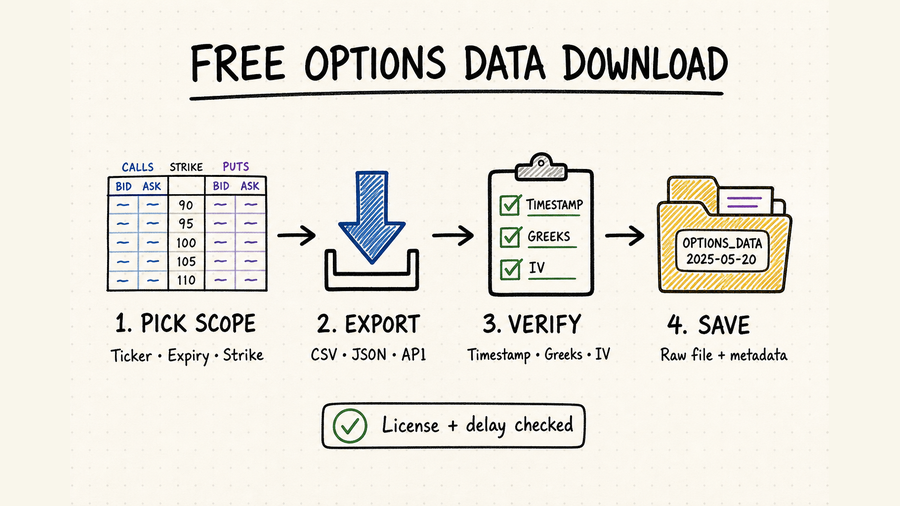
Free options data download: the short answer
Use a broker export or a market-data API for current chains; use exchange and research datasets when you need documented reference files.
Define ticker, expiration range, strikes, quote interval, and whether you need chains, trades, quotes, Greeks, or open interest.
Free access often means delayed snapshots, short history, rate caps, personal-use terms, or missing Greeks.
Keep the untouched download with its retrieval time, source, timezone, adjustment rules, and license note before cleaning it.
Where to download free options data
No single free source covers every contract, date, quote, trade, and Greek. A public dashboard, downloadable sample, API free tier, and broker export are different products: compare the actual file or endpoint, not the supplier logo.
| Source type | Typical download | Best use | Watch for |
|---|---|---|---|
| Broker export | Current chain or watchlist CSV. | Manual research and small snapshots. | Login, entitlements, redistribution terms. |
| Free market-data API | JSON chains, quotes, contract metadata. | Repeatable scripts and scheduled pulls. | Rate caps, pagination, delayed quotes. |
| Exchange or regulator | Reference files, calendars, statistics. | Contract validation and official context. | May not include full quote history. |
| Research dataset | Samples or curated historical files. | Teaching, prototypes, reproducible examples. | Coverage gaps and noncommercial licenses. |
Fields every options download should preserve
Store the underlying symbol, provider contract ID, OCC-style symbol when available, expiration date, strike, option type, multiplier, and exercise style.
Keep the quote timestamp and timezone, bid, ask, last price, bid/ask sizes, volume, open interest, and the underlying price observed at the same moment.
Preserve implied volatility and Greeks only with their model assumptions, calculation time, and source. Never mix provider-computed values as if they were identical.
Add retrieval time, endpoint or export name, request parameters, page cursor, provider version, license note, and a checksum for the raw file.
A reproducible options-data download workflow
1. Write the dataset contract
Define underlyings, expiration window, strike range, calls and puts, observation clock, required fields, file format, compression, partitioning, and acceptable delay. State whether the result is a current snapshot, end-of-day history, or point-in-time intraday data.
2. Download into an immutable landing area
Write every original file or API page once. Name it with supplier, dataset, market date, retrieval time, and page or partition. Store a checksum, byte size, response headers, parameters, and license note in a sidecar manifest before parsing.
3. Validate completeness before normalization
- Confirm expected files, pages, expirations, and contract counts arrived.
- Reject truncated archives, checksum mismatches, duplicate pages, and malformed rows.
- Distinguish empty data from authentication failure, no entitlement, holiday, and not-yet-published.
- Compare a sample of contract symbols, strikes, and timestamps with the supplier interface.
4. Publish raw, clean, and derived layers separately
Normalize types and field names into a clean layer while preserving source values. Calculate midpoint, spread, moneyness, IV, or Greeks only in a derived layer with versioned logic. A correction should add a traceable version rather than silently rewriting the original evidence.
5. Reconcile every scheduled run
Track expected versus received partitions, row counts, unique contract keys, null rates, timestamp ages, and correction counts. Alert on missing expirations, unexplained schema changes, multiplier shifts, or a download that succeeds technically but returns an incomplete universe.
Use QVeris to find options data capabilities
The exact QVeris Options Chain Tool is the closest verified capability for building a repeatable current-chain download. Its record includes calls and puts by expiration and strike with last price, bid, ask, volume, and open interest. Inspect one response in the Playground before deciding the export schema; history, pagination, timestamps, and entitlement still require testing.
- Test one known symbol and expiration, then save the raw response unchanged.
- Record the tool ID, parameters, retrieval time, response checksum, and validation result.
- Use the Free Options Data API Guide when the workflow needs scheduled API access rather than manual downloads.
FAQ
Start with broker exports, free options APIs, exchange reference files, and research datasets. Compare history, delay, fields, rate limits, and license before choosing.
Samples and limited history exist, but complete historical chains, quotes, trades, Greeks, and implied volatility are rarely free.
Not necessarily. Many free feeds are delayed, snapshot-based, available only during a broker session, or restricted by exchange entitlements.
CSV is convenient for spreadsheets and batch research. JSON is better for repeated API calls, nested contract metadata, and pagination.
References and next steps
Cboe options statistics
Historical Option Data samples
Alpha Vantage options documentation