
Free Options Data
Sources, APIs & Limits
Find the right free source for delayed chains, historical research, API prototypes, or point-in-time backtests.
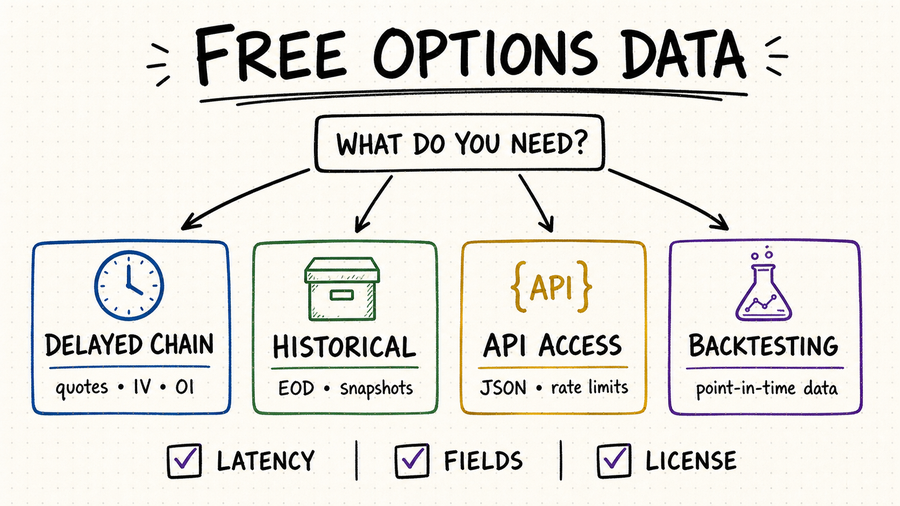
TL;DR
Delayed option chains and limited snapshots are useful for learning, screening, and manual research.
Free history is usually a sample, a narrow ticker set, an end-of-day snapshot, or a capped API plan.
Consolidated U.S. real-time options data carries exchange licensing and redistribution constraints.
Use point-in-time chains with bid, ask, underlying price, corporate-action handling, and documented timestamps.
Where to get free options data
Start with the job, not the provider. A browser chain, a research download, and a production API solve different problems even when all three advertise a free tier.
Exchange and broker pages can expose strikes, expirations, bid, ask, volume, open interest, implied volatility, and sometimes Greeks. Cboe, for example, labels its public quote dashboards as delayed.
Use a capped plan to validate symbols, response schemas, pagination, and rate-limit handling. Confirm whether options endpoints, history, Greeks, and commercial use are actually included.
Commercial history vendors often publish small CSV samples. They are useful for testing parsing, schema design, and file size—not evidence that the full universe or long history is free.
A broker may expose entitled quotes and chains to an eligible account. Confirm whether the data is limited to personal display, whether exchange agreements apply, and whether automated storage is permitted.
Compare the fields before you compare prices
| Data type | Minimum useful fields | Good for | Common free-tier gap |
|---|---|---|---|
| Current chain | Contract, expiry, strike, call/put, timestamp, bid, ask, last, volume, open interest. | Screening and manual analysis. | Delayed quotes or no API. |
| Historical EOD | As-of date, underlying close, bid, ask, volume, OI, IV, contract adjustments. | Daily strategy research. | Short lookback or samples only. |
| Intraday history | Quote/trade timestamp, bid/ask sizes, sequence, exchange, underlying timestamp. | Execution and microstructure tests. | Rarely free at useful depth. |
| Analytics | IV, delta, gamma, theta, vega, model inputs, and calculation timestamp. | Risk views and volatility studies. | Vendor methods may be undocumented. |
Turn free options data into a research-ready dataset
Define one observation before collecting many
Specify whether a row represents a contract definition, quote, trade, daily summary, open-interest observation, or model calculation. Each type has a different natural key and clock. Flattening all values into one mutable row makes corrections, late fields, and backtests difficult to audit.
Keep source facts separate from derived analytics
Bid, ask, trade, volume, and open interest come from market-data processes; midpoint, spread, implied volatility, and Greeks may be calculated. Store the calculation method, inputs, and version with every derived value so results can be reproduced when a model changes.
Build quality gates around completeness and time
- Reject malformed contract symbols and duplicate contract-time keys.
- Distinguish zero, null, not entitled, not calculated, and not yet published.
- Compare expiration and strike coverage with a contract-reference universe.
- Store the raw payload, supplier, retrieval time, market timezone, and license snapshot.
- Flag crossed markets, stale quotes, impossible negative values, and unexplained multiplier changes.
Know when free data stops being enough
Move beyond a free source when the research requires a complete survivorship-free universe, deep intraday history, deterministic corrections, service guarantees, broad team access, or redistribution rights. Upgrading is not only about more requests; it is often about provenance, completeness, and legal use.
Use QVeris to find and verify options-data capabilities
The exact QVeris Options Chain Tool is a verified match for current chain inspection. Its capability record includes calls and puts by expiration and strike with last price, bid, ask, volume, and open interest. Test one known symbol in the Playground before inferring history, full market coverage, Greeks, or a particular entitlement.
- Run one symbol and expiration in the QVeris Playground and preserve the raw response.
- Map returned fields to the dataset schema before writing a bulk collector.
- Record the tool ID, request parameters, source times, retrieval time, and validation result.
FAQ
Sometimes for personal display through a broker or promotion. Production API, non-display, team, and redistribution use often require separate entitlements.
It is useful for current-chain exploration, but it is not a documented point-in-time historical options database for rigorous backtests.
At minimum: contract identity, timestamp, bid, ask, underlying price, volume, open interest, and adjustment history. Greeks should include method and timestamp.
Usually no. Open interest is commonly calculated and published on a daily cycle, so its date semantics matter.
References and next steps
Cboe delayed quotes
Nasdaq data policies
Historical Option Data samples
Tradier option chains