
Free Options Chain Data API
Fields, Greeks & Limits
Learn which options-chain fields matter, what free tiers omit, and how to validate a provider before your prototype reaches production.
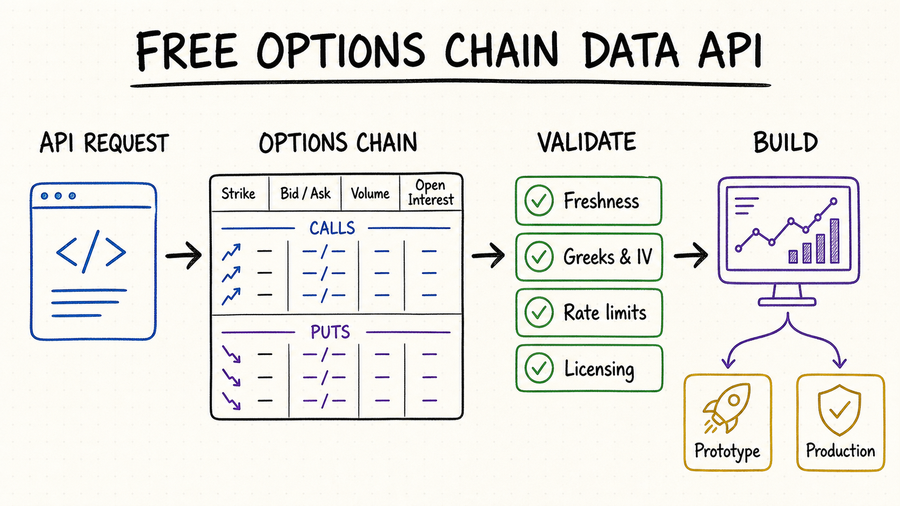
TL;DR
A chain API is usable when every row has stable contract identity, explicit field clocks, predictable pagination, and documented null semantics.
Retain contract symbol, underlying, expiration, strike, side, multiplier, bid, ask, trade, volume, open interest, and source times.
Greeks and implied volatility are model outputs. Preserve their calculation time and assumptions instead of mixing them with exchange facts.
Prove completeness, idempotent ingestion, quota capacity, licensing, and recovery from partial pages before scheduling the pipeline.
Fields a useful options chain API should return
An options chain is more than a list of strikes. Your application needs enough identifiers, quotes, trading activity, and timing metadata to compare contracts without guessing what each value means.
Require the underlying symbol, OCC-style contract symbol where available, expiration date, strike price, option type, and exercise style.
Bid, ask, last price, quote timestamp, and quote condition are more useful than a single last-traded value.
Volume, open interest, bid-ask spread, and contract size help you distinguish a listed contract from a realistically tradable one.
Quote time, trade time, open-interest date, analytics calculation time, provider generation time, and receipt time describe different events and should not share one generic timestamp.
Multiplier, deliverable, root symbol, currency, settlement style, and adjustment status prevent standard and non-standard contracts from being combined.
Normalize into facts without discarding the raw payload
Store the untouched response beside normalized contract, quote, trade, daily-activity, and analytics records. This preserves evidence when a supplier changes nesting or corrects data. Use a composite key that includes supplier, contract identifier, observation type, source timestamp, and sequence where available; retrieval time alone is not a market-data key.
What “free” usually means for options data
| Free access type | What you get | Best for | Key limitation |
|---|---|---|---|
| Delayed chain | Quotes may lag the market by minutes. | Learning, UI prototypes, end-of-day review. | Not suitable for live execution. |
| Limited requests | Low per-minute or daily quotas. | A few symbols or scheduled jobs. | Whole-market scans throttle quickly. |
| Basic fields | Contracts and quotes without Greeks or IV. | Custom analytics pipelines. | You must source rates and calculate metrics. |
| Trial access | Fuller data for a short evaluation window. | Testing schema and integration quality. | Not a permanent free plan. |
A practical API test workflow
Use a heavily traded symbol and request several expirations. Confirm pagination, expiration formats, strike ordering, and call/put pairing.
Record the response time, quote timestamp, market session, timezone, and every nullable field. A documented null is safer than an unexplained zero.
Walk every page for one expiration, record cursors, and verify that contract keys are unique. Repeat the request to detect unstable ordering or contracts moving between pages.
Compare returned expirations and contract counts with a reference universe. Flag missing pages, filtered strikes, adjusted contracts, and responses that end without an explicit completion signal.
Replay the same raw response twice, then ingest a corrected version. The first replay should create no duplicates; the correction should remain auditable without erasing its predecessor.
Use QVeris to discover options data capabilities
The exact QVeris Options Chain Tool is the verified task match. Its public capability record includes calls and puts by expiration and strike with last price, bid, ask, volume, and open interest. Inspect one response in the Playground before designing the normalized schema; the record does not guarantee every timestamp, pagination rule, market, or entitlement.
- Probe one symbol and expiration in the QVeris Playground and save the raw response.
- Map every returned field to identity, quote, trade, daily activity, analytics, or metadata.
- Record the tool ID, parameters, retrieval time, schema version, and validation outcome.
FAQ
Sometimes a provider offers limited or trial access, but exchange licensing and redistribution costs make unrestricted real-time options data uncommon.
Yes. You need a pricing model plus the underlying price, strike, time to expiry, risk-free rate, dividends, and an implied-volatility estimate.
No. Calls and puts are separate contracts, and each quote, trade, daily field, or calculation can have a different timestamp and lifecycle.
Keep the original payload and version normalized records. An idempotent upsert should apply the correction without deleting the audit trail.
References and next steps
Tradier option chains
Polygon options API
Alpha Vantage options documentation
Massive options snapshot