
Free Options API Guide
Compare free options data for chains, quotes, Greeks, implied volatility, and history—then verify delay, limits, coverage, and licensing.
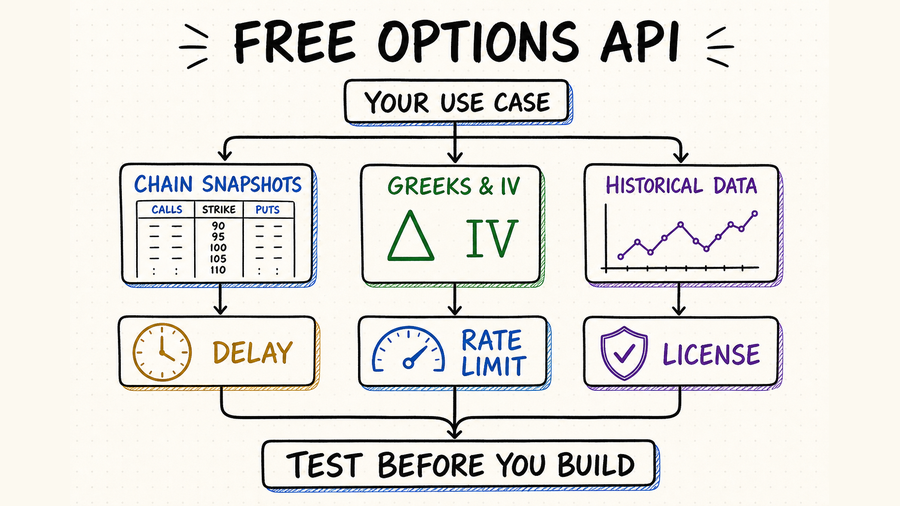
Quick Summary
Typical entry plans expose option chains, contract quotes, expirations, strikes, volume, open interest, and sometimes Greeks or implied volatility.
Check quote delay, venue coverage, request limits, contract history, Greeks methodology, redistribution rights, and commercial-use terms.
A scanner, live dashboard, order assistant, and historical backtest need different clocks, schemas, capacity, and licensing.
A current chain endpoint does not prove that expired contracts or point-in-time quotes can be retrieved later.
Which options API endpoints do you need?
Start with the workflow rather than a provider list. A usable options integration is rarely one endpoint: contract reference data identifies the instrument, chain discovery finds listed expirations and strikes, quotes and trades describe market state, daily fields add volume and open interest, and model endpoints may calculate implied volatility or Greeks.
Expirations, strikes, call/put flags, contract symbols, exercise style, multiplier, deliverable, and listing status.
Bid, ask, last trade, quote size, volume, open interest, session status, and timestamps. Confirm whether values are live, delayed, or end-of-day.
Implied volatility, delta, gamma, theta, vega, and rho are calculated fields. Preserve the calculation time and, where supplied, the underlying price, rate, dividend, and model inputs.
Backtests need expired contracts, delisted strikes, corrections, and observations as they were known then—not a present-day chain joined to revised data.
How free options APIs compare
No single source fits every options workflow. Exchange-backed resources are useful for authoritative contract and market-structure checks; vendor APIs normalize chains and analytics; broker APIs may expose entitled quotes for an account; downloadable datasets are convenient for repeatable research.
| Source | What it offers | Best for | Watch for |
|---|---|---|---|
| Exchange-backed source | Contract directories, delayed quotes, specifications, and market notices. | Verification and primary-source research. | Data may be fragmented or subject to display terms. |
| Free options-data API | Normalized chains, quotes, Greeks, IV, and selected history. | Apps, agents, prototypes, and research pipelines. | Rate limits, delays, history gaps, and license restrictions. |
| Broker API | Account-entitled quotes, positions, orders, and trading context. | Personal monitoring and execution workflows. | Requires an eligible account; redistribution is usually restricted. |
| Historical bulk dataset | Portable files containing expired contracts, quotes, trades, or analytics. | Notebooks, model research, and backtests. | Free samples may cover only short periods or limited underlyings. |
Compare sources with the same test set: one liquid near-the-money contract, one far expiration, one thinly traded strike, and one adjusted contract. Compare symbology, timestamps, bid/ask freshness, open interest date, Greeks methodology, missing contracts, and error messages. Identical field names do not guarantee identical calculations.
Test a free options API before integration
1. Write a concrete acceptance query
Use one liquid underlying, a known expiration, a narrow strike range, and an explicit data clock. State the fields required by the application and which may be null. This turns a vague feature comparison into a reproducible test.
2. Measure the real cost of a chain
Count pagination, per-contract follow-up calls, retries, expiration discovery, and underlying quotes. A nominal requests-per-minute allowance may support far fewer refreshed chains than expected, especially when Greeks require a separate endpoint.
3. Validate identity, clocks, and nulls
- Parse the standardized contract symbol and cross-check expiration, strike, and call/put side.
- Keep quote, trade, open-interest, model-calculation, and receipt timestamps separate.
- Distinguish zero from missing, not entitled, not calculated, and market closed.
- Test adjusted contracts and thin strikes instead of validating only at-the-money contracts.
4. Confirm production rights and failure behavior
Verify storage, display, redistribution, end-user, and commercial-use terms. Then force invalid symbols, exhausted quotas, timeouts, and partial pages. Production code should preserve the last valid snapshot, surface staleness, and avoid silently treating an incomplete chain as a complete one.
Use QVeris to find options data capabilities
The exact QVeris Options Chain Tool is a verified match for current calls and puts organized by expiration and strike, with bid, ask, volume, and open interest among its documented fields. Test it in the QVeris Playground before assuming symbol coverage, history, Greeks, or exchange entitlements.
FAQ
Yes. Many providers offer free tiers for chains, Greeks, or historical contracts, usually with request limits, delayed data, or restricted exchange coverage.
Sometimes, but often they are delayed or limited to specific venues. Always inspect timestamps, entitlements, and exchange-coverage notes.
No. A valid backtest needs point-in-time observations, expired contracts, and the information set available on each historical date.
No. Models, inputs, timestamps, rates, dividends, and smoothing can differ. Compare the methodology before mixing calculated fields.
References and next steps
Cboe delayed quotes
Tradier option chains
Polygon options API
Alpha Vantage options documentation